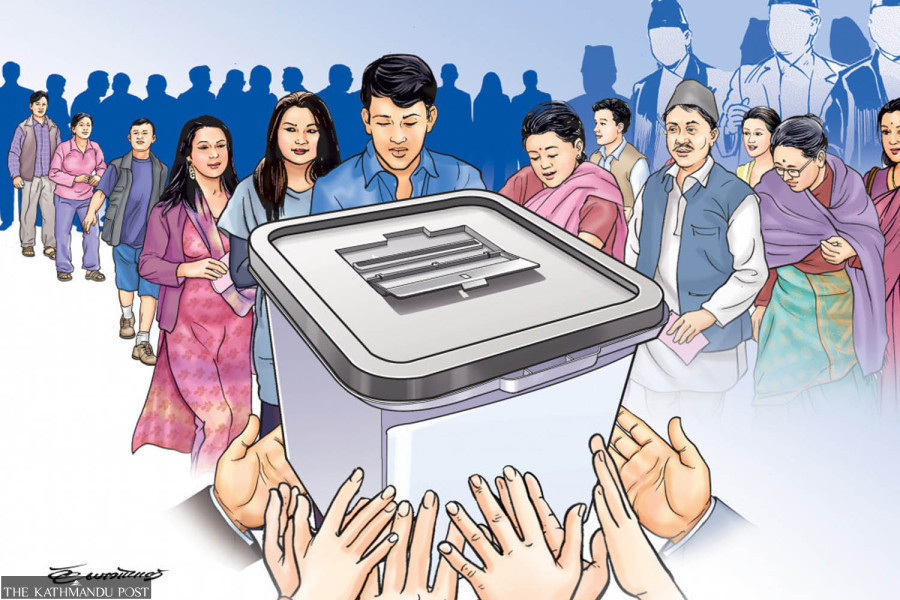
18.9 million voters deciding the fate of 6,619 candidates combined, under the first-past-the-post and the proportional representation systems. Post file illustration
The election fever has gripped the country with the completion of the nomination process. Along with candidates from the respective constituencies, top leaders across party lines are already at work wooing voters, even as the Election Commission has warned against the campaigning before February 19. As the country eagerly awaits the March 5 midterm elections for the House of Representatives (HoR) announced following the Gen Z-led movement that led to its dissolution, the Post explains the different facets of the poll.
What is the composition of the HoR?
Nepal has a bicameral federal parliament. A 59-strong upper house, called the National Assembly, is a permanent body with a third of its members getting elected biennially after completing their six-year tenure. The HoR, the lower house, is 275-strong, with 60 percent getting elected under the first-past-the-post (FPTP) and the remaining under the proportional representation (PR) system.
The country has been divided into 165 electoral constituencies, each electing one member under FPTP. Registered voters in each constituency can cast two votes: one for the FPTP and the next for PR. Under the FPTP, also known as direct election, each voter can vote for the candidate of their choice. The candidate who secures the highest number of votes gets elected from the respective constituency.
Voters can cast a second vote for the contesting parties. The 110 seats are allotted to the parties based on their vote share, but they must qualify as national parties. Parties securing at least three percent of the total PR votes and winning a minimum of one seat under the direct election are recognised as national parties.
How many parties are in the race?
The commission’s record puts the number of registered parties at 136—around a fourth of which were registered after the September Gen Z movement. Of them, 120, including those contesting under a single election symbol, applied to contest the election. The number was further reduced by the time the parties submitted the closed lists of PR candidates and fielded candidates for the FPTP system. While 63 political parties, contesting under 57 election symbols, have submitted the closed lists, 68 parties have fielded their candidates for the direct system.
How many candidates are in the fray?
The final tally of candidates for FPTP stands at 3,406. Of these, 68 parties have fielded 2,263 candidates, while 1,143 are contesting as independents. Of the total candidates contesting direct elections, 3,017 are males and 388 females. Only one is from the sexual and gender minority community.
The candidates are predominantly above 41 years of age. Those below 40 years number 1,056. While 1,925 are aged between 41 and 60 years, 425 are senior citizens. Even as 3,487 candidates had filed nominations, 81 candidates either withdrew from the race or had their nominations scrapped by the commission after being found ineligible.
The number of candidates for 110 proportional seats stands at 3,213. Unlike in the direct election system, only parties, not independent candidates, can submit candidacies under the PR system.
Who can vote and what is their size?
Any Nepali national can acquire citizenship after reaching the age of 16. However, one cannot exercise the right to franchise without turning 18 years and being registered as a voter. As per the commission’s report 18,903,689 citizens are eligible to vote in March—an increase of 915,119 voters compared to the 2022 elections. Among them, 52 percent are aged 18-40, which falls under the youth category. As per the 2021 census, 12,412,173 of the country’s total population of 29,164,578 is youth.
How is security being managed?
Following a security assessment, the Central Security Committee has decided to mobilise 325,000 security personnel for security during the upcoming elections. This includes around 80,000 from the Nepali Army, 35,000 Armed Police Force personnel, 71,000 Nepal Police personnel, and 149,000 election police. The two police forces have been conducting recruitment of election police who will be in the field for little above a month. The army personnel will be mobilised from February first week.
How much money is being spent?
The Ministry of Finance has released Rs19.21 billion as of the last week for logistics and security management. The commission, which bears the responsibility to manage the election, has so far received Rs6.72 billion. The highest allocation—Rs10.39 billion—has gone to the Ministry of Home Affairs, while the Defense Ministry has received Rs1.99 billion.
The money spent in election campaigning by the political parties is several times higher than the government spends.
Binod Ghimire covers parliamentary affairs and human rights for The Kathmandu Post. Since joining the Post in 2010, he has reported primarily on social issues, focusing on education and transitional justice.




 14.82°C Kathmandu