Nepali Congress names Gagan Thapa its PM candidate
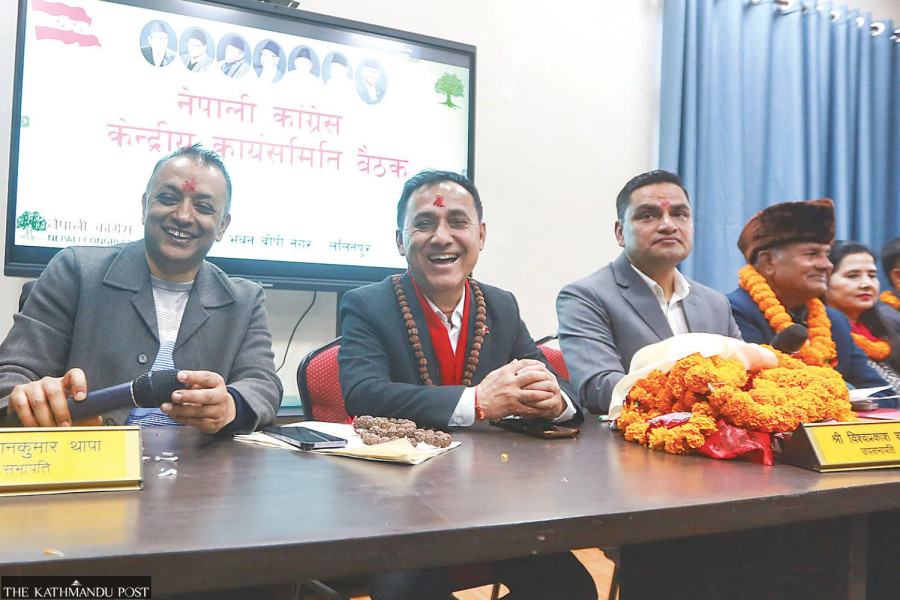
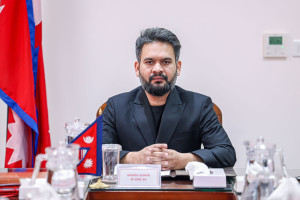
Thapa, the new president of the party, pledges reforms, inclusiveness, and united push into March 5 parliamentary elections. Nepali Congress President Gagan Thapa (left) and other newly elected office-bearers take charge, at the Sanepa office on Friday. POST PHOTO: DIPEN SHRESTHA
The Nepali Congress on Friday declared party president Gagan Thapa as its prime ministerial candidate if the party wins a majority in the March parliamentary elections.
A meeting of the newly elected central working committee held at the party headquarters in Sanepa decided to go to the polls by projecting Thapa as the party’s candidate for prime minister, said Devaraj Chalise, the Congress spokesperson.
It was the first central committee meeting since Thapa was elected Congress chief by a special general convention on January 15.
Party vice-president Bishwa Prakash Sharma said the move was intended to give voters a clear choice on who the party wants to lead the government. Sharma had tabled the proposal at the meeting.
The Congress move comes after the CPN-UML and the Rastriya Swatantra Party (RSP) announced their own prime ministerial candidates. The UML has already named its chair KP Sharma Oli, while the RSP has declared the immediate past mayor of Kathmandu, Balendra Shah, as its choice ahead of the elections. Other leaders are also aspiring to become prime minister.
According to Sharma, on the basis of five criteria—individual background, values, contribution, competence, and vision—the party declared Thapa as its prime ministerial candidate. He said, “Among the names currently being discussed as prime ministerial candidates, the candidate put forward by the Congress stands out.”
Thapa is contesting the snap parliamentary election from Sarlahi-4.
A rival faction led by the party’s immediate past president, Sher Bahadur Deuba, had deployed youths loyal to him and opposed to the new leadership to block the new Congress leadership from entering the party headquarters for several days. They left the premises only on Thursday, allowing Thapa and the new leadership to take charge.
Eight days after being elected president, Thapa reached the Congress central office in Sanepa and assumed the role for the first time. A central committee meeting followed. Thapa told journalists that the Congress had transformed itself before entering the election race. He instructed party leaders and cadres to focus on election preparations.
He also said that the method of selecting candidates would be corrected and made more inclusive next time. “From next time onwards, Congress candidates will not be selected this way. Friends at the district level will decide by voting. Due to time constraints, we could not complete the work [this time],” Thapa said.
“Even though we wanted to do things differently, we couldn’t this time. If we had more time, we could have made it [selection process] more inclusive.”
Acknowledging weaknesses in the candidate selection process, he added, “There have been some mistakes and shortcomings. As chairperson, I ask everyone to understand the errors and difficulties.”
Thapa said some issues arose due to the pressure of starting candidate selection on January 16 and submitting nominations by January 19, and that he would take responsibility for them.
“We could not select candidates in accordance with the document presented at the special general convention. From next time, candidates will be selected through voting from the grassroots level,” Thapa said. “Because we had to begin selecting candidates on January 16 and register them by January 19, even if we wanted to, we could not ensure inclusiveness and balance in the nomination process.”
He said that shortcomings occurred because they had to proceed without consulting party aspirants. He expressed his commitment to correcting these issues both personally and institutionally. “We can still discuss the shortcomings, but now there is no alternative but to move forward unitedly into the election,” he said.
A strong faction of the party led by Deuba had boycotted the special general convention that elected Thapa as party president. Thapa was elected through the convention, and different opinions remain within the party.
Thapa said it was the party members themselves who changed the Congress. “This Congress did not change on its own—we changed it. We transformed the Congress,” he said. “Now it will also transform the country. With this resolve, the Congress has entered the election.”
He called on the party’s one million active members across the 165 constituencies, saying, “There are differing opinions even within the party. Issues related to the general convention can be discussed later.” Thapa was elected through the recently concluded special convention and there are counter views and arguments inside the party.
Friday’s central working committee meeting also decided to form a central publicity and outreach committee under the coordination of party spokesperson Chalise, and a central office building reconstruction committee under former treasurer Umesh Shrestha for the reconstruction of the Nepali Congress Central Office building. The office was among numerous public and private properties torched by protesters on the second day of the anti-corruption Gen Z revolt on September 9.




 19.14°C Kathmandu