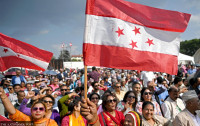
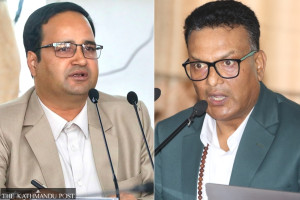
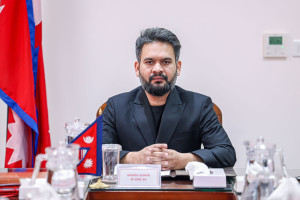
Hundreds of people in multiple vehicles escorted Rastriya Swatantra Party (RSP) senior leader Balendra (Balen) Shah as he filed his nomination in Jhapa constituency-5 on Tuesday. Projected by the party as its prime ministerial candidate, Shah was seen openly breaching the Election Commission’s code of conduct and its directive to refrain from extravagance.
The scene at the nomination of CPN-UML chair KP Sharma Oli, Shah’s rival in the constituency, was no different. On the very first day of the election race, both prominent figures openly challenged the constitutional commission and long-established electoral norms.
Increasing flashiness in the country’s election campaigns has long been a concern. Amid repeated calls to curb such extravagance, the commission has been imposing the code of conduct before every election.
The code for the March 5 election came into force on Sunday. Finalised after incorporating the feedback of political parties, it was enforced in their consent. Yet cross-party leaders, including those calling themselves alternative forces and even independent candidates, have been openly challenging the norms developed with their own consent.
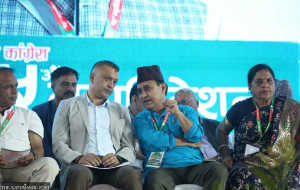
Those closely observing the upcoming election say not just Shah and Oli, but dozens of candidates have ignored the the code of conduct, including Nepali Communist Party coordinator Pushpa Kamal Dahal; RSP Lumbini province chief Devraj Pathak; and Nepali Congress candidate Bharat Dhakal and UML candidate Min Gurung in Syangja-1. They not just reached respective election offices with hundreds of supporters but even brought musical ensembles, despite the commission banning them.
In several places children were seen in campaigns, which is strictly barred not just by the code of conduct but also by the laws relating to child rights.
However, the commission says it received just one complaint on Tuesday and it is not about extravagance. Yagya Bhattarai, chief at the commission’s legal department, said they have received just one complaint about the Koshi chief minister’s involvement in the publicity campaign.
“The Jhapa election office has received a complaint that Koshi chief minister Hikmat Karki was involved in the publicity campaign,” he said. “We are studying whether to seek clarification [from the accused].” He said further action could be taken if the clarification is unsatisfactory.
Bhattarai said the commission has no formal information about the code of conduct violations.
Election observers say lax enforcement of the code of conduct is the reason political parties and their leaders are indifferent towards it.
“Why does the commission have to wait for formal complaints when video clips are circulating everywhere, clearly showing excessive flashiness on the nomination day?” asked Shree Krishna Subedi, chair of the Election Observation Committee, Nepal (EOC), a poll monitoring organisation. “It can, and must, take suo moto action.”
He said his organisation is closely monitoring election campaigns and recording incidents of code violations. If the commission doesn’t act proactively, the EOC will submit a list of violations, Subedi told the Post. “We believe the commission will perform its scrutiny effectively. If not, we will move the Supreme Court with a public interest litigation demanding a ruling against the commission,” said Subedi.
Election observers say the commission should take action right from the start to maintain decency in election campaigns.
A Central Monitoring Committee comprising 11 members has been formed under the leadership of an election commissioner to monitor the code of conduct. It also includes representatives from various ministries and security forces. Similarly, at the district level, district monitoring committees have been formed under the chief district election commissioners.
The code of conduct states that violators can be fined up to Rs100,000 or have their candidacies cancelled. In addition, candidate/candidates could be barred from running for office for up to six years. It also allows the commission to make public the names of the violators along with details of their violations.
“The campaign has just begun. Cases of code violations are only going to increase,” said Subedi. “If action is taken right at the start, it will act as a deterrent against such practices the closer we get to elections.”
Binod Ghimire covers parliamentary affairs and human rights for The Kathmandu Post. Since joining the Post in 2010, he has reported primarily on social issues, focusing on education and transitional justice.




 15.69°C Kathmandu