



 13.46°C Kathmandu

Sun, Oct 11, 2026
Politics
Dharan rallies to Harka Sampang’s beat as rivals stay quiet
Shram Sanskriti Party chair blends grassroots activism with national ambitions in Sunsari–1, challenging established parties.
bookmark![]()
Post Photo ![]()
Post Photo ![]()
Post Photo
Gaurav Pokharel, Elina Rai & Parbat Portel
Published at : January 18, 2026
Updated at : January 18, 2026 15:17
Sunsari
In Dharan, the mornings are already marked by political discussions, even when neighbouring Itahari and Biratnagar remain quiet. At the break of day, the streets resonate with Harka Sampang’s own voice singing, “Shram garau Nepali ho, bhokai marne din aaiskyo’, translated as “Let’s work, Nepalis; the days of starving are here.” For locals, the tune signals that the Shram Sanskriti Party’s chair has arrived. Party leaders and workers fan out, going door-to-door, while the familiar melody draws voters to the streets.
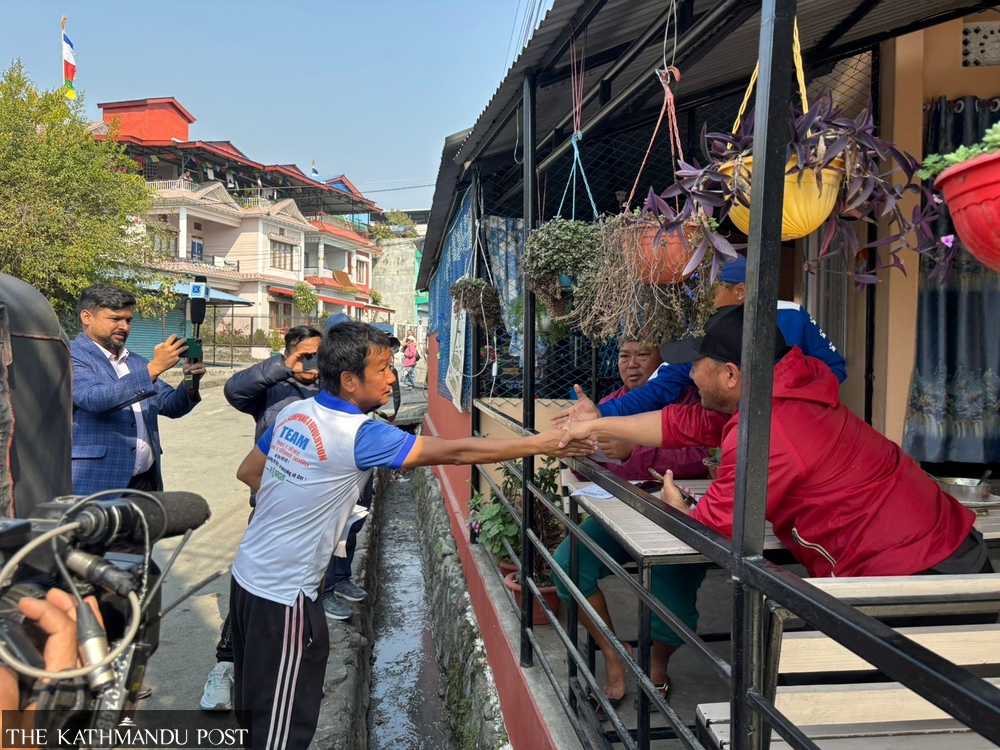
At 11am on Friday at Durga Chowk in ward 9 of Dharan Sub-metropolitan City, the upbeat song blared as workers danced in unison, and Sampang stepped out, greeting residents with folded hands. Three years ago, during his first mayoral bid, he toured the same alleys alone, a handheld microphone in one hand, delivering speeches on a motorcycle. This time, the motorcycle is still part of his campaign, but the crowds are larger and the atmosphere electric. Wherever he appears, onlookers gather.
Back then, few paid attention. Now, the moment his modern campaign song plays, people emerge from every household. Wearing a black tracksuit and a T-shirt that reads “Harka Sampang – A Revolution”, he moves from home to home, greeting voters and handing out pamphlets outlining his agendas: democracy, federalism, and a directly elected executive presidency.
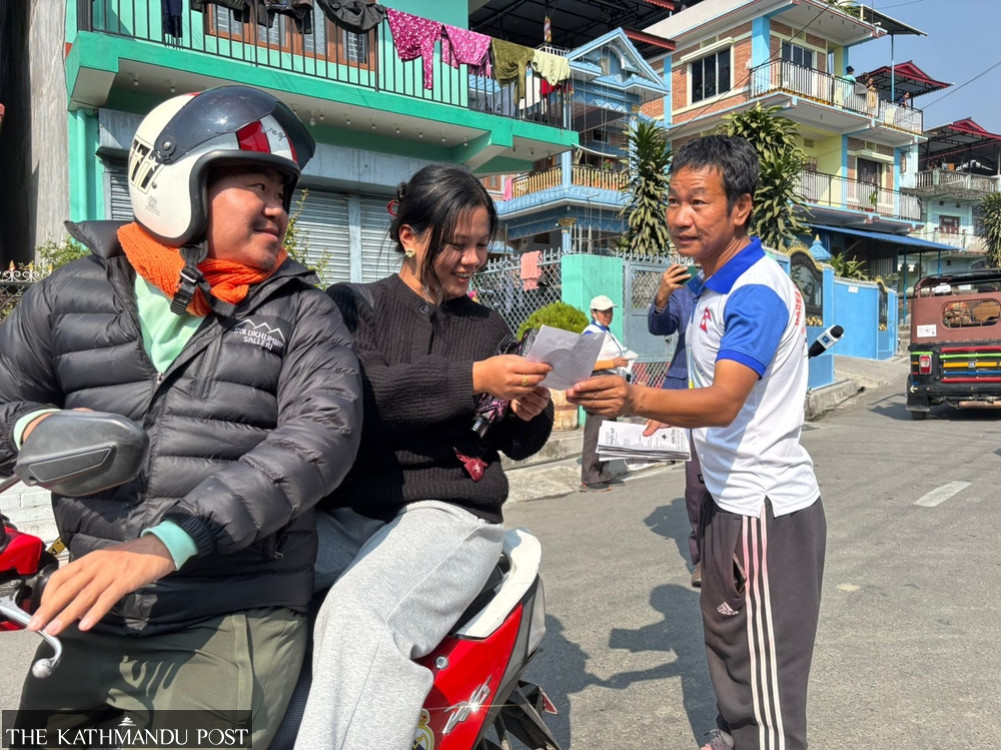
At a small grocery shop in Chandani Chowk, Sampang urges voters to “vote for the soil this time.” Forty-two-year-old Amrit Rai smiles at this request, taking the pamphlet. A woman waiting on a scooter catches his attention and Sampang greets her with a smile and slips her a leaflet, urging the schoolteacher to back his party.
Onlookers like Hema Limbu, 31, are impressed. “No other party leaders have been on the ground yet. He is already walking the streets asking for votes,” she said. “Harka will get a seat from Sunsari-1.”
At Aapgachhi Chowk, Sampang’s microphone echoes slogans: “Where should the vote go?” Cadres respond, “To the soil.” The election symbol of the party is two hands holding soil. His team not only asks for votes; they carry sacks and clean the streets, turning the campaign into a mix of activism and canvassing.
Usha Limbu, 50, from Bhanu Smriti Chowk, recalls supporting Sampang in an earlier movement. “He would win even without this effort,” she said. “But we walk door-to-door to clean neighbourhoods.” She adds that she hopes his next goal will be the prime ministership.
Sampang pastes the party’s election symbol in another house and requests support from 65-year-old Tilma Khatun. After the team leaves, she admits to the Post that she does not even have a citizenship certificate.
As the campaign’s pace quickens, Sampang insists on entering every home. At a roadside banana stall, he hands a pamphlet to Mahiman Basnet, an elderly seller. Basnet refuses, saying he already has one. Sampang insists, eventually placing it in a carton box, which Basnet discards. “He will win the election,” Basnet later remarks, “but he is stubborn.”

Throughout the canvassing, Sampang rarely directly asks for votes. Instead, he emphasises the election symbol of his party. The Shram Sanskriti Party was founded by Sampang after the Gen Z movement.
There were rumours that he might contest outside Dharan, even suggesting a challenge to UML chair KP Sharma Oli in Jhapa–5. But Sampang has confirmed his focus remains on Sunsari–1. “I am not considering any other constituency. In Jhapa–5, our candidate Samir Tamang is capable of taking on the heavyweights,” he said. Sampang has yet to resign from his post as mayor.
At a home in Pashupati Chowk, 49-year-old Amar Gurung greets Sampang and accepts campaign materials. Gurung says no other candidate has visited him. “He has done good work. He will win here,” said Gurung, citing that he solved the city’s water crisis.
Just three years ago, residents had to walk two to three kilometres for water and often relied on water tankers five to six times a month. Sampang’s pledge of free drinking water helped secure his mayoral victory. “Other leaders made promises they never kept,” says 68-year-old Radhe Karki.
“He delivered.”
As mayor, Sampang did not confine himself to office work. He initiated a labour campaign, personally carrying stones every Saturday. “My hands used to get blisters,” he recalled. “I went to Singha Durbar countless times asking for water. We used local resources when no support came our way.”
After 99 days of voluntary labour, water was brought to Dharan from the Kokaha stream, 40 kilometres away, through the forests of Barahakshetra.
He also pushed for an airport in Dharan but failed to secure support from the Ministry of Culture, Tourism and Civil Aviation. The government argued that Biratnagar airport, 55 kilometres away, was sufficient. Still, voters admire his initiative. “He tried hard for us,” says street vendor Mani Kumar Raut, 52.
Not all are convinced. Some, like Ganga Maya Karki, 56, claim Sampang favours Janajati communities, while Manish Mahara from Dharan-15 says the party prioritises Rai and Limbu voters. Others argue that his achievements speak for themselves.
Younger voters like 24-year-old Vicky Pariyar highlight job concerns. “I returned from Qatar, but I need opportunities here. I like his ideas, but local problems remain unresolved,” he says.
Before Sampang, Sunsari–1 was considered a UML stronghold. The constituency has seen victories by leaders such as Manmohan Adhikari, Leela Shrestha Subba, and poet Kunta Sharma. In 2022, Ashok Rai of the then Janata Samajbadi Party won with UML support. This time, Sampang’s candidacy has shaken UML, Nepali Congress, and the Rastriya Swatantra Party.
RSP has yet to launch visible activity. UML and Congress are still finalising candidates. Meanwhile, Sampang distributes party tickets nationwide from a Dharan tea shop, handwritten slips bearing his signature. On Friday, he handed a ticket for Okhaldhunga to Uddhav Kumar Rai.
Aryan Rai, party general secretary, notes that aspirants now travel to Dharan instead of Kathmandu to collect tickets. “We’ve broken the tradition of everything happening in Kathmandu,” he says. Sampang, once with the nationalist Nepal Party and the Mongol National Organisation, plans for his party to contest across the country, aiming to establish a national party.
Sunsari–1 includes 20 wards of Dharan Sub-metropolitan City, five wards of Barahakshetra Municipality, and two wards of Ramdhuni Municipality, with 150,232 registered voters. Sampang’s campaign is intensifying across the region.
Gaurav Pokharel
Pokharel is a journalist at Kantipur Media Group covering national security, defence, and good governance.
Parbat Portel
Parbat Portel is the Jhapa correspondent for Kantipur Publications.

Most Read from Politics
Home Minister Sudan Gurung to visit India next week
Nepal’s climate diplomacy faces a test of delivery
Uproar in Nepal parliament over former chief justice’s unexplained detention
From the Himalayas to the islands, Nepal calls for a united climate response
Gagan Thapa wins Congress presidency with 94 percent of the vote
Editor's Picks

Constitutional Bench caught in seniority, ‘pick and choose’ dispute

A Dom boy’s long road to becoming a doctor

From blankets to handmade dolls, two foreign women bring comfort to flood survivors

News Analysis: When institutional defence exposes institutional fault lines

It’s a bird … it’s a plane … it’s the Indian ambassador’s farewell tweets
E-PAPER | October 11, 2026

×