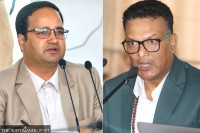
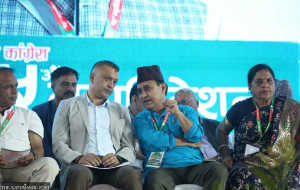
The Jhapa constituency 5, long a stronghold of CPN-UML chief KP Sharma Oli, is now set for an unprecedented contest as Kathmandu Mayor Balendra Shah prepares to contest from the constituency in the March 5 elections.
During the parliamentary election in 2022, Oli emerged victorious from Jhapa constituency 5, setting a record. He was elected for the House of Representatives with the highest number of votes till then by a candidate. Oli defeated Nepali Congress candidate Khagendra Adhikari with a thumping margin. The UML supremo bagged 52,319 votes while Adhikari secured 23,743.
Jhapa-5 has been Oli’s electoral constituency since 1991, and he has contested elections from the area continuously since. He suffered defeat only once, in the 2008 Constituent Assembly election, when he lost to CPN (Maoist) candidate Bishwadeep Lingden.
In the past two parliamentary elections, Oli’s main challenger was Congress’ Adhikari, who left his teaching career at Kathmandu’s Tri-Chandra College to enter politics. Oli, however, continued to secure comfortable victories with the backing of the Rastriya Prajatantra Party (RPP), which maintains a strong foothold in the constituency. In return, the UML has consistently supported RPP chairman Rajendra Lingden in neighbouring Jhapa-3.
Mayor Shah—popularly known as Balen—is preparing to contest the election with the declared aim of beating Oli in his own constituency and institutionalising the agenda raised by the Gen Z movement. The electoral battle in Jhapa-5 is shaping up to be an intriguing contest this time.
According to Bhupadev Shah, Balen’s personal secretary, Balen plans to resign as Kathmandu mayor on January 17 and two days later attend a public meeting in Janakpur before heading to Jhapa-5 to file his candidacy.
“We are trying to establish an agenda of change by defeating, in his own constituency, the person who cracked down on the Gen Z movement and took young lives,” said Shah, adding that all preparations were underway accordingly.
As part of his campaign preparations, Balen is planning to rent a house in Jhapa-5. He has already held meetings with a team led by Prakash Pathak, chair of the Rastriya Swatantra Party (RSP) in Jhapa, and the party’s district secretary Shambhu Prasad Dhakal. He has also met youths from Damak, including Santosh Dulal, as well as Yatish Ojha of the Nepal Gen Z Front.
“When we met him [Balen] at Jwagal in Lalitpur on January 11, he clearly stated that he would contest the election against former Oli from Jhapa-5. We are preparing accordingly,” said Pathak.
On December 28, Shah formally joined the RSP through a unification agreement and will contest the election under the party’s banner. The RSP has also decided to project Shah as a future prime ministerial candidate.
The Sushila Karki-led interim government, formed in the wake of the Gen Z movement, has announced plans to hold the House of Representatives election nearly two years ahead of schedule.
Oli was prime minister at the time of the September Gen Z uprising during which around 77 people were killed.
The Gen Z revolt was driven by demands for political restructuring, good governance and an end to corruption.
According to Sashim Pokhrel, who was appointed joint spokesperson for the RSP following Shah’s entry into the party, the mayor’s decision to contest from Jhapa–5 is calculated. By challenging Oli in his own constituency, Shah believes he can send a message to the rest of the country.
Election fever has gripped the Jhapa constituency with Balen’s proposed candidacy. The locals describe the situation like a stone thrown into a calm pond. Voters who confidently predicted Oli’s victory well before polling day have begun to suggest that a different outcome is possible this time.
“In the past, UML chief Oli secured more than 52,000 votes here—no old-generation leader could defeat him,” said Ram Prasad Koirala, a voter from ward 9 of Damak Municipality. “But leaders from the new generation like Balen could defeat him and upend old trends. This time, the result could be different.”
In the 2022 election, RSP candidate Suresh Kumar Pokhrel secured 11,748 votes in Jhapa-5 while the party received 18,205 votes under the proportional representation system from the constituency. Koirala says that even the discussion of Balen’s candidacy has already pushed established candidates into a defensive position.
“Balen has not even come to Jhapa yet. Voters have only seen and heard of him on social media and television, and there is already excitement,” he said. “Just imagine what the atmosphere will be like once he starts going door to door. Right now, every household in Jhapa-5 is talking in his favour.”
Oli, who has been active in the communist movement since the 1960s, has repeatedly been elected from this constituency. This time, however, some voters who previously helped secure his victories say they are preparing to change their vote.
Pabitra Dhimal, 50, from Damak, said she would vote for Balen if he entered the race. “Even before he arrives, many people are calling him a good candidate. He managed to get rid of Kathmandu’s waste problem—why wouldn’t he do good work here?” she said. “Everyone in my family has decided to vote for Balen.”
Dhimal added that while some still insist that votes should go to ‘Ba’—a common nickname for Oli—she believes the public will pick Balen. She also recalled that Oli was defeated in Jhapa-5 by a Maoist candidate in 2008. “I think something similar will happen this time,” she added.
UML leaders claim that Oli ushered in a wave of development in Damak-5 and insist that voters have not even considered his alternative. Voters, however, counter that most of the much-touted development projects remain incomplete.
In Damak, the widely publicised Damak Commercial Complex—promoted as the tallest view tower in the country—has yet to come into full operation. The 18-storey building was vandalised during the Gen Z movement.
In the same constituency, efforts to build an Indigenous Stadium in Geuriya of ward 5 of Kamal Rural Municipality have been stalled since 2009 due to disputes over its name. While serving as prime minister in 2015, Oli renamed the proposed facility the Madan Bhandari Stadium.
Local residents, however, obstructed the project after the decision to name the stadium after the late UML leader Bhandari and to establish an indigenous museum there, arguing that the land had long been used by indigenous communities as a burial ground.
Initially, the project was inaugurated in April 2010 by then defence minister Bidya Bhandari (the late Bhandari’s wife) under the name Indigenous Stadium, acknowledging the site’s cultural significance. When the proposal to rename it failed to gain support—even from Nepali Congress leaders—the construction could not move forward.
Oli later announced plans to build an alternative stadium on land belonging to the Humsedumse Community Forest in ward 3 of Damak Municipality. Yet, years on, the construction of the stadium remains stalled.
Other ambitious projects have also failed to materialise. Oli laid the foundation stone for a Nepal-China Friendship Industrial Park in Damak in 2019, promising an investment of Rs64.9 billion. Five years on, no tangible progress has been made.
Plans to turn Damak into a model city and to build the province’s largest convention hall remain confined on paper. “People say no one else can bring projects like Oli, but has anyone asked how many of those projects actually moved forward?” asked Parbat Basnet, 25, a local organiser of the Gen Z movement.
Young voters express deep frustration. Sugam Sigdel, 19, a BBS student at Damak Multiple Campus, said anger against Oli runs deep among youth. “Our friends were killed, many were injured during protests. This time voters have a capable alternative. With someone like Balen, people won’t hesitate to back him,” he said.
Most voters aged between 18 and 35 we met in Jhapa-5 indicate that they are likely to change their vote this time. Some, however, still express doubts about whether Balen will win. “Oli will probably still win. But this time I will not only vote for Balen, I will also go door to door asking others to vote for him.”
Samjhana Baral, 33, said she had long been a supporter of the Nepali Congress, but in past elections she voted for Oli, seeing him as a prime ministerial candidate. “This time my vote will go to Balen,” she said. Despite voting repeatedly to bring Oli to power, she feels little has been achieved on the ground.
Not everyone, however, is convinced. Ishwari Gautam from Kamal-2 believes Balen will face difficulties as an outsider. “Local leaders understand local problems better,” he said, adding that he might abstain from voting altogether.
UML leaders remain confident. “When Oli was prime minister, projects poured into Damak. Voters know very well whom to choose,” said Ram Paudel, chairman of UML’s Damak municipal committee.
Elderly voters also largely remain loyal to Oli. “He built roads and bridges, but people don’t understand him,” said Taranidhi Sapkota, aged 87, from Damak-8. Yet even some long-time party supporters now admit the contest will be tighter than ever before.
With shifting alliances, youth mobilisation and an unprecedented challenger, Jhapa-5 has become a litmus test for generational change in Nepali politics. Whether Balen’s gamble pays off or Oli’s grip holds firm will be known on D-day, but one thing is clear—Jhapa-5 will not see a routine victory this time.




 12.72°C Kathmandu