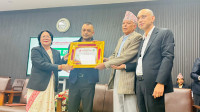
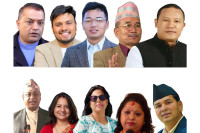
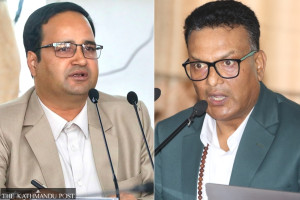
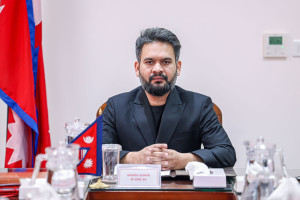
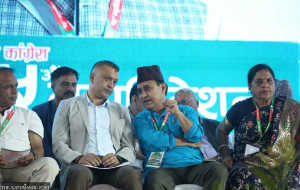
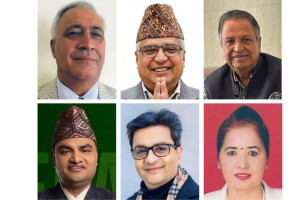
Experts split on whether legitimacy rests with general convention or central committee. Congress leader Min Bishwakarma makes public the central committee’s decisions at Sanepa. Angad Dhakal/TKP
The Nepali Congress formally split on Wednesday, hardly a week before nominations for the first-past-the-post system for the March 5 snap polls. This has triggered a fight for legitimacy between the two factions.
With marathon meetings failing to bring a truce, the grand old party split in two—one led by Sher Bahadur Deuba, and another by Gagan Thapa, who has been elected party president by the special general convention. The organisers of the special convention on Tuesday had informed the Election Commission that the national meeting was being held in presence of the majority of general convention representatives.
On Wednesday, the Deuba faction claimed before the commission that no such convention had been officially called. It also stated that a majority of the central working committee had sacked general secretary duo Gagan Kumar Thapa and Bishwa Prakash Sharma and deputy general secretary Farmullah Mansoor.
“Both sides have sent letters to the commission. It is a matter of legitimacy,” said Narayan Prasad Bhattarai, spokesperson at the commission. “The commission will take proper decisions based on the existing law.”
The commission, which is under intense pressure preparing for elections, now has the added responsibility of determining Congress’s legitimacy. The four-star party flag and election symbol—tree—will remain with the faction that is recognised as legitimate. The side that fails to gain legitimacy can form a new party but will not be allowed to participate in the election.
“The commission is aware that the Congress’ dispute shouldn’t affect the election. It will, therefore, take the decision without delay,” said a senior official at the commission. “Existing laws, the party statute, and past practices will be taken into consideration.”
The special convention was called by 54 percent of the convention representatives. Clause 17(2) of the Congress statute states that 40 percent of representatives can call such a convention, the most powerful decision-making body. Though the statute does not specify what percentage of convention representatives can elect new leadership, legal experts say a majority has the authority to do so. The convention organisers claim over 60 percent of representatives participated.
Senior advocate Gopal Krishna Ghimire, former president of the Nepal Bar Association, said that because every decision has been taken by the majority of the party’s supreme body—general convection—its decisions are legitimate. “The convention is legitimate and so are its decisions. I believe the commission will recognise the newly elected team,” he said.
Addressing the convention on Wednesday evening, Thapa announced that they are the official Congress. “I have faith in the Election Commission, the country’s laws, and its institutions. The Election Commission must recognise the outcome of the special general convention,” he said.
However, some legal experts argue that the Political Parties Act is the primary law the commission can rely on to decide party legitimacy, and it does not recognise a special convention. Article 255 of the constitution envisions general convention every five years and the central committee had already announced the convention for April. “No existing laws recognise special general convection,” said a former attorney general.
He said, in case of a dispute, the provision under Section 44 of the Act is invoked which states that the faction which holds a majority among the office-bearers and members of the Central Working Committee shall be recognised as the party as it existed prior to the dispute. The Deuba faction commands support of the majority of the committee.
“Sections 43, 44, 45, and 46 of the Political Parties Act, don’t recognise the leadership elected through a special general convention. Such a faction cannot get recognition as a political party, nor can it claim the party’s name and election symbol,” he said.
Section 43 of the Act authorises the commission to settle disputes between two or more parties, or between two or more factions of the same party, regarding the party’s name, seal, statute, flag, symbol, office bearers, central committee, or the authenticity of decisions of the central committee.
First, the commission will invite both factions to reach a compromise. If that doesn’t happen, it can make a decision based on its own assessment. It may even need to verify the representatives’ numbers before making the decision, which is a time-consuming process.
“In principle, the general convention is the highest authority. The Election Commission must update the details endorsed by the convention. The faction that held the convention holds legitimacy,” said senior advocate Dinesh Tripathi.
Binod Ghimire covers parliamentary affairs and human rights for The Kathmandu Post. Since joining the Post in 2010, he has reported primarily on social issues, focusing on education and transitional justice.




 14.81°C Kathmandu