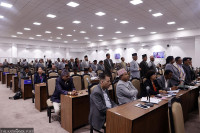
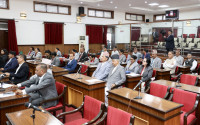
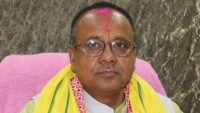
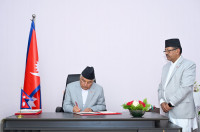
Nepali Congress General Secretary Bishwa Prakash Sharma’s report, presented at the party’s second special general convention, lays out a critical assessment of the party’s current condition, the roots of public anger, and the direction needed for its future political course.
The report closely examines youth-centred discontent and the Gen Z movement, concluding that public anger is not the result of external forces or sudden events but a product of political, economic, social and governance failures. It acknowledges that Congress failed to recognise and address citizens’ dissatisfaction in time and stresses the need to learn from that failure.
Sharma argues that the Congress must undergo renewal and redefinition. While retaining its name, flag and election symbol, he calls for a change in thinking, working style and political culture. The dossier underlines that meaningful transformation is unavoidable, stating that old habits cannot build a new future.
It links declining public trust to frequent changes of government, policy instability, corruption, administrative hurdles and economic slowdown in recent years. Weaknesses in education, health, employment, agriculture and the implementation of federalism are listed, with the report concluding that progress is impossible without good governance.
The report also admits that although Congress-led governments built laws and institutions, implementation remained weak. It proposes a merit-based, transparent and competitive appointment system and calls for an end to political quota-sharing in constitutional bodies, regulatory agencies and diplomatic postings.
Recalling the party’s historic role in establishing democracy, republicanism and federalism, the report says the responsibility to strengthen these achievements in the current context rests with the Congress itself. It concludes that the party must pursue a balanced path that protects past gains while addressing present-day public discontent.
Sharma, in his report presented at the ongoing special general convention, has proposed major changes to improve representation within the party’s structure.
He suggested ensuring representation of members under 40 years in the central working committee, with 20 members under 30 and 20 members aged 30–40, making a total of 40 representatives.
The report also proposes that provincial working committees include 10 members from each age group, while district, federal constituency, provincial assembly constituency, and municipal committees have at least six members from each group. Ward committees are to have a minimum of four members from each age group.
Acknowledging inclusivity, the report states that each electoral constituency should send four representatives to the central and provincial conventions, including at least two women and at least one member under 30 years.




 26.12°C Kathmandu