Congress general secretaries call for sweeping reforms
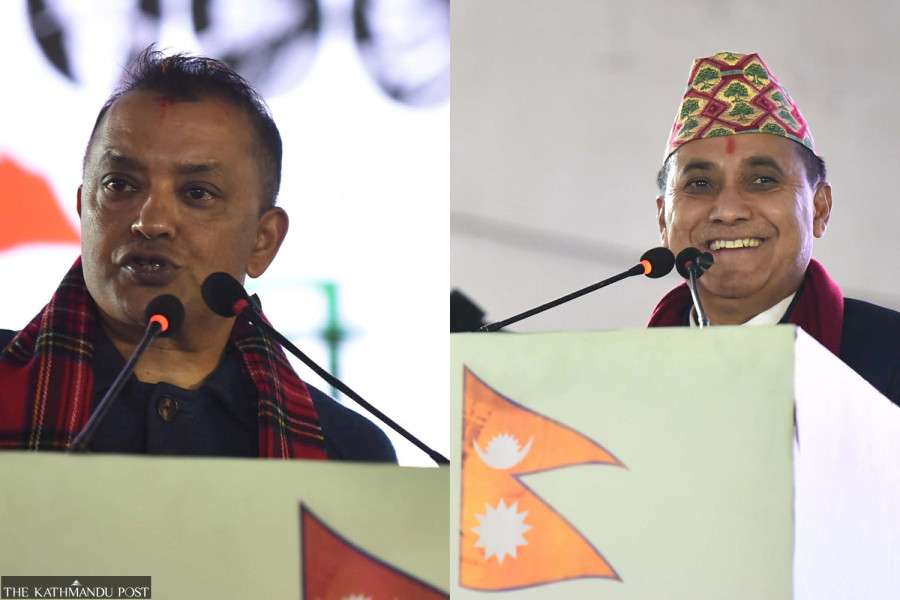
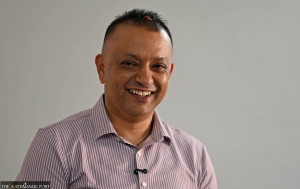
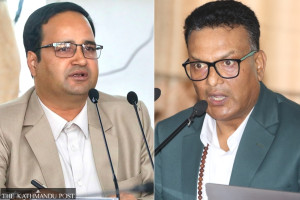
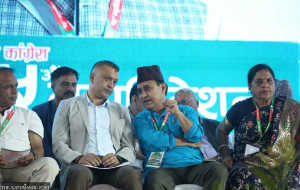
Thapa and Sharma present bold proposals on governance, anti-corruption, electoral reform, inclusivity and national development. Nepali Congress general secretaries Gagan Thapa (left) and Bishwa Prakash Sharma Post Photos
Nepali Congress General Secretaries Gagan Thapa and Bishwa Prakash Sharma have proposed a series of reforms across multiple sectors, including on good governance, electoral reform, and corruption control.
At the closed-door session of the party’s special general convention on Monday, Thapa presented his political document, which includes implementing a provision allowing a person to become a Member of Parliament through the proportional representation system only once. He said that opportunities provided through this system would be limited to one time per individual.
Thapa also proposed introducing a system of internal competition (primary elections) within the party. “Through internal competition among members at the relevant levels, candidates will be selected from among three individuals—including at least one woman—who get the highest number of votes,” General Secretary Thapa said. “For this purpose, a digital candidate evaluation and recommendation system will ensure equal opportunity for all interested individuals and guarantee candidate selection based on merit, capability, integrity, and organisational contribution.”
Thapa also proposed introducing a lateral entry system within the party to bring professionals and individuals with long-term contributions in business and other fields into various party structures.
At every level, one-third of the members of executive committees will be women, youth, workers, professionals, and persons with disabilities, he stated in his political document. Inclusive representation will also be ensured at every level, based on community clusters, including Madhesi, Dalit, Muslim, Indigenous, Janajati, Tharu, and others, he added.
Thapa also proposed launching a national rejuvenation campaign to ‘defeat the politics of despair, hatred, and revenge,’ and to instill hope, trust, and a sense of security among the people. “The main objective of this campaign is to make politics people-oriented and society-centered, restore self-confidence and national self-respect among ordinary citizens, and promote democratic values,” he said.
Both Thapa and Sharma called for a provision limiting a person to serving as prime minister for only two terms. They committed to initiating amendments to both the party statute and the Constitution to enforce this provision.
“The proposal that the country’s chief executive [the prime minister] should be limited to only two terms, in line with the sentiments of the Nepali people, party leaders and cadres, and especially the younger generation, is endorsed by this special general convention,” the report on contemporary politics presented by Thapa states.
Sharma’s report echoed this. “Correcting the mistakes of the past, this special general convention declares that, in the future, no one from the Nepali Congress will be prime minister more than twice. The Nepali Congress will take the initiative to have this two-term prime minister policy enshrined in the Constitution.”
Thapa also addressed the rising populism in Nepali politics. He said institutions must be capable and strong within a democratic system and the responsibility of protecting liberal democracy while confronting the challenge of populism lies with the Nepali Congress.
“Following the global wave of populism and anarchism, a growing tendency can be seen in Nepal as well, where certain trends and figures are undermining democratic system, liberalism, pluralist principles, and established values and norms,” he said. “Because of such figures and tendencies, an illusion is being created that democratic systems and institutions are strengthened not through institutions themselves but through miracles.”
Sharma has put forward 18 policy reform proposals.
He has called for: determining the prime minister’s term (two term); policy stability; electoral candidacy and coalition reforms; fairness in budget allocation; capital expenditure and the development model reform; rights of Non-Resident Nepalis; developing the Budhi Gandaki hydropower project (under GDPP model or investment by government, diaspora, and private sector participation); merit-based evaluation in political appointments; an end to power-sharing deals; the education bill and respect for teachers; ending disorder in educational institutions; zero tolerance against social anomalies; eliminating administrative hassles; the rights and welfare of workers and a minimum wage; ending nepotism, primary elections in candidate selection; and formation of an internal good governance commission.
Likewise, General Secretary Thapa has said that corruption is the main reason behind the growing public disillusionment with the state and has put forward an eight-point commitment to control it. He proposed that any leader or member at any level accused of corruption should be automatically suspended.
General Secretary Sharma has called on Gen Z leaders to reflect on their role in the September 8 protests. While he supported holding the perpetrators of violence accountable, he emphasised that the excessive use of force by the state that led to the deaths of youths was one of the gravest incidents in Nepal’s history.
Sharma also said that the nationwide destruction on September 9 should be investigated impartially, and the guilty brought to justice.
On foreign policy, Thapa has stressed that safeguarding the country’s national interest is the top priority. He said this in the political report shared at the inauguration of the special convention on Sunday.
“In the context of our traditional multi-dimensional political, diplomatic, economic, social, cultural, and trade relations with neighboring and rising power nations like India and China, we will prioritize strengthening these ties with warmth, intimacy, and depth, focusing on mutual benefits, equal gains, and respect, in order to maximize the economic development benefits from India and China,” Thapa stated in his political report.
He also claimed that for Nepal’s prosperity and economic development, international relations will be further diversified, and more intimate and strong ties will be developed with the broader international community.
He added that Nepal’s national unity, territorial integrity, universal freedom, national independence, national security, as well the principles of the UN Charter, Panchsheel, and non-alignment would serve as guiding policies for an independent and balanced foreign policy.
Similarly, the principle of universal equality will be institutionalised as a fundamental tenet of Nepal’s international relations and foreign policy, Thapa added.




 14.81°C Kathmandu