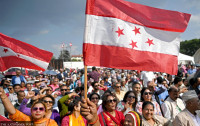
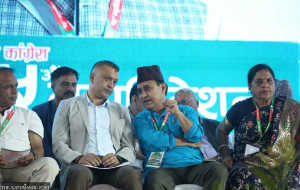
Ignoring pressure and resistance from the party’s establishment faction, the special convention of the Nepali Congress, called by general secretary duo Gagan Thapa and Bishwa Prakash Sharma, convened in the Capital on Sunday.
The two-day-long second special jamboree was called with signatures from around 54 percent of general convention representatives. The statute of the grand old party makes it mandatory to call a special convention if 40 percent of the representatives demand such a convention specifying clear reasons.
Despite the statutory provision, party president Sher Bahadur Deuba had been reluctant to summon the convention. With the backing of 2,488 general convention representatives, who stood for the special convention, Thapa and Sharma took a bold decision to call the meeting of the party’s supreme body. The current number of Nepali Congress representatives stands at 4,556.
Legal experts, who have long followed Congress politics, say the special convention is completely legitimate. However, the legality of its future course will depend on the attendance of representatives at the closed-door session. The session starts Monday morning.
Even as clause 17 (2) of the Congress statute states that 40 percent of representatives can call the convention, it does not say anything about the number of representatives who can make policy decisions.
“In principle, decisions taken by any majority of over 50 percent are legitimate. However, the Congress statute does not explicitly mention this,” said senior advocate Gopal Krishna Ghimire, former president of the Nepal Bar Association, who is close to Congress. “If fewer than 50 percent of representatives show up by the time the closed-door session begins, the special convention will end up being just another gathering.”
As 2,278 marks the halfway mark, the presence of 2,279 or more representatives will enable any decisions.
Addressing the convention’s inaugural session, Thapa said that, if the representatives so wish, they can not only change the party’s policies but also elect a new leadership.
Changing the party leadership and statutory provisions can, however, create complications, as the Deuba faction might refuse to accept the convention’s outcome and pursue a legal challenge, says Ghimire.
“The Election Commission will have to handle the complications first. The dispute might even land in court,” said Ghimire, who was the party’s chief election commissioner in the previous convention in 2021.
If a special general convention elects the new party leadership, the commission must be informed in accordance with Section 51 of the Political Parties Act. The section states that a party must notify the commission within 30 days of any change or amendment to its name, statute, rules, seal, flag or symbol, office bearers, and other matters.
Upon receiving such information and details of related actions, the commission conducts the necessary study and scrutiny. If found to be in accordance with the constitution, laws, rules, and the party statute, it updates the party’s details in its records.
The process will lead to complications as there is a high chance that the Deuba faction will approach the commission to halt it, claiming the convention was illegitimate. Section 43 of the Act authorises the commission to settle disputes between two or more parties, or between two or more factions of the same party, regarding the party’s name, seal, statute, flag, symbol, office bearers, central committee, or the authenticity of decisions of the central committee.
First, the commission will invite both factions to reach a compromise. If that doesn’t happen, it can make a decision based on its assessment. It may even need to verify the representatives’ numbers before making the decision, which is a time-consuming process.
“The commission will have to recognise the decisions made by the ongoing convention if it has the presence of a majority of the representatives,” said a senior official at the commission. “The [new] dissident faction will either have to accept it or opt for the formation of a new party.”
There is no problem in the registration of a new party, but it will not be allowed to participate in the election that is only 53 days away. The deadline for registering parties for the purpose of the House of Representatives election expired on December 14.
“Let’s not delve into hypotheticals now. The commission will take appropriate decisions if and when the complaints are filed,” said Yagya Bhattarai, chief at the legal department in the commission.
As there are high chances that more than 50 percent of representatives will participate in the convention, the probability of a change of guard is high. The party statute envisions a 161-member Central Working Committee, including 13 office bearers.
“The problem is going to be complex. As everything is happening when the elections are right around the corner, the party will suffer a lot,” said Ghimire.
Binod Ghimire covers parliamentary affairs and human rights for The Kathmandu Post. Since joining the Post in 2010, he has reported primarily on social issues, focusing on education and transitional justice.




 14.81°C Kathmandu