Congress, UML set to win all seats up for grabs in National Assembly
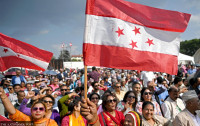
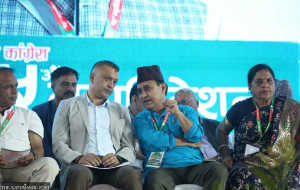
Parties file candidacies for 18 seats in the upper house as two major forces turn election to a mere formality. Senior Madheshi leader Mahantha Thakur, 82, (centre) heads to file candidacy for National Assembly member on Wednesday. Post Photo
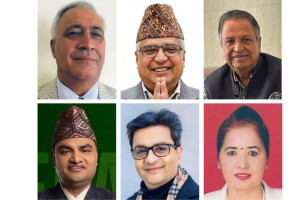
A total of 44 cross-party leaders are contesting for 18 National Assembly seats in an election that has turned out to be merely a formality following the alliance between the Nepali Congress and the CPN-UML that jointly hold the largest vote shares across the provinces.
“Candidates from seven parties have filed their nominations,” said Suman Ghimire, information officer at the Election Commission. “A single candidacy has been filed in one of the clusters of Koshi Province, leaving the position unopposed.”
Although 19 seats in the upper house will fall vacant on March 4, voting will be held for only 17 seats, as one candidacy has gone unopposed and another member will be nominated by the President on the government’s recommendation. The Election Commission on Wednesday called for nominations for the January 25 election.
As per the election schedule, complaints against candidates can be filed on Thursday. The commission will examine the nomination papers and the complaints on Friday and Saturday, and the list of candidates will be published on Saturday evening. Candidates can withdraw their nominations on Sunday, and the commission will publish the final list later on the same day. Election symbols will be provided to the candidates on Monday.
Over the last few days, three major parties—the Congress, the UML and the Nepali Communist Party (NCP)—were in intense negotiations on seat sharing. Attempts for the tripatriate alliance failed after the Congress and UML refused to allocate four seats to the NCP, the newly unified party with a merger of over a dozen of communist parties and groups.
As the three-party negotiations failed to reach a conclusion, the NCP decided to contest solo while the Congress and the UML sealed a deal to vie in nine and eight seats, respectively.
The remaining one seat was given to Loktantrik Samajbadi Party Nepal (LSP-N). The party’s chair Mahantha Thakur is contesting in the position from the Madhesh Province. Though Thakur’s party has merged with the Janata Samajbadi Party, Nepal (JSP-N), they are yet to become one legally.
As per the commission’s report, in addition to the Congress, UML, NCP, LSP-N and JSP-N, Nepal Majdoor Kishan Party and Rastriya Janamorcha, too, are in the race in some of the provinces.
According to records at the parliament secretariat, the highest number of retiring lawmakers are from the UML and the NCP with eight each; one member each from the JSP-N and LSP-N are also retiring in March after completing their six years of tenure. Likewise, Bamdev Gautam, who was appointed by the President, is also retiring two months later. The Congress, which is the second-largest party in the upper house, however, has none of its lawmakers retiring.
An electoral college of provincial assembly members, chairs and vice-chairs of rural municipalities, and mayors and deputy mayors of municipalities, metropolis and sub-metropolis are the voters for the polls to be held between 9 am and 3 pm on January 25. While the vote weightage for the provincial assembly members is 53, it is 19 for the local representatives.
Based on the weightage of the voters, the Congress and UML alliance commands two-thirds majority in five provinces while enjoying a comfortable majority in Madhesh and Sudurpaschim; it is hence almost certain that all of their candidates will be elected when the results are published on January 25 evening.
The candidacy of Sunil Bahadur Thapa, from the Congress in Koshi, has already become unopposed though the commission is yet to declare him the winner. Thapa, who was political advisor to President Ramchandra Paudel, had quit in mid-December after the assurance from the party to field him for the lawmaker’s post. Thapa had quit the Rastriya Prajatantra Party and joined Nepali Congress in July 2020.
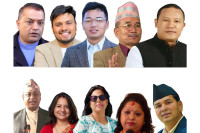
Along with Thapa, Dharmendra Paswan and Ranjit Karna from Madhesh; Gita Devkota from Bagmati; Jagat Timilsena from Gandaki; Chandra Bahadur KC and Basudev Jangali from Lumbini; Lalitjung Shahi from Karnali; and Khamba Bahadur Khati from Sudurpaschim Province are the Congress candidates.
As per the commission’s report, the UML has fielded Roshni Meche and Som Portel from Koshi Province, Rekha Jha from Madhesh Province, Prem Dangal from Bagmati Province, and Samjhana Devkota from Gandaki Province. Likewise, Ram Kumari Jhakri from Lumbini, Meena Rakhal from Karnali, and Lila Bhandari from Sudurpaschim are contesting from the party.
If there is no dramatic change in the current dynamics, the Congress-UML alliance will have close to two-thirds majority in the upper house in March. The Congress, with 16 seats at present, will take its tally to 25 to become the largest party. The UML, on the other hand, will have 1o seats. As Anjan Shakya, who made it to the upper chamber through presidential nomination, is considered close to the UML, the two-party alliance will command 36 seats—three short of the two-thirds majority of 39.
Binod Ghimire covers parliamentary affairs and human rights for The Kathmandu Post. Since joining the Post in 2010, he has reported primarily on social issues, focusing on education and transitional justice.




 14.81°C Kathmandu