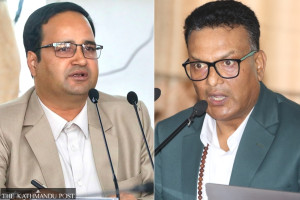
The Election Commission says it’s trying to reduce its spending on poll-related materials by relying mostly on existing stocks and limiting new purchases to articles “absolutely necessary”.
Making public its logistical details, the constitutional election management body said it has sufficient stocks of ballot boxes and voting screens with no need for fresh procurement. It also has stocks of materials such as stamps, forms, ink and stamp pads to meet the requirement partially. The procurement will be only for the shortfall.
Of the 51 types of materials necessary for the elections, 37 will be procured from provincial and district election offices as the commission has decentralised the authority, according to the commission’s report. The commission has already released necessary funds to its subordinate offices.
The commission has started printing documents such as ballot papers for the proportional representation system, having received the parties’ closed lists of PR candidates.
The commission has received over Rs6 billion from the Ministry of Finance out of its request for Rs8 billion as the poll expenditure. The amount doesn’t include the security cost, which is more than double the commission’s cost.
There are a total of 18.9 million voters, an increase by over 5 percent—915,119—from the 2022 elections.
The number of political parties registered for election purposes has also grown from 87 in 2022 to 114 this time for the first-past-the-post vote. Of them, 102 are contesting with their own election symbols, while 12 are participating under five shared symbols.
For the proportional representation system, 64 parties have submitted closed lists. Among them, 54 are using their own symbols, while 10 parties are contesting jointly under four shared symbols. The total number of candidates under this system stands at 3,424.
Under election laws, only parties that qualify as national parties by securing at least 3 percent of the total votes cast are entitled to seats under the PR category. Among more than 70 parties that contested the 2022 election, only seven achieved the national party status.
The number of observers willing to monitor the March 5 snap polls has also increased. While the number of domestic observer organisations has increased from 21 to 27, international observer groups have doubled from two to four.
The Carter Center, The Multidisciplinary Institute of Training and Learning and International Republican Institute, all from the United States of America, have been accepted as international observers. The Asian Network for Free Elections is the fourth foreign organisation to receive the permission.
In addition, the commission is inviting election commissions of other countries and their diplomatic missions to observe the polls to be held in over two months from now.
According to the commission, the polling facilities have been expanded to accommodate a growing electorate. Compared to 2022, there are an additional 75 polling stations this time, bringing the total to 10,967. The number of polling centres has increased by 962 to 23,189.
The commission said it has been holding regular coordination meetings with key stakeholders. These include repeated discussions with the government, all-party meetings held in the presence of the prime minister, and coordination with security agencies on election security.
The commission has also consulted former election officials, media regulatory bodies, and heads of government communication institutions, while continuing dialogue with political parties and other stakeholders.




 20.58°C Kathmandu