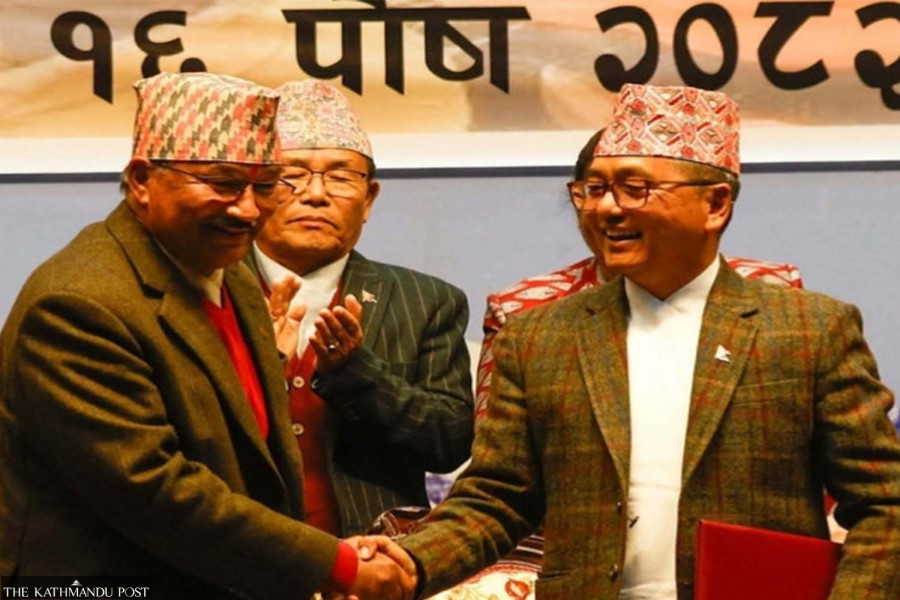
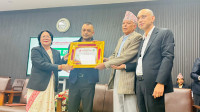
The two parties finalised their merger on Tuesday, a week after Rajendra Lingden and Kamal Thapa signed unity agreement. RPP-Nepal chair Kamal Thapa (left) shakes hands with RPP chair Rajendra Lingden during their reunification program organised in Kathmandu on Wednesday.
The Rastriya Prajatantra Party (RPP) and the Rastriya Prajatantra Party-Nepal (RPP-Nepal) have formally reunited, closing yet another chapter in the decades-long cycle of splits and mergers within Nepal’s pro-monarchy bloc.
The unification was announced in Kathmandu on Tuesday by party RPP chair Rajendra Lingden and RPP-Nepal chief Kamal Thapa, who jointly released the unity declaration. Both leaders framed the merger as a strategic step towards consolidating pro-monarchy forces at what they described as a critical political moment.
The formal announcement comes a week after Lingden and Thapa signed a brief unity understanding at the RPP’s central office in Dhumbarahi on December 24. That agreement paved the way for the final merger.
Thapa had walked out of the RPP in 2021 after losing the chairmanship to Lingden during the party’s general convention, subsequently reviving the RPP-Nepal.
The two parties had since operated separately, despite overlapping ideological positions and intermittent collaborations, including in recent pro-monarchy demonstrations.
Both parties led by Lingden and Thapa advocate for the restoration of Nepal as a Hindu Kingdom, which was abolished in 2008 by the Constituent Assembly following the success of the People’s Movement II in 2006. They, however, have failed to make any significant presence in the parliament. The Lingden’s RPP had just 13 seats in the recently dissolved 275-member House of Representatives, while Thapa’s party won no seats during the latest election in 2022.




 17.63°C Kathmandu