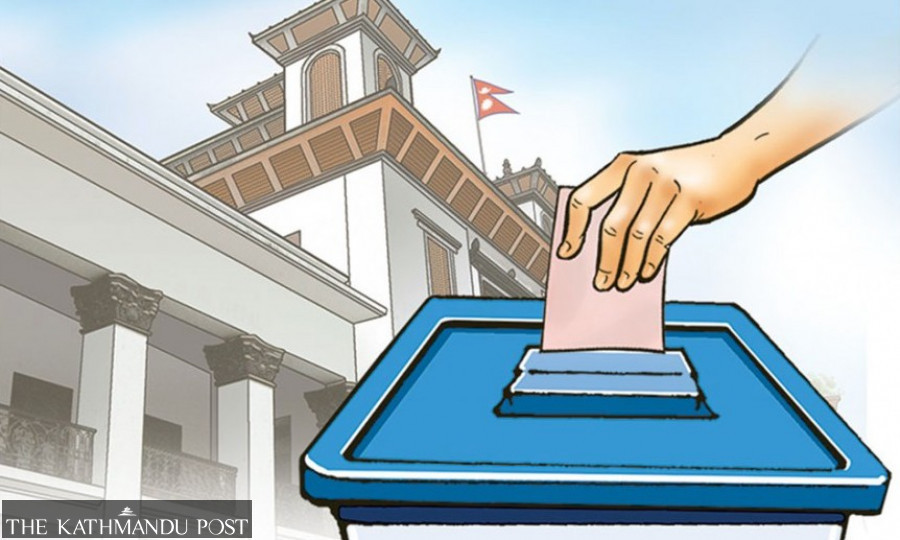
With just five days to the deadline to submit the closed list under the proportional representation (PR) system, political parties are busy finalising the names of their candidates.
Different parties have developed different criteria to select the candidates under the PR category for the House of Representative elections to be held on March 5. While some have already received the recommendations from their lower committees, others are still waiting for them.
The Nepali Congress and the CPN-UML have decided not to repeat those who were elected under the same category in the past. They have also asked their subordinate committees not to recommend the names of the incumbent representatives at the local units, provincial assemblies and National Assembly.
However, the Congress on Wednesday decided to withdraw the names of 19 leaders who were included in the closed list of the PR category in different provincial assemblies, opening the doors for them to be recommended at the federal level.
“We have already received the recommendations from all districts. The party will pick from among them,” said Krishna Prasad Paudel, the chief secretary at the Congress head office.
Even as the UML has yet to officially announce to take part in the snap polls, it is doing homework to finalise the names of the PR candidates. Niraj Acharya, who heads the party’s election department, said provincial committees have tasked districts to submit at least three alternative names, including one woman, from a constituency under the PR category.
“Some districts have already forwarded the names while others are in the final stage. The party will finalise the names by the deadline,” he said.
The Nepali Communist Party, which was formed after a merger of around a dozen of leftist parties and groups, has set Saturday as a deadline for the subordinate offices to submit the names. Districts with a single electoral constituency have been instructed to recommend at least four candidates, including a minimum of two women, while districts with more than one constituency have been asked to recommend an additional two candidates from each constituency.
The party has also instructed that recommendations be made in line with constitutional and prevailing legal provisions, taking into account clusters such as women, Dalits, Janajatis, Madhesis, Tharus, Muslims, persons with disabilities, backward regions, and minorities.
The Rastriya Swantantra Party, which started the selection process earlier than other parties, has received applications from 353 aspirants. Probable candidates will have to make presentations before voting to make it to the final list, according to Bipin Acharya, the party’s joint general secretary.
As many as 110 in the 275-strong lower house will be elected under the PR system. The parties will get the seats in proportion to the PR votes they receive. However, each major party generally submits a list of 110 candidates.
As per the election schedule the parties contesting the March 5 polls must submit their closed list on December 29 and 30. The final closed list will be published on January 3.
While 114 parties are contesting under the first-past-the-post category, 100 parties, including those that have applied to contest under a single election symbol, have been registered for the PR system.
Each party will have to submit inclusive candidates lists based on the share of different castes and communities in the national population. Amending the Act to elect the members of the House of Representatives through the ordinance, the government has adjusted the representation of different clusters in proportion to the 2021 census.
The share of the Khas-Arya cluster, which was 31.2 percent as per the 2011 national census, declined to 30.3 percent in a decade. As per the revised Act, the cluster will lose one seat this time compared to the 2022’s election. There has been a slight decline in the share of the indigenous nationalities cluster from 28.7 to 28.2 percent.
Dalit and Tharu are the other clusters that have seen a decrease in the share of the population. The share of Dalits has gone down to 13.4 percent from 13.8 percent, and that of Tharus to 6.5 percent from 6.6 percent.
However, the share of Madheshis has gone up by nearly one percent to 16.2 from 15.3 percent which has led to an increase of one seat in the cluster. The commission will not accept the list that doesn’t have representation as prescribed by the revised Act.
Binod Ghimire covers parliamentary affairs and human rights for The Kathmandu Post. Since joining the Post in 2010, he has reported primarily on social issues, focusing on education and transitional justice.




 14.82°C Kathmandu