Parties urge PM to engage top leaders to ensure elections
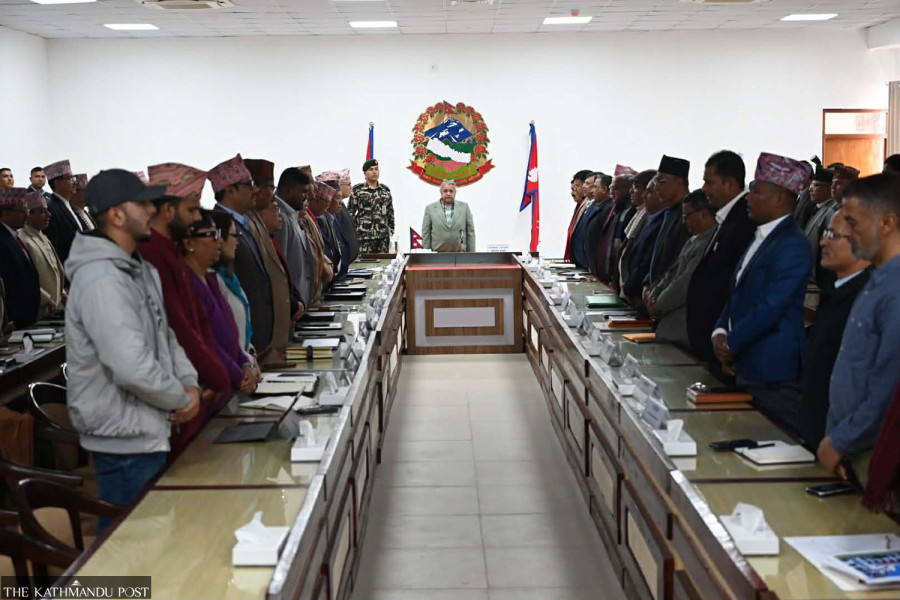
Maoist leader and legal expert stress caution as government aims to expand voting rights through ordinance. Representatives of political parties and stakeholders stand for the national anthem at the start of a meeting organised by the Election Commission and the Ministry of Home Affairs at Singha Durbar on Monday. Prime Minister Sushila Karki is seen at the centre, facing the camera. The meeting sought suggestions on proposed election provisions, including overseas voting, out-of-constituency voting, and a no-vote option that the government wants to introduce through an ordinance. Angad Dhakal/TKP
Political party leaders, legal experts, and public intellectuals have cast doubt on the snap elections scheduled for March 5 citing various shortcomings, but stressed that elections are unavoidable.
In a meeting jointly called by the Election Commission and the Home Ministry, politicians and experts urged Prime Minister Sushila Karki to personally engage with top party leaders to create a conducive environment for the polls.
The meeting, called to seek suggestions from political parties and other stakeholders on three election-related provisions—voting rights for Nepalis living abroad, out-of-constituency voting and the introduction of a no-vote option. The government is working to introduce an ordinance to include these provisions in the upcoming elections, but party leaders and experts raised concerns about the government’s preparedness to implement them.
Commenting on the government’s proposal, Nepal Communist Party (formerly CPN-Maoist Centre) leader Barshaman Pun said that rules should not be changed since the election process has already begun. Although he said he is ready to cooperate for the March 5 elections, he emphasised altering rules midway could lead to conflict.
“To fulfill the election mandate, we are ready to do whatever is necessary. But according to global standards and our practical experience, rules should not be changed once the game has begun. If they are changed, it could lead to conflict,” Pun suggested. He added that although the demand for citizens living abroad to be allowed to vote is legitimate, the Election Commission should clearly state what it can and cannot do in this regard.
He also warned that if the election cannot be held on the scheduled date, then the dissolved lower house may be reinstated. “If the government tries to go beyond six months, which would be against the constitution, we will not support it. We have clearly stated this,” he said. “If a new parliament does not emerge within six months, either the people will make a decision through the streets, or the old parliament will be reinstated. On these matters, we are all clear.”
Party leaders and experts said the government has done too little and late for bringing such laws related to the elections.
Former lawmaker Radheshyam Adhikari, who is also a legal expert, said that voting rights for Nepalis living abroad, provisions for temporary voters to cast ballots, and the option of NOTA (None of the Above or no vote) can only be made possible through legislation.
The government said it is preparing to amend four election-related laws to address the three issues. The home ministry has drafted the amendment bill and requested suggestions for improvement.
According to the draft, Nepalis living abroad would be granted voting rights, and overseas Nepali missions could serve as polling centres. The bill also proposes allowing voters who are unable to reach their designated polling station in Nepal to vote from another constituency within the country.
Adhikari warned that while these laws are necessary, drafting them now could create further uncertainty for the March elections, especially as the deadline for parties to submit proportional representation lists is only a week away.
“There are technical, political, and diplomatic difficulties,” he said. “We must move forward without disrupting the rules of the game. This is not the time to amend the law.”
Adhikari also said that moving ahead on election-related issues without consulting major political parties could cause serious problems and urged both the government and Election Commission to engage with party leaders.
Former minister Bidhyadhar Mallik said that a NOTA option could be implemented and should be introduced in the March elections. He also stated that if inter-district voting can be arranged through the national identity card, efforts should be made in that direction.
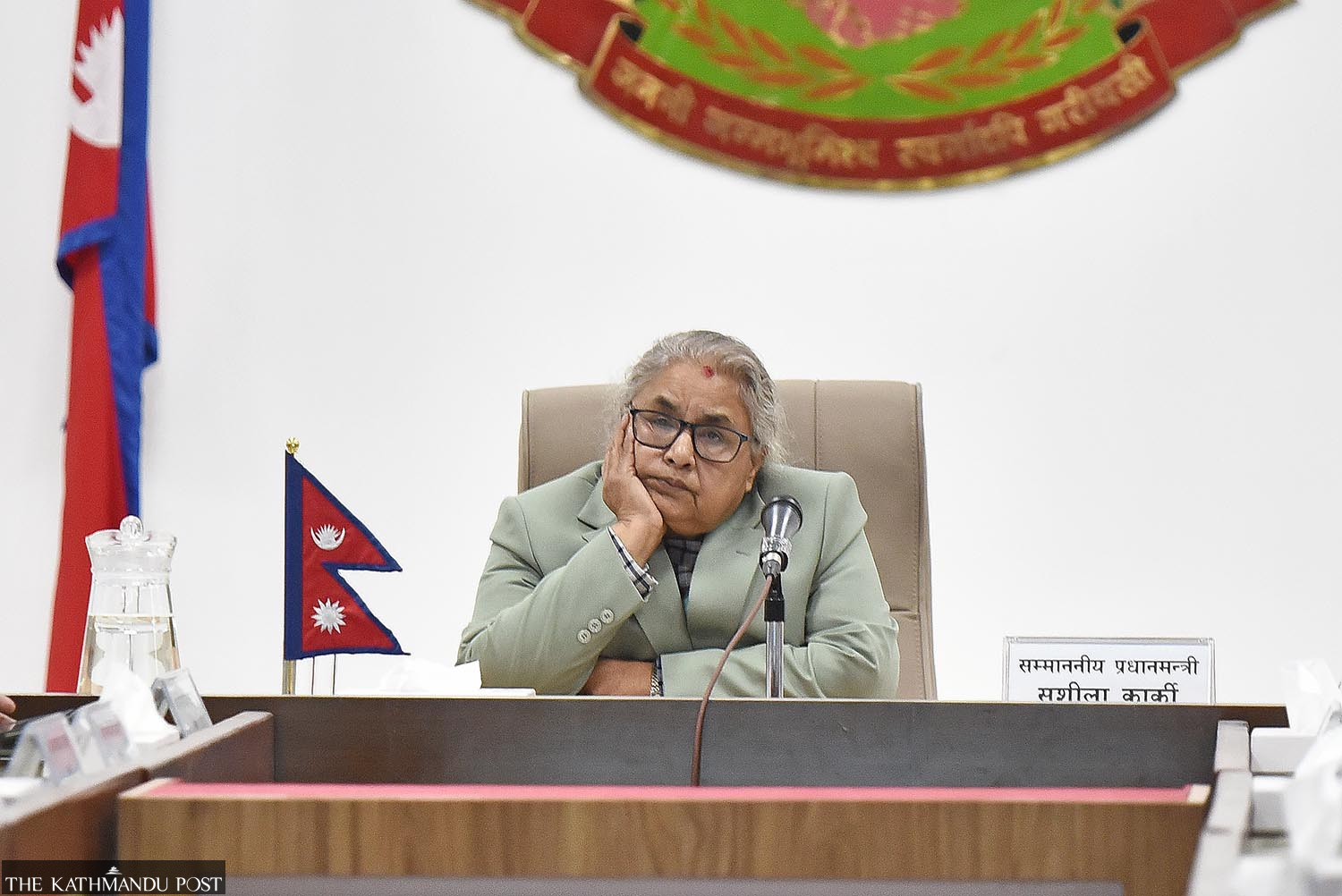
Prime Minister Karki listens intently to party leaders at a meeting in Singha Durbar, Monday. Angad Dhakal/TKP
He also stressed that the agreement between the government and youths regarding the Gen Z movement should be implemented. He added that allowing Nepalis living abroad to vote would be difficult at present due to the limited time available.
Mahendra Yadav, the joint general secretary of Nepali Congress, said that in order to ensure the elections are held on the scheduled date, Prime Minister Karki should immediately engage in dialogue with top leaders of major political parties. “Elections cannot be conducted by fostering hostility towards political parties and their leaders, and therefore the prime minister should not delay holding discussions with top leaders of political parties to create a conducive environment for the polls,” he added.
In the meeting, newly elected secretary of the CPN-UML, Mahesh Basnet, stated that his party believes that elections scheduled for March 5 will not take place.
“In principle, we are in favour of holding elections. However, given the current environment and petitions in the Supreme Court challenging the government’s legitimacy along with demands for reinstatement of dissolved parliament, our conclusion is that elections will not happen on March 5.”
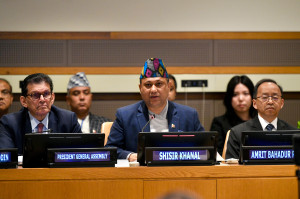
Rastriya Swatantra Party leader Shishir Khanal said that law and order are essential preconditions for holding credible elections. He emphasised that it is the government’s responsibility to ensure a fear-free environment and guarantee the safety of leaders, parties, and candidates.
“Law and order are the most critical factors for credible elections and for election campaigning,” Khanal said.
He added that inter-district voting is practically possible, and that his party is ready to cooperate.




 15.26°C Kathmandu