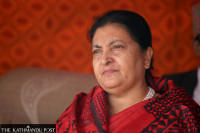
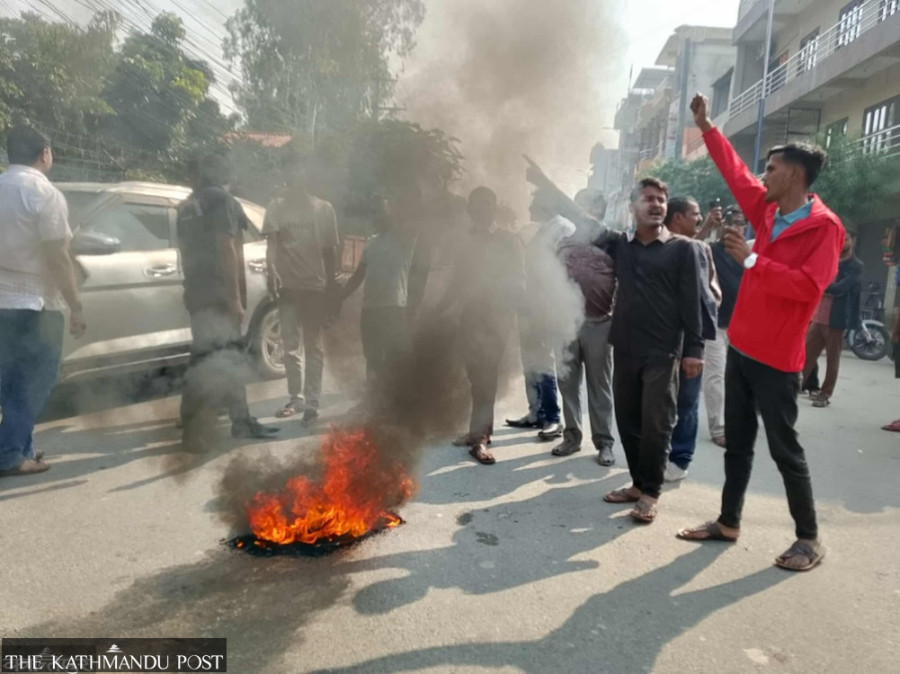
Province head Sumitra Subedi Bhandari dismissed hours after ‘secretly’ swearing in a new chief minister at a hotel. Party cadres burn tyres to protest chief minister appointment in Janakpur, Monday. Post Photo
In a dramatic turn of events, Madhesh Province Head Sumitra Subedi Bhandari, who left Janakpur for Kathmandu at 4 am on Monday citing health reasons, appointed CPN-UML leader Saroj Kumar Yadav as the new chief minister of Madhesh.
The assembly’s seven political parties immediately protested her move, accusing her of appointing the chief minister unconstitutionally. Within hours, Janakpur witnessed unrest after cadres of the seven parties took to the street—and even resorted to vandalism outside the office of the province head.
Following her controversial move, the Sushila Karki-led federal government dismissed Bhandari and recommended Surendra Labh Karna as the province head later on Monday evening.
In Janakpur, caretaker Chief Minister Jitendra Sonal saw off Bhandari at 4 am on Monday. Carrying a bouquet, Sonal personally approached Bhandari at her residence, wished her a speedy recovery, and asked his supporters staging a sit-in outside to step aside as he led the motorcade forward.
Bhandari, however, reached a Bardibas-based hotel where she appointed UML assembly party leader Saroj Kumar Yadav, elected from Mahottari, as the chief minister under Article 168(3) of the constitution.
At 5:20 am, Yadav took the oath of office and secrecy at the hotel. UML lawmaker Lakhan Das Tatma, Nepal Sanghiya Samajbadi Party’s Bimala Ansari and Rastriya Prajatantra Party’s Kanchan Bichchha were also sworn in as ministers without portfolio.
“She (Bhandari) deceived us,” Sonal told the Post. “By violating the constitution, she went to a hotel, appointed a new chief minister and administered the oath of office—an act that struck at the very essence of federalism," he said.
Following the appointment, RPP central chair Rajendra Lingden directed his party’s minister to quit the government at the earliest, saying the ‘midnight appointment’ made in a Bardibas hotel went against the party’s policy.
Political stakeholders and analysts termed the province chief’s controversial act unconstitutional. The chief minister appointment came at a time when seven parties, including the Nepali Congress, had been putting pressure on her to call for a new coalition government under Article 168(2), while the UML, staging protests at the province head’s office in Janakpur, had demanded that a minority government be formed under Article 168(3).
On Sunday evening, Bhandari had met with lawmakers from the Congress, the CPN (Maoist Centre), the Loktantrik Samajbadi Party, the CPN (Unified Socialist), the Janamat Party, and the Janata Samajbadi Party, assuring them that she would decide only after further consultation. But she left the province head’s official residence in Janakpur early Monday, saying she was travelling to Kathmandu for treatment.
Her sudden travel to Bardibas in Mahottari district to appoint Yadav as chief minister has drawn widespread criticism, with many accusing her of using illness as a pretext to bypass the due constitutional process.
The Madhesh Province government led by Sonal collapsed on Saturday, just 25 days after its formation, after he failed to secure a vote of confidence in the provincial assembly. Sonal, who had formed the government on October 15 with the support of 56 lawmakers under Article 168(2) of the constitution, resigned hours before the scheduled trust vote when it became clear that he would not get the backing of all of his coalition partners.
Two Maoist lawmakers—Rahbar Ansari and Mala Karna—publicly announced that they would neither vote for nor against the motion, effectively abstaining from the confidence vote.
Similarly, former chief minister Satish Kumar Singh and lawmaker Tribhuvan Sah, who had earlier supported Sonal, announced that they would be absent from the assembly session. The suspension of Janata Samajbadi Party lawmaker Saroj Singh Kushwaha further weakened Sonal’s position.
The chief minister needed 53 votes to prove his majority in the 107-member Madhesh assembly.
Article 168(2) states that in cases where no party has a clear majority in a provincial assembly, the provincial head shall appoint as the chief minister a member of the assembly who can command a majority with the support of two or more parties represented in the assembly.
Likewise, Article 168(3) stipulates that in cases where the chief minister cannot be appointed under clause (2), the provincial head shall appoint the assembly party leader of the party which has the highest number of members in the assembly as the chief minister. The chief minister appointed under clause (2) or (3) must obtain a vote of confidence from the assembly no later than 30 days after the date of such appointment.
The UML, which is the largest party in the assembly, insisted on appointing the chief minister as per Article 168(3) while other parties asked Bhandari to call for political parties to form a coalition government under Article 168(2) first before jumping to the 168(3).
It is learnt that Bhandari appointed UML leader Yadav as chief minister at around 11 pm on Sunday. However, as leaders and cadres from the Nepali Congress and six other parties were staging protests and a sit-in in front of the Province Chief’s residence, Yadav was unable to receive the appointment letter or take the oath of office.
Amid mounting pressure, Province Head Bhandari allegedly administered the oath of office to UML leader Yadav at the hotel on Monday morning—an act critics say was carried out with partisan bias. Soon after the ceremony, she reportedly left directly for Kathmandu.
Bhandari’s personal secretary, Tikaram Upreti, defended the decision, saying the oath had to be conducted outside the Province Chief’s Office because protests and sit-ins by rival parties were taking place in front of both her residence and the office premises.
“There was no conducive environment to hold the swearing-in ceremony at the office,” Upreti said. “After assessing all constitutional aspects and consulting legal experts, the Province Chief appointed Yadav as chief minister, as the leader of the largest party in the provincial assembly.”
According to Upreti, Bhandari’s asthma, persistent cough, and high cholesterol had worsened at night, prompting her to travel to Kathmandu for treatment. “Since the oath would not take long, it was held at a location along the route,” he added.
A senior Mahottari police officer confirmed that the Panas Cottage, a secluded lodge at Kalapani along the BP Highway in Bardibas, was chosen on the suggestion of newly appointed Chief Minister Yadav himself. “Around 4:30 am, some UML supporters arrived to briefly open the hotel, saying the Province Chief and the new chief minister were on their way,” the officer said.
After the introduction of the provincial structure, the Madhesh province completed its first full five-year term under Chief Minister Lalbabu Raut of the Janata Samajbadi Party (JSP).
After the provincial assembly election in 2022, Saroj Kumar Yadav of the JSP from Bara initially led the government for about 13 months. However, after coalition partners—the Janamat Party, UML, and the Maoist Centre—withdrew their support, the government collapsed, and Satish Kumar Singh of the Janamat Party became the second chief minister.
The political turmoil deepened after Singh resigned amid the Gen Z movement, intensifying the power struggle in the province. As the Janamat Party itself plotted to topple its own-led government, the provincial political equation became even more volatile.
A Cabinet meeting on Monday evening decided to remove Bhandari and forward Labh’s name to President Ramchandra Paudel for appointment, federal government spokesperson and Minister for Communications Jagadish Kharel said.
Labh, who holds a PhD in economics, is known for his expertise in political and economic affairs of the Madhesh region. He also served as a member of the
National Planning Commission in 2021 and taught for many years at Ramswarup Ramsagar Multiple Campus in Janakpur.
Parties hit the street
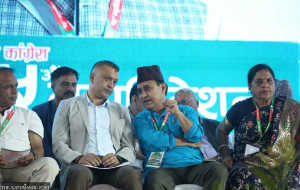
Leaders and cadres of seven political parties, including the Nepali Congress and the Maoist Centre, staged a protest outside the Madhesh Bhawan on Monday against the appointment of chief minister.
As news spread that the newly appointed chief minister was heading to the office of the provincial government, lawmakers and cadres of the seven parties gathered outside the gate, chanting slogans and burning tyres. There was a heavy deployment of security personnel around the building as the number of protesters grew.
The enraged protesters resorted to vandalism outside the office of the province head. They chanted slogans against the province head and demanded her resignation, accusing her of acting against federalism and democratic norms. Video clips showed Loktantrik Samajwadi Party leader and former lawmaker Parameshwar Sah assaulting an employee of the provincial head's office. Other individuals accompanying him also joined in the beating and vandalising the public properties.
Petitions at Supreme Court challenge chief minister appointment
Two separate writ petitions have been filed at the Supreme Court against the appointment of the Madhesh chief minister, terming the move as unconstitutional.
Advocate Rakki Prasad Sah and Arjun Sah lodged the petitions on Monday, naming the Office of the Province Head and the Office of the Chief Minister and Council of Ministers of the province as defendants. The apex court has scheduled a hearing for Tuesday.
Petitioner Rakki Prasad Sah said that Article 168(2) of the constitution was still applicable when the new appointment was made. He argued that the Province Head Bhandari should have first invited parties to form a coalition government under this provision rather than invoking Article 168(3).
The petitions also seek an interim order to maintain the status quo until the case is resolved.




 12.9°C Kathmandu