



 28.33°C Kathmandu

Tue, Sep 29, 2026
Opinion
After the Tarai unrest, lessons the government cannot ignore
That it took violence and deaths to extricate Shah out of the cocoon he has woven around himself and act says a lot about how our country is being governed.
bookmark
Deepak Thapa
Published at : August 6, 2026
Updated at : August 6, 2026 07:54
For someone seemingly more at home in the virtual world and surrounded by a narrow coterie of friends, the recent unrest that swept parts of the eastern Tarai must have been a rather rude awakening for our prime minister, Balendra Shah. That it took violence and deaths to extricate Shah out of the cocoon he has woven around himself and start acting like a real leader says a lot about how our country is being governed.
There was not much Shah actually did, though, apart from being briefed by the chiefs of security agencies and, in turn, providing the briefest of briefings on the situation to the President, which itself was preceded by a short address to the nation uploaded only on social media.
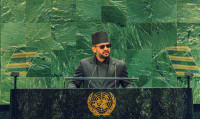
That he (or his advisers) had the presence of mind to put out his speech in Maithili as well does Shah (or them) credit. Except that one was left wondering why he would not have taken the national address more seriously. For an artiste with some claim to fame, one would have thought speaking to a camera would come easy to him. Instead, what we got was a pre-recorded performance of less than four and a half minutes spliced together from a number of cuts.
Even worse, it appeared that the prime minister had not gone through the address in advance to get a feel for both words and the emotions being conveyed. Hence, we were treated to a somewhat tentative and halting performance with his eyes wavering fully from left to right to left as he read out of the teleprompter, making the whole thing look rather insincere. In this day and age, when technology is readily available anywhere, there is no reason why the use of the teleprompter cannot be made to look more natural, a la, say, Barack Obama.
Regardless, one can be somewhat certain that for people in that part of the Tarai, not only where the disturbances were but elsewhere, too, hearing the leader of the nation imploring them to shun violence in their own language would have meant something. Just as it must have seeing the home minister in their midst sans the trappings of his office. For a population long used to being given short shrift by the Nepali state, such gestures, albeit belated, would have indeed made a difference.
There are three issues though that Home Minister Sudan Gurung will need to deal with if we are to avoid a repeat of Sunsari-like conflagrations in the future.
Police attitudes
The first has to do with police training. As the violence rocked Sunsari and began spreading westward, Gurung found himself in a rather unenviable position of having to defend, in principle at least, the brutality of the police he had experienced from the receiving side during the Gen Z protests that propelled him to where he is now. It has been reported that he took quick action to penalise the officials responsible for the police firing, but he himself might have set the tone for police high-handedness with ambiguous statements such as “The security forces have been handcuffed for the past 36 years”.
While Gurung was likely referring to the political meddling that has bedevilled both the police and armed police, it could also be read as giving carte blanche to our cops who have never shied from heavy-handedness. Particularly when incidents like the beating of Gen Z activist Majid Ansari go unaddressed, and the police appear to have been in cahoots with state and extra-state actors during the recent attempted intimidation of some media houses.
More worrisome is what a ruling party MP from the Tarai asked: “Why is it that the police resort to firing even under the flimsiest of pretexts?” There are any number of instances even in the recent past to support his claim. While the police response in Kathmandu during last year’s Gen Z protests might seem to counter his argument, the fact remains that the police do need to be re-trained to adopt a completely different approach to crowd control.
Among the solutions proposed are calls for including more Madheshis in the police. But we all know that without proper investment in training, that alone will not suffice. Cops are cops, everywhere in the world. Instead, a more meaningful approach should include: i) use of force as a last resort, and, more importantly, ii) as in the case of the Tarai or anywhere the dominant ethos is feeble or absent, oriented in socio-cultural and linguistic sensitivities. We can at least hope then that there won’t be shouts of ‘Shoot the Biharis’ when the police deal with Madheshis, as was reportedly the case back in 2015.
Intelligent intelligence
The second priority should be bolstering intelligence gathering throughout the nation. That the prime minister did not invite the head of the National Investigation Department, the country’s premier intelligence office, during the security briefing mentioned above, speaks volumes. Gurung is right when he blames extreme politicisation of the security forces for eroding their efficacy; when personnel have to expend their energy in currying favour with their political bosses, not much can be expected of them. The malaise having been diagnosed, it is now time for a cure.
As has been widely reported, the Armed Police Force (APF) had warned of exactly a Sunsari-like situation. Subsequent governments failed to act on the APF’s findings and recommendations, and hence the nation has now paid the price.
No one keeping tabs on the goings-on in the Tarai would require a government report to grasp how things are. Hindutva extremists have been active in Nepal for nearly as long as India has been independent, bringing their brand of hate and destruction to a country that had been largely untouched by the sectarian violence that swept the pre- and post-partition of India. By and large, though, violent incidents remained largely contained even though the episodic incidents were on the rise.
Since the rise of the Hindu supremacist party in India in 2014, and with the active connivance of its affiliates, the Hindutva brand has now swept across Nepal, particularly in the Tarai. As a political scientist noted, the ‘actionable package of shakha-mandir-sangstha-school-party that we see in India as the vehicle for Hindutva’s long march through the institutions does not yet exist in Nepal’. But Hindutva networks do exist and ‘[w]e have seen multiple incidents, protests, riots, provocative processions of idols through Muslim neighbourhoods, social media provocations, and...a lot of Hindutva-affiliated propaganda distributed in Nepal’s border towns and cities…’.
Another scholar had more recently warned about the ‘DJ phenomenon’ of religious music provocatively blared through loudspeakers. It was precisely DJ music that had led to the initial altercation in the Sunsari village where it all started. Any intelligence officer worth her salt would have flagged these developments to the government years earlier.
Hence, the third action required of the government is to begin the long, hard, controversial and even thankless task of deradicalising the youth. As a fellow analyst wrote, the focus needs to be equally on the madrasa and the mandir, but more on the latter. Any effort will be an uphill task, having to struggle against the double-barrelled onslaught of the systematic anti-Muslim (along with anti-Christian and, eventually, anti-anyone-not-a-Hindu) propaganda from Hindutva extremists from across the border, and the echo chamber of social media. Complete success is not guaranteed since mischief-makers will always find ways to make mischief. But the alternative is being engulfed by the kind of religious conflict common in our neighbourhood, which we have been fortunate enough to be spared thus far.
Deepak Thapa
Deepak Thapa has been a fortnightly columnist with The Kathmandu Post since 2009, writing on a range of topical social and political issues.
.jpg&w=200&height=120)

Editor's Picks

What triggered the Rasuwa flood? Scientists piece together a complex chain of events

The floods keep coming. Nepal keeps starting over

In a settlement destroyed by the Bhotekoshi flood, a disabled couple offer strangers the little they have

Nepal working on detailed assessment as Bhotekoshi flood reconstruction could cost up to $5 billion

Rabindra Dhant gave Nepal a reason to smile. Now his camp wants real action behind the praise
E-PAPER | September 29, 2026

×