Police actions against Gen Z activists raise concerns over shrinking space for dissent
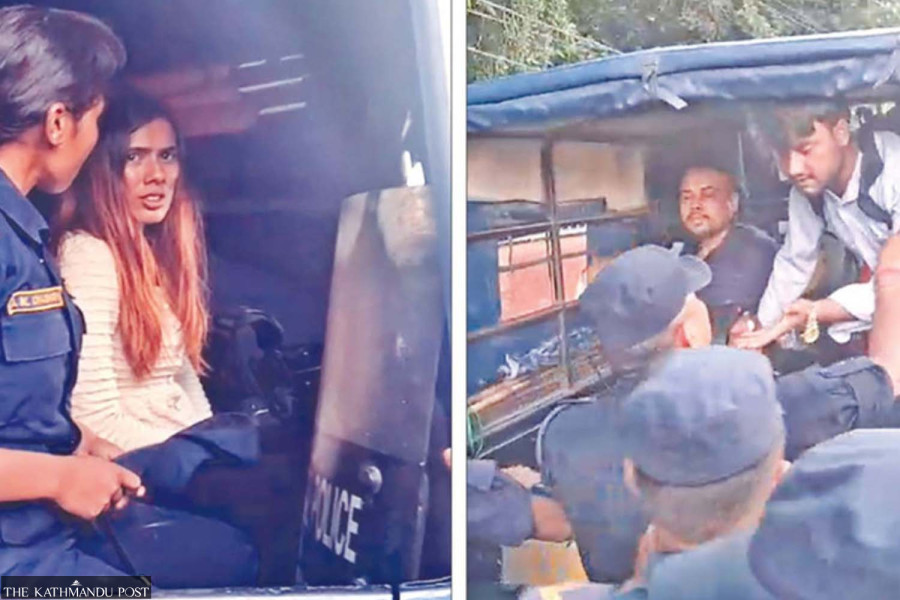
Detentions of activists supporting flood-affected squatters and critics of the government have sparked criticism from rights advocates, while police say they acted only against those obstructing law enforcement. Police detain Gen Z activists Sarisma Thapa, Majid Ansari and Nelson Ghatani on Saturday as they demanded dignified management of displaced squatters left stranded after the Kirtipur holding centre was inundated. Post photo
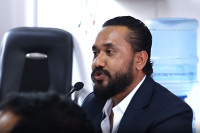
Police on Saturday detained Gen Z activists Majid Ansari, Sarisma Thapa and Nelson Ghatani after they reached a holding centre in Kirtipur to express solidarity with squatters affected by flooding.
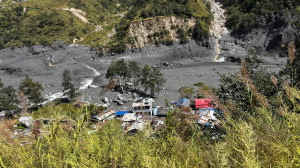
The three activists had gone to the centre, where displaced squatters had been kept, after heavy rain flooded the facility. They had been demanding a dignified solution for the squatters’ relocation and wanted to stand with those affected by the government’s arrangements.
Ansari, who is also a legal practitioner, however, was allegedly assaulted by police at the gate of the holding centre. Thapa and Ghatani were taken into a police van after officers allegedly used abusive language against them.
Ansari said he asked police to show an arrest warrant before he was taken away. Instead, officers allegedly scolded him, used offensive language and told him not to engage in politics as a student.
“I was suddenly grabbed by the collar from behind and then beaten,” Ansari told Kantipur from his bed at Tribhuvan University Teaching Hospital. “My vision became blurred after I was hit around the eye. I could not see properly.”
Police took him to the Metropolitan Police Circle, Kirtipur where Deputy Superintendent of Police Shiva Kumar Budhathoki accused him of obstructing police duties.
Thapa said they immediately informed senior police officials and human rights activists after Ansari was allegedly assaulted.
“Although we were not kept in custody, we were placed in a separate room inside the police office,” she said. “After some time, all three of us were taken to Kirtipur Hospital for medical examination.”
Police generally take individuals for a medical check-up before keeping them in custody for investigation. Thapa said she and Ghatani had no visible injuries, while Ansari was bleeding.
“Treatment for Ansari started there, while Nelson and I were taken back to Kirtipur Police Circle,” she said.
According to Thapa, the two were released later in the evening after signing a statement saying they would not repeat such activities. Ansari was taken to the Teaching Hospital for further treatment.
She said police officials continued to describe Ansari as being under their control even after he was admitted to the hospital.
On the same day, police arrested 26 people who had gathered outside the gate of the District Police Office in Morang to protest in support of Ansari.
The protesters, who held a peaceful sit-in at around 9:30pm, were released on Sunday after signing commitments that they would not participate in similar activities in the future.
Superintendent of Police Kabit Katawal, chief of the District Police Office, Morang, said they were detained because they blocked the main gate of the police office and disrupted police operations and vehicle movement.
“They were taken into control after repeated requests to leave were ignored,” Katawal said. “They were released to their guardians after signing an undertaking not to stage such protests again.”
Meanwhile, police detained activist Durga Prasai at Tribhuvan International Airport on Sunday after he returned to Kathmandu from his home district, Jhapa.
Prasai had planned to speak to journalists at the airport about his criticism of government actions. Police detained him, saying he was preparing to stage a protest in a restricted area.
“An airport is a sensitive security zone. The district security committee had also decided that protests cannot be held there,” said Superintendent of Police Pawan Bhattarai, spokesperson for Kathmandu District Police Range.
Prasai was taken directly to his residence in Bhaktapur after being detained and later released. He has previously faced arrests over his public statements.
Concerns over shrinking space for criticism
Some observers say police are increasingly treating peaceful expressions of dissent as security threats.
The recent arrests are part of a broader pattern of action against people who have criticised the government.
On April 11, YouTuber Roshan Pokharel was arrested in Panchthar for allegedly producing content on YouTube that used abusive language against Prime Minister Balendra Shah.
The District Police Office in Panchthar arrested Pokharel after the Cyber Bureau requested an investigation. He was released to his family following widespread criticism of his arrest.
Later, based on the police investigation report, a court ordered him to be sent to custody for trial in a case filed under the Electronic Transactions Act, 2006. On July 2, District Judge Kumar Maskey ordered his detention pending further proceedings.
Former National Human Rights Commission member Kapil Shrestha said the recent arrests appeared to send a message that no one was safe from state action for questioning the government.
“After the Gen Z movement, young people gave a landslide mandate hoping for a government that would operate with wisdom, sensitivity and respect for human rights,” Shrestha told Kantipur. “But the behaviour of those in power now does not show adequate concern for human rights.”
He accused the government of using police action to hide its failure to resolve the squatters’ issue after facing criticism over the sudden removal of settlements.
“The police administration becomes even more aggressive when state leaders themselves lack sensitivity,” he said.
Police have also taken action against individuals who criticised other members of the government.
On July 7, a young health worker, Nabesh Adhikari, was arrested for allegedly making harsh comments against Health Minister Nisha Mehta on social media.
Adhikari had posted a picture of the minister with a red cross mark and called her a ‘mafia minister’ while demanding her resignation. He was released the following day.
Human rights advocate Shobhakar Budhathoki said democratic freedoms include the right to exchange views, organise, gather and move freely.
“The constitution and Nepal’s international commitments do not allow authorities to restrict these activities,” he said. “However, recent actions suggest that the government has become active in limiting civic freedoms.”
He criticised the government for using the police to silence citizens’ voices.
“Police are responsible for implementing state policies and programmes, but they must exercise judgment,” Budhathoki said. “Their behaviour and language must remain within the limits of dignity.”
He said recent police actions reflected excessive use of force and urged the organisation to improve its conduct and professionalism.
Police defend actions
A senior Nepal Police official said authorities initiate action after receiving complaints about posts on social media.
“In some cases, people use extremely offensive and unacceptable language, and the Cyber Bureau also acts proactively,” the official said. “There can also be interest from political levels, but action is taken only after assessing the strength of the case.”
However, police have not been able to keep most recent detainees in custody for long.
Former Deputy Inspector General Hemanta Malla said people cannot be arrested, investigated or prosecuted merely for questioning or criticising the government.
“In a democracy, people have the right to criticise and challenge the government as long as they remain within the bounds of law and civility,” he said. “Deploying police against people simply for expressing criticism is unacceptable. Law enforcement must act only within its legal mandate.”
Malla warned police officers to remain cautious as public frustration with the government grows.
“Anger against the government is often directed at police officers working on the front lines,” he said. “Police must be careful and sensitive in their behaviour and communication.”
Dipak Dhami, chair of the student organisation All Nepal National Free Students Union, said it was unfortunate that activists, journalists, rights workers and others trying to understand citizens’ conditions were facing force.
Deputy Inspector General Abi Narayan Kafle, spokesperson for Nepal Police, said authorities only take action against those who obstruct police work, incite unrest or threaten public security.
“We respect lawful protests. The law takes its course if someone takes the law into their own hands or obstructs public officials,” he said. “Police remain committed to protecting human rights while enforcing the law.”




 22.76°C Kathmandu