



 20.28°C Kathmandu

Sat, Oct 17, 2026
Columns
How did Prime Minister Shah’s address become impactful?
Carrying a rapper background and the style of expressing certain topics directly and clearly on social media, the 'Balen vibe' is sustained in the PM’s UNGA speech.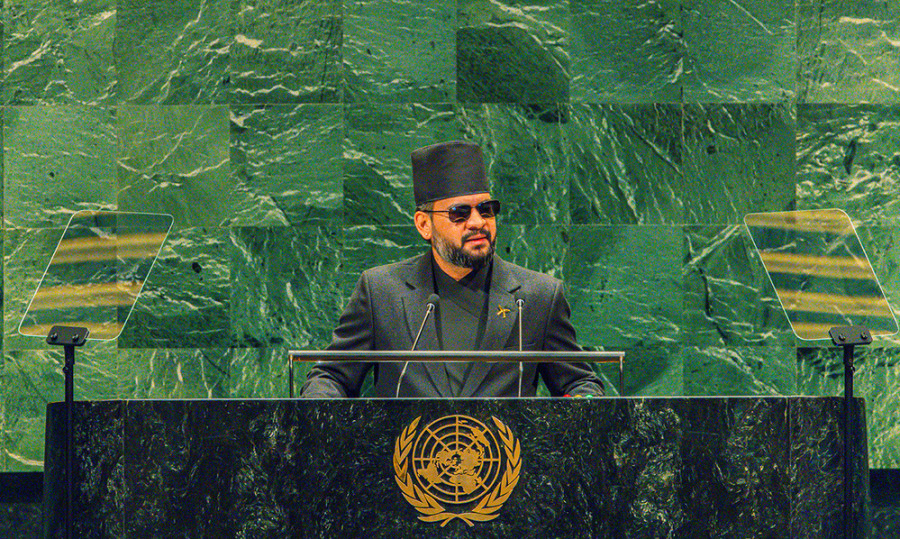
bookmark
Rupesh Shrestha
Published at : September 27, 2026
Updated at : September 29, 2026 13:18
“I come before you from Nepal—a distant country in the Himalayas—carrying a close warning for humanity.”
This is the very first sentence immediately following the general opening remarks in the speech delivered by Nepal’s Prime Minister Balendra Shah at the United Nations General Assembly. Had a conventional speech style been used, other sentences might have taken its place instead. For instance: “I am honoured to speak at the 81st General Assembly of the United Nations.” Or, “Thank you for the opportunity to speak on behalf of Nepal. Before I put forward my thoughts...”
However, Prime Minister Shah’s speech enters the subject directly. The opening sentence is used in a way that is more than sufficient to grab attention. It contains not just his identity—a ‘remote country of the Himalayas’—but also carries a ‘grave warning for humanity’ from this country to the world. In the science of rhetoric, this is called a ‘Hook’.
It is said that the beginning of public speaking must be powerful. When a speaker steps onto the stage for an address and fails to captivate the audience within the opening minutes, the likelihood of the speech being impactful decreases significantly. Due to factors such as numerous reference materials, a list of crucial topics that must be addressed, a parade of facts and figures, the protocol of the speaking venue, and the speaker’s own abilities and limitations, writing a speech runs the risk of becoming entirely formal. However, by properly recognising the audience's expectations and psychology, the human angle, and timing, speechwriting can be made impactful.
The following six sentences contain an account of the catastrophe in Bhotekoshi—not statistics of the disaster’s impact, but a human interpretation, a description of physical infrastructure damage, and even the waiting stories of affected families. And they highlight the paradox of countries like Nepal pursuing sustainable development. They make a direct attempt to reach the heartbeat of the listener. This also clarifies what subject the Prime Minister’s speech will focus on.
There are primarily three ways to begin a speech: through a story, a question, or statistics. A skilled writer, when drafting a speech, can bring all three styles together. For example, after these six sentences, the question was asked: Have we heard that warning?
Many media outlets around the world built their news stories by anchoring on this very question by Shah and raised the issue of the disaster experienced by Nepal. This is the characteristic of an effective speech: the audience’s attention goes precisely where the speaker intends it to go, namely, the rhetorical impact.
Let's talk about a few more stylistic elements. Earlier, I mentioned the effective stylistic use of presenting a subject from a human perspective rather than formality. Another sentence in the speech that many noted is—“We have built a world with flawless logistics for war and broken logistics for food.”
While presenting one’s arguments, if one can play with contrasts, the result is impactful. A single sentence portrays and compares pictures of two different worlds. In the English language, this sounds even more powerful. The media use such sentences as quotable. In speeches, such sentences are called ‘Power Phrases’. Some such sentences are timeless and are cited in books as important quotes of individuals, written on university walls, and jotted down by people in their diaries.
Some can easily mention systemic inequality or discrimination. Such vocabulary does not always carry the core essence and gravity of the subject. But the mentioned sentence and a few others bring jargon down to the level of experience and understanding, giving a broader meaning than conventional words.
An important difference between report writing and speech writing is that the most important statistics in a speech are used in such a way that the statistic itself presents an argument. Statistics like emitting less than 0.1 percent of carbon and having to bear 100 percent of the damage are arguments in themselves, as well as outrage and questions. Skilled writers do not use statistics in a speech to display the speaker’s intellectual capacity or study, nor to lecture the audience. Rather, if a single statistic can present the entire reality and argument all at once and provoke deep thought, why not include that statistic? That exact usage is present here.
In the speech, local issues of Nepal are elevated as global problems. And that is the reality. Saying, “We have built a world with flawless logistics for war and broken logistics for food,” puts forward the argument that this is not Nepal’s private misfortune. Then Shah followed the statement by, “Ask Bangladesh, ask Bhutan, ask India, ask Maldives, ask Pakistan. Ask any country in our region, and the same thing will be heard.”
Speeches sometimes become solipsistic—focusing only on one's own problems, lacking the energy or attention to check if others are facing the same. But an effective speech seeks a shared point of experience. A leader speaking on an international platform certainly does not have the luxury of narrowing down by talking only about themselves. By addressing neighbours and shared struggles, a local crisis was transformed into a human and global issue. Surely, the representatives and listeners of the named countries thought about this, didn't they?
Shah followed the statement, “I am told I am the youngest Head of Government to address this Assembly this year. I did not come here to make that the story.”
This is a clever trick. Shah mentions that he is addressing the General Assembly as the youngest head of government. Here was a place where it could have become self-centred. But by avoiding making it the main story, the focus is entirely shifted. This method is adopted to confirm that he has come to talk about issues rather than talking about the self.
Raising the aspirations of the new generation, the topic of generational transition in leadership in Nepal has been discussed. Explaining that this generational transition is not just a national story, but part of a global consciousness against conflict, inequality, and lack of opportunities, Nepal’s political transformation is globally energised. Yes, the story is the same, but why should that platform listen and accept it when telling this story on that stage? Such points provide the answer to that question. This style of making narratives universal increases the acceptability of the speech.
Speeches by leaders of countries like Nepal sometimes run the risk of becoming bundles of complaints. Moreover, in such times following a disaster, there is an equally high risk of turning into a plea for assistance. Conversely, solutions that only suggest technical remedies sound purely procedural. In Shah’s speech, a storytelling style has been adopted—character portrayal, building conflict, engaging the audience in the conflict, and leading them to a resolution. Systemic failure was shown as the cause of conflict, and the proposal of a ‘Himalayan Climate Resilience Mechanism’ was presented as a solution. This style is adopted to elevate the speaker above being a critic and problem-proposer to a leader with a vision.
There is another interesting usage in the speech. Former US President Barack Obama used a rhetoric instrument at The Democratic National Convention, 2004, to unite America’s diversity:
“There’s not a liberal America and a conservative America - there's the United States of America. There's not a black America and white America and Latino America and Asian America; there's the United States of America.
There is rhythm in these sentences; the sentence structures are similar, and they land in the same way. Obama is not the only one who used parallel sentence styles to explain what America is and isn't. Martin Luther King Jr.'s renowned ‘I Have a Dream’ has similar usage. Such usage is often interpreted as making that speech a poetic one. In the Nepali context, such excerpts are also found in speeches delivered by Madan Bhandari. Examples of his use of a style of shocking the audience’s mind by asking consecutive questions in the identical grammatical pattern can be found."
Now let's look at an excerpt from Prime Minister Balendra's speech:
Climate justice is, therefore, not only about money. It is about distributive justice - who bears the costs. It is about procedural justice - who has a voice. It is about whether the future of mountain communities, small island states, landlocked and least-developed countries, and generations yet unborn count equally.
Here, three sentences flow in the same style. This is called the ‘Rule of Three’. Furthermore, identical sentence structures are called ‘Parallel Phrasing’. Parallel phrasing does not have to be limited to three sentences. Consider this example:
Let us fund resilience, and invest in insurance and innovations.
Let us build strong infrastructure and institutions.
Let us reduce dependence on fossil fuels.
Let us prepare early-warning, awareness-raising, and life-saving systems.
Let us reform this system that makes the most vulnerable the most powerless.
And when the next warning comes from the roof of the world: let us be ready to listen, and ready to act.
Five sentences are in the same structure, and the sixth holds a stronger call.
There is another place where the Rule of Three is used. Six words starting with the English letter 'R' are divided into two parts and expressed this way:
“That is why this Assembly must note six words:
Relief. Rehabilitation. Reconstruction.
And also: Responsibility. Reparation. Resilience.
The first three are what we need after disaster.
The second three are what we need to ensure that disaster does not become a permanent condition.”
Interpreters of speechwriting craft believe that dividing anything into sets of three words or sentences helps the audience process it easily and makes it memorable. But rhythm is necessary in that. The rule of three extends to Eastern philosophy, from ‘Satyam, Shivam, Sundaram’ to Girija Prasad Koirala’s use of ‘Sahamati, Sahakarya ra Ekata’ (Consensus, Cooperation, and Unity). When words or phrases in such structures are spoken while maintaining that exact style, it gives the listener’s mind a sense of an orderly structure and complete mastery over the subject.
Speech is also called an art. Just as metaphors and similes are used alongside many other styles in other literary genres, metaphors and similes are also used in speeches. This transports the viewer and listener to the scene the speaker wants to show. Hearing about abstract policy concepts might not be interesting to the viewer-listener. But a domestic and touching example like “When a house is on fire, 50 forms are not made people fill out” cuts through institutional complexities and directly impacts the listener's mind. It explains procedural hassles in a single stroke, in a single sentence, in a single breath. And it sets up problems in large structures as a question. Perhaps the Prime Minister’s personality was also well considered while drafting the speech.
Who drafted the Prime Minister’s speech? One would wonder how this could be written, blending suggestions from various scholars with the Prime Minister’s personality. What if it turned out full of technicalities and statistics like Finance Minister Swarnim Wagle’s? Or would it just be limited to something like an election speech? However, because it closely matched the Shah’s own temperament, the speech turned out unconventional and impactful. Carrying a rapper background and the style of expressing certain topics directly and clearly on social media, the ‘Balen vibe’ is sustained in the speech.
The end of a speech must be strong. If a problem is raised at the beginning, showing how the solution is unfolding at the end and where the speaker stands in that process is most appropriate. This method is adopted in this speech—a ‘Call to Action’, an invitation for collective action. This sounds positive and shows the resolve to walk together once the identification of the problem and the path to a solution are seen. Besides this, another technique considered effective is suspense or a twist.
Finally, wishing that Pashupatinath bless the welfare of the world and that this world be able to walk on the path shown by the Buddha, non-Nepali speakers are given suspense and homework, while an attempt is made to connect Nepali speakers with the help of religion and history. An unexpected twist is created here, the meaning of which people have interpreted in various ways.
Rupesh Shrestha
Shrestha is news chief of Kantipur Television.





Most Read from Columns

Before you take credit for Khula Manch, read its history

Shah went to the UN to speak for Nepal, then left before he could make the most of it

Bhotekoshi flood wasn’t a freak event. It’s the Himalaya doing what it does

Lesson learned after the death of Ronaldo

Why passive neutrality won’t take Nepal anywhere
Editor's Picks

Dashain paints the country in festive colours

Buying a goat for Dashain? Look for the green mark

Explained: Why does an hour long flight to Dhangadhi cost more than a flight to New Delhi?
Bhotekoshi flood wasn’t a freak event. It’s the Himalaya doing what it does

How Tenzing Sherpa became Nepal’s breakout star at the Asian Games
E-PAPER | October 17, 2026

×