



 14.68°C Kathmandu

Mon, Oct 19, 2026
Columns
Are Nepali schools ready for the AI takeover?
From panicked teachers to copy-pasting students, artificial intelligence is rewriting the rules of education—leaving traditional pen-and-paper exams struggling to keep up.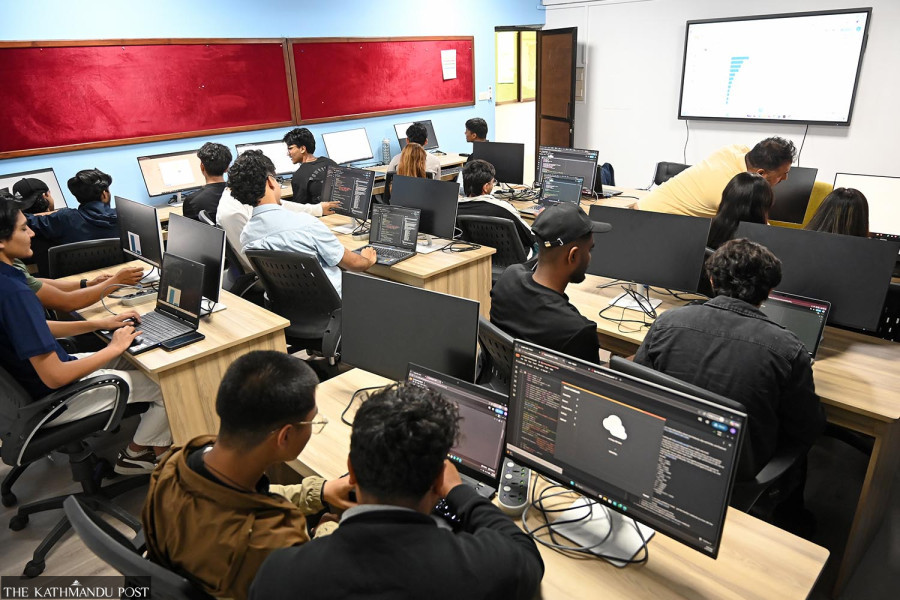
bookmark
Suresh Kandel
Published at : September 28, 2026
Updated at : September 28, 2026 13:13
Have you ever imagined a class run by robots, where artificial intelligence (AI) delivers teaching and learning? And if that day comes, how would anyone assess what is taught and what is learned?
My own question began when I caught a student relying entirely on ChatGPT to finish an assignment. Prompt engineering has reshaped the world, yet many schools, colleges and universities still hold firmly to pen and paper. Technology is neither a blessing nor a curse. What matters is how we use it, and increasingly it shapes how we live.
Among secondary school students, AI use is spreading fast. Very few remain outside its grip when an assignment is due. Young learners today have little appetite for sitting with a problem for an hour until it yields. I see their creativity thinning, and their patience with it.
Nepal’s National AI Policy 2025 marks a milestone. It opens the way for AI education in the school curriculum in the coming years. Meanwhile, AI has already moved beyond the brick-and-mortar classroom into the digital one. It is hard to find a student who has never used it or knows nothing about it.
I will concede that the use of AI has real merits. It sharpens students’ ability to search for information and gives them new ways to learn and present ideas. A short, clear answer arrives in seconds and spares them hours of reading through books. It can also shape its response as a chart, a figure or a graph, in whatever language the request was made.
The trouble begins with how it is used. AI answers what you ask. It has no sense of your level or how you learn. The most visible problem is copied assignments, but the deeper one is students trading their study time for screen time and ending up with almost nothing in their heads. Copying an answer without grasping a single line of the concept leaves a kind of brain fog, marked by weak focus, mental confusion and poor memory.
Classroom engagement has fallen sharply, since an answer is always a few seconds away. Students sit in the room but are absent from the lesson. The screen has cost their health as well. Few in my class arrive properly rested. Patience is shorter now, and I see more anxiety, sudden flares of temper, headaches and memory complaints. These are the young people who will one day lead the government and steer the economy, and they will do it with AI in hand.
Then comes the ethical dilemma. Which answer is the honest one: the one drawn from books and the student’s own language, or the one generated by AI, when the substance of both is much the same? The consequences surface quietly in the examination hall, where students who have only ever copied are left with nothing to write and fail.
The government has directed schools to use AI in teaching and learning through its AI policy, but it offers no clear plan for implementing it or for evaluating students. That gap at the centre widens as AI users multiply in every classroom. Parents cannot tell whether their children are on track. The assignments are complete, and attendance is regular, yet examination scores are poor. Some begin to wonder whether the teacher is teaching well at all.
Banning AI outright is no answer. Adapting to it sustainably is the way forward. Technology is advancing, and no one can be kept from it. Nepali students must also compete in a global market, and they will struggle if they are shut out from the growing use of AI. Humanity has travelled from hunting and gathering to a technology-driven world. The fear now is that AI will take their jobs, or that students will become dull if they cannot turn theory into practice by solving and finishing real problems themselves.
This is where government must lead. It has to search for new models of teaching and learning and steer students from dependence on AI toward creativity with it. China, now a new economic power, is pushing ahead with AI in its classrooms.
Consider what this could look like. A teacher explaining the map of Nepal could use AI images and videos to locate places interactively, mixing fun with information. Lessons like that stay with students far longer.
The current curriculum makes such teaching hard, because it rests on a system of vomiting back what was memorised. A student with a firm grasp of the subject who falls ill during exams and writes poorly will score low, and that score becomes the only measure of what he knows. In theory, we talk about many parameters and indicators. In practice, we are forced to judge one another by exam marks. The government must take leapfrog steps to change the curriculum and prepare students for change from the ground level up.
Change is inevitable. Human progress has always meant taking up new tools rather than avoiding them. The real risk is that students will fail to turn theoretical knowledge into practical skill. There is a quieter worry too. Young people are beginning to trust the prompt, and how they refine it is shaping their mindset.
The remedies are within reach. Teaching should be reformed around AI. Teachers need training in AI-friendly methods. Students should be set challenging tasks that build creativity, using AI to strengthen the skills they need to compete in the global workforce. And the rote-and-recall system has to give way through curriculum reform.
Growth balanced with limits creates no threat. The real question is whether we are ready for the change and willing to arrange the resources it demands. AI will shape ideas according to how we use it and what we gather from it. Used well, it could be the tool that lifts Nepal's classrooms out of boredom and into lively engagement.
Suresh Kandel
Kandel holds an MBA from Pokhara University and lectures on business.





Most Read from Columns

Before you take credit for Khula Manch, read its history
Shah went to the UN to speak for Nepal, then left before he could make the most of it
Bhotekoshi flood wasn’t a freak event. It’s the Himalaya doing what it does

Lesson learned after the death of Ronaldo
Why passive neutrality won’t take Nepal anywhere
Editor's Picks




E-PAPER | October 19, 2026

×