Flood damage to Nepal’s hydropower sector could run into billions
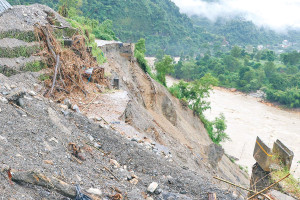
Preliminary estimates suggest the Bhotekoshi floods have caused extensive damage to hydropower projects and transmission infrastructure, while insurance coverage and reconstruction costs remain unclear. An electrical substation and transport vehicles are inundated with thick mud, silt, and debris following the Bhotekoshi flash flood. Photo Courtesy: Ministry of Energy
Nepal’s electricity authority says the devastating Bhotekoshi floods may have caused losses running into hundreds of billions of rupees across more than a dozen hydropower projects and electricity transmission infrastructure, far exceeding initial estimates by private sector developers.
The scale of the destruction has also raised urgent questions over how damaged projects will be rebuilt and who will bear the cost.
Rajan Dhakal, spokesperson for the Nepal Electricity Authority (NEA), said on Friday that the authority’s preliminary assessment pointed to losses worth hundreds of billions of rupees.
“For now, our priority is rescue operations, the search for missing people and restoring electricity supply,” Dhakal said. “There has been unimaginable loss of life and property. The Rasuwagadhi Hydropower Project has been completely washed away, while the Chilime project has been buried. Our preliminary estimate is that the damage runs into hundreds of billions of rupees.”
His estimate is substantially higher than that of the Independent Power Producers’ Association, Nepal (IPPAN), whose senior officials have put average losses in the sector at around Rs25 billion to Rs30 billion.
Uttam Bhlon Lama, senior vice-president of IPPAN, said older hydropower projects with ground-level powerhouses suffered extensive or complete damage.
“Newer projects with underground powerhouses and desanders have suffered comparatively less damage,” Lama said. “Overall, we estimate losses at around 25 to 30 percent of the total project cost, although a complete assessment is still pending.”
At least 13 hydropower projects, both operational and under construction, have been damaged in Rasuwa and Nuwakot districts.
Affected operational projects include the 20MW Langtang Khola project, which was in the testing phase, the 5MW Mailung Khola, 14.8MW Mailung Khola, a 25MW solar project operated by the NEA and its subsidiaries, the 14MW Devighat, 24MW Trishuli, 60MW Upper Trishuli A, 22MW Chilime and the 111MW Rasuwagadhi Hydropower Project.
Projects under construction that have been affected include the 37MW Upper Trishuli 3B, jointly owned by the NEA and Nepal Telecom, the privately developed 120MW Rasuwagadhi Bhotekoshi, the 6.42MW Upper Mailung A, the 216MW Upper Trishuli 1 and the 15.6MW Middle Trishuli Ganga project.
Insurance could play a crucial role in determining how quickly the projects are rebuilt.
While private hydropower projects are generally insured, government-owned infrastructure may not have comprehensive insurance coverage, according to industry experts.
Raju Raman Paudel, former executive director of the Nepal Insurance Authority, said insured projects should be able to claim compensation after losses are assessed.
“Once the damage is evaluated, insurance companies will make the payments,” he said. “But there are concerns that not all NEA projects are insured. That could create difficulties.”
Despite growing climate risks, many government-owned structures in Nepal remain uninsured, he said.
Sushil Dev Subedi, executive director of the Nepal Insurance Authority, said a detailed assessment of physical damage had yet to begin because rescue and relief operations remained the immediate priority.
“Once restoration work begins, insurance companies will start assessing the risks and losses, after which claims can be processed,” he said.
Some of the affected projects have investments from Nepali banks and multinational companies, he added, but all are insured through Nepali insurance companies. Licensed surveyors will assess the damage on behalf of insurers.
“It is rare for hydropower projects to be uninsured,” Subedi said. “All projects under construction are generally insured, but we cannot yet say with certainty whether every operational project has coverage. Everyone is still focused on rescue operations.”
He said insurance companies had the capacity to settle legitimate claims.
Mohan Kumar Dangi, president of IPPAN, said all private-sector hydropower projects had insurance coverage and developers expected to use insurance payouts to finance reconstruction.
“Some structures have been buried, and others may have been washed away,” he said. “The assessment will take some time.”
Projects with limited damage could be rebuilt relatively quickly, while severely damaged projects would take longer to restore, he said. IPPAN would also coordinate with the government on reconstruction.
Dangi said the damage was unlikely to create an immediate electricity shortage in Nepal because domestic generation currently exceeds national demand.
Flood shock hits stock market
The disaster has also rattled Nepal’s stock market, with hydropower and non-life insurance companies among the hardest hit.
Of the 13 sectoral indices traded on Wednesday, the hydropower index fell 2.84 percent and the non-life insurance index dropped 3.90 percent, reflecting investor concerns over the scale of losses and potential insurance liabilities.
On Thursday, while the benchmark Nepse index slipped by just 1.04 points, the hydropower sub-index fell by 19.48 points and the non-life insurance index dropped by 201.81 points.
Many of the companies whose share prices fell most sharply were hydropower projects located in Rasuwa and Nuwakot, the districts worst affected by the flooding.
Non-life insurers are particularly exposed because they provide coverage for damaged hydropower infrastructure. Investors fear that large insurance payouts could affect the companies’ profitability, brokers said.
The non-life insurance index fell by 404.05 points on Wednesday and another 201.81 points on Thursday. The hydropower index dropped 104.33 points on Wednesday and 19.78 points the following day, while the life insurance index fell by 175.13 points and 28.10 points respectively.
By contrast, the manufacturing and processing index rose by 41.44 points on Wednesday and 178.18 points on Thursday, as investors anticipated increased demand for construction materials during the reconstruction phase.
On Wednesday, shares in Rasuwagadhi Hydropower fell 15 percent, followed by Mailung Khola Hydropower at 14.99 percent, Trishuli Jal Vidyut at 12.95 percent, Upper Mailung Khola at 11.56 percent, Sanjen Jalvidyut at 11.18 percent and Chilime Hydropower at 10.12 percent.
Meanwhile, shares in Sarbottam Paints Industries rose 15 percent, Upper Hewakhola gained 10.43 percent and Kalinchok Hydropower increased 3.21 percent.
Broker Narendra Sijapati said the contrasting movements were a predictable response to the disaster.
“It is natural for the shares of hydropower companies operating in devastated areas to fall,” he said. “Non-life insurers also face major payouts. But reconstruction will eventually begin, and that will increase investment and demand.”
Construction-related companies moved in the opposite direction. Sarbottam Paints rose 15 percent, followed by Ghorahi Cement at 8.19 percent, Sonapur Minerals and Oil at 5.05 percent, Bhagawati Hydropower at 4.72 percent, Palpa Cement at 4.53 percent and Shivam Cement at 4.17 percent.
Sijapati said the decline in hydropower shares would not necessarily extend across the entire sector, as companies outside the disaster zone remained largely unaffected.
He added, however, that broader investor confidence remained fragile, partly because of government policies and uncertainty surrounding the economic impact of the disaster.
He recalled similar market behaviour after Nepal’s devastating earthquake, when shares of cement companies rose on expectations of increased reconstruction activity.
The life insurance sector could also face pressure because travel insurance is mandatory for pilgrims undertaking the Kailash Mansarovar pilgrimage and the disaster has resulted in significant loss of life, he said.




 15.68°C Kathmandu