Chepang children risk swollen rivers to get to school
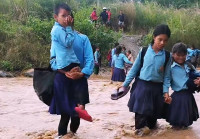
With no bridge over the Lothar Khola, students and residents of four wards in Makwanpur’s Raksirang rural municipality face dangerous crossings and months of disrupted transport every monsoon. Chepang students cross the swollen Lothar Khola on Thursday. Pratap Bista/TKP
The rain was pouring down as school let out at 4 pm on Thursday. As students prepared to head home, the Lothar Khola had swollen into a muddy torrent.
Chinimaya Chepang, an eighth-grader from Kharkhande in Ward 6 of Raksirang rural municipality, rolled up her trousers and stepped into the river. Other students followed. With the current running fast, older children carried younger ones across, some on their backs and others tucked under their arms.
Children from Kharkhande and the lower settlements of Silinge in Raksirang-6 attend Thakaltar Secondary School in Thakaltar, Ward 11 of Rapti municipality in neighbouring Chitwan district. Around 50 children from Kharkhande and nearby settlements study there, according to Singhlal Chepang, a former ward chair of Raksirang-6.
“During the monsoon, students risk their lives to get to Thakaltar for their education,” he said.
All the students who attend the school from these settlements belong to the Chepang community, one of Nepal’s historically marginalised Indigenous groups.
“This year, we have not heard of the Lothar Khola sweeping away any students. Otherwise, one or two children die after being swept away almost every year,” Singhlal said.
Two months ago, three students from Hetauda Sub-Metropolitan City-19 died after being swept away by the Basudev Khola. They were returning home from school when the river suddenly flooded.
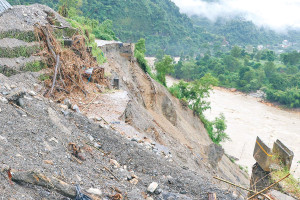
The Lothar is a steep stream between Thakaltar in Chitwan and Kharkhande in Raksirang-6. Its water level can rise suddenly, creating a powerful current. With no bridge, residents of wards 6, 7, 8 and 9 of Raksirang also struggle to cross it during the rainy season, said local resident Harkaram Chepang.
Motorcycle crossings cost Rs2,000
Saroj Chepang, from Kharkhande, paid Rs2,000 to have his motorcycle carried across the Lothar Khola while returning home from Hetauda. He crossed on foot as young men waiting by the riverbank carried his motorcycle to the other side.
Saroj was travelling by motorcycle from Hetauda through Chepang Marg in Bhandara, Chitwan. Reaching home required crossing the Lothar, but the swollen river was too dangerous to ride through. Dinesh Chepang, from Silinge in Raksirang-6, also paid Rs2,000 to have his motorcycle carried across.
During the monsoon, eight to 10 young men in the area make a living by ferrying motorcycles across the river, charging up to Rs2,000 per vehicle. Although they help motorcyclists for a fee, there is no one to help young children cross.
Without a bridge, residents of the four wards and students travelling to Thakaltar face the same ordeal every year. Vehicle traffic has been disrupted for the past two months, with larger vehicles unable to cross since the river flooded.
Residents of Raksirang’s wards 6, 7, 8 and 9 rely on the river crossing for daily travel and the transport of everything from construction materials to food. Agricultural produce from the villages also passes along this route to market. When the river rises during the monsoon, vehicles cannot cross. If the water becomes too high, students are unable to attend school.
Vehicles travelling from Bhandara in Chitwan serve settlements including Silinge, Damarang, Kharkhande and Siladhuni. But transport comes to a standstill during the rainy season because there is no bridge over the Lothar Khola.
“The lack of a permanent bridge over the Lothar also makes it difficult to take sick people to hospital by ambulance during the monsoon,” said Singh Bahadur, a former ward chair of Raksirang.
For residents of the four wards, where most people belong to the Chepang community, the bridge remains a pressing need. Rural municipality chair Raj Kumar Malla said the local government had repeatedly asked the provincial and federal governments to fund its construction, without success.
“The rural municipality does not have the budget to build such a large concrete bridge. But without one over the Lothar, residents face serious difficulties during the monsoon,” Malla said.
The rural municipality prepared a detailed project report for the bridge three years ago and sought funding from both levels of government. Neither allocated the money, leaving residents to cope with the annual disruption, said rural municipality vice-chair Banastam Thing.
The lack of a bridge also brings development work to a halt for months.
“Once June begins, development work stops in the four wards of Raksirang. Work resumes only after the river subsides, around November,” said Govinda Ram Chepang, a resident of Silinge, former Constituent Assembly member and president of the Nepal Chepang Association.
“People here have been struggling with the lack of a bridge over the Lothar for a long time. We have been pressing the authorities to build one, but our calls have gone unanswered,” he said.




 20.13°C Kathmandu