As Nepal announces schools for autistic children across all provinces, here’s what to heed
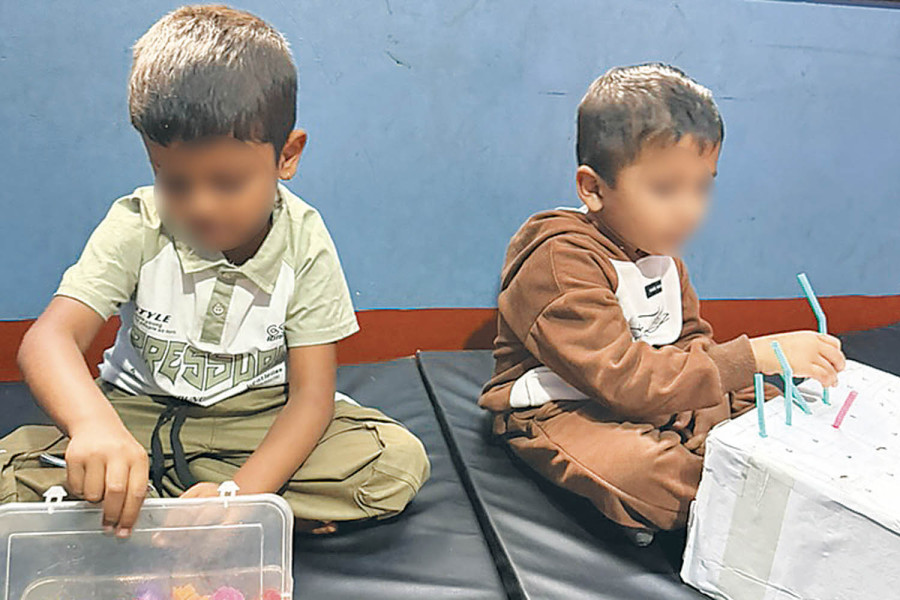
For fifteen years, a handful of schools have supported children with autism with little government help. Children busy with activities such as straw sorting and colour sorting. Photo: Courtesy of SSDRC
When Shekhar Dhakal’s daughter Pihu was two years old, she was diagnosed with autism. He enrolled her in a nearby school, but the staff struggled to manage her behaviour. She felt isolated. So Dhakal emptied the ground floor of his home in Banasthali and hired a teacher to teach her.
Within weeks, four or five other parents had knocked on his door, asking if their children could join. He said yes. But the setup quickly proved difficult—children began running out into the street, and a single teacher working out of the ground floor of a house was no longer enough. So in 2019, Dhakal and his wife formalised what had begun as a father’s desperation into Nepal Autism School — one of a small number of institutions that have spent years building what the state is now promising to create.
‘‘We don’t want any credit,’’ Dhakal said. ‘‘Our daughter is autistic, so we just didn’t want other parents to go through what we had to.’
On April 2, for the first time, the government announced it would build autism schools in all seven provinces. The people who have been doing this work for 15 years without state support say the plan is welcome—but incomplete.
On the occasion of World Autism Awareness Day this April, the Ministry of Education, Science and Technology, in coordination with the Ministry of Health and Population, announced plans to establish one autism-based model school in each of Nepal’s seven provinces. A technical committee has been formed to prepare a concept paper and operational framework. The Ministry of Education will run the schools, the Ministry of Health will provide clinical and therapeutic support, and the Ministry of Women, Children and Senior Citizens will coordinate with NGOs and service providers. It is one of the more significant government commitments to autism education in the country’s history.
The announcement follows years of groundwork by a small number of schools and practitioners who built what they could, when they could, with almost no state support. What they built and what they learned now offers a map of both what is possible and what the government’s plan will need to get right.
When Sabita Upreti founded the Special School for Disabled and Rehabilitation Centre (SSDRC) in 2010, she was turned away from every mainstream school she approached on behalf of children with disabilities. Schools feared that admitting such children would discourage neurotypical students from enrolling. Before starting SSDRC, Upreti had worked in physical rehabilitation, travelling on weekends to remote villages. In Bhaktapur, she encountered an eight-year-old boy locked alone in a room, eating dirty rice.
‘‘I couldn’t control my tears,’’ she recalled. ‘‘He is a child, but his whole life was confined to a room.’’
She left her job and used the money her family had saved for her wedding to start the school. ‘‘I didn’t have knowledge, and I barely had money,’’ she said. ‘‘I just had the desire to do something for these children.’’
Today, SSDRC supports 62 children with a staff of around 40 therapists, teachers and psychologists. Its grounds include outdoor play areas, gardens and therapy spaces. It trains teachers in 10 schools across Nepal.
‘‘At that time, even the government didn’t know the word ‘autism’,’’ Upreti said. ‘‘People thought it was a mental illness.’’
Nepal formally recognised autism as a neurological condition in 2017 — a shift that Upreti and others in the field had advocated for years. It helped reshape public understanding, though misconceptions persist.
‘‘When people meet one autistic child, they assume all autistic children are the same,’’ she said. ‘‘But it is a spectrum. Every child is different.’’
At Nepal Autism School in Banasthali, the methodology Dhakal and his wife developed did not come from a textbook. It came from their daughter, and from every child who came after her.
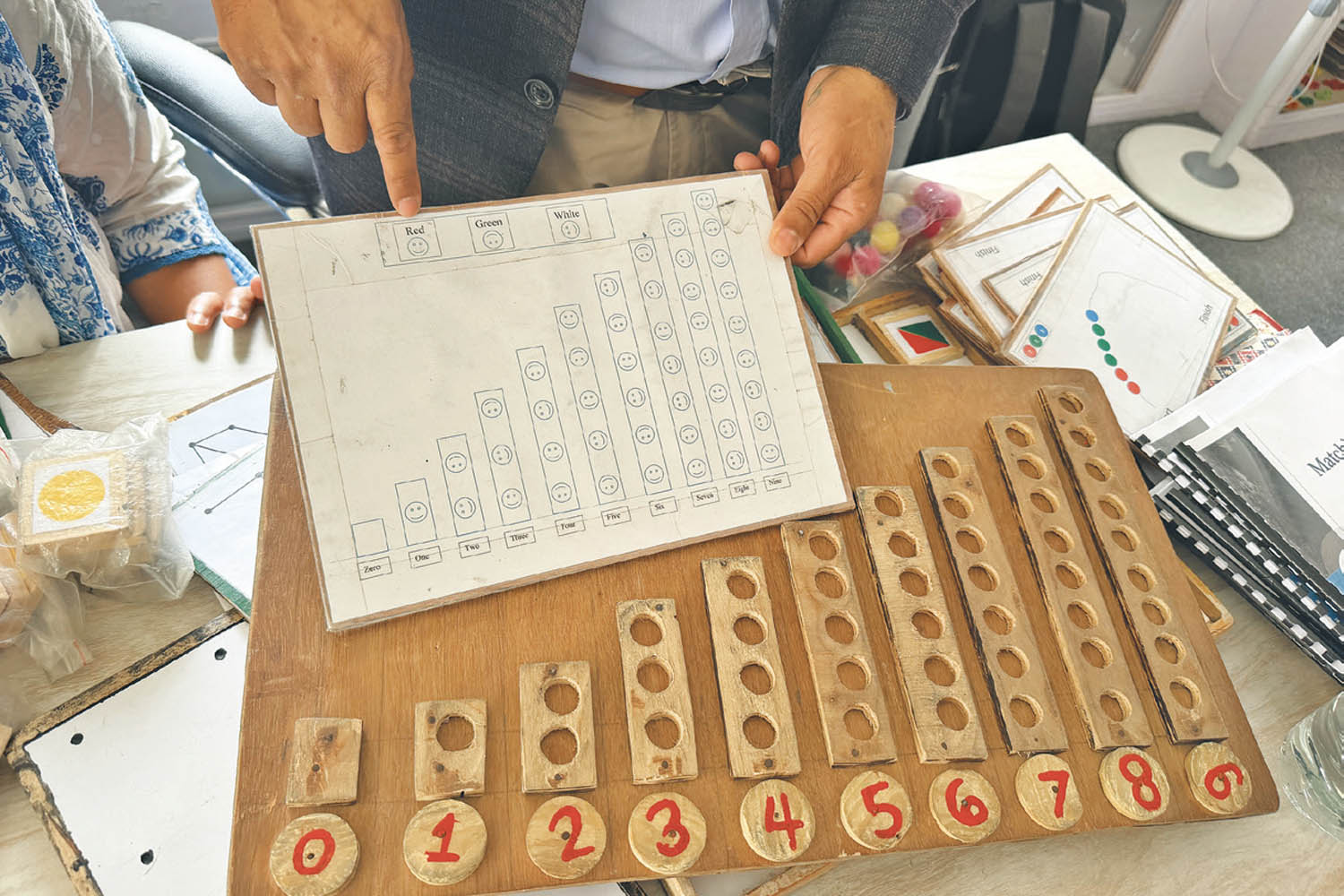
The school currently has 25 students between the ages of 3 and 12, supported by 10 teachers, with never more than 5 children per 2 teachers in any classroom. The school runs from 9am to 3pm, with 45-minute sessions, covering cognitive development, sensory integration, socialisation, language, and physical activity. The school teaches verbal and non-verbal children differently, with separate education models for each. For non-verbal students, learning happens through pictures, tracing, matching, and structured activities that build toward independence.
‘‘My daughter is non-verbal,’’ Dhakal said. ‘‘But from the materials we designed, she can do basic mathematics. She writes and understands without speaking.’’
The school’s approach to writing begins not with a pencil and paper but with sand — tracing patterns, then stencils, then freehand structure. Students progress through levels, with advancement only after they master the previous stage. Every three months, each child is evaluated across behavioural, sensory, functional, academic, and therapy dimensions.
The curriculum has drawn attention beyond Nepal. According to Dhakal, after collaborating with an organisation in Malaysia, the partner reported that 80 percent of their previously non-verbal students had begun to speak. Volunteers from the Netherlands have visited the school to study its methods.
But like SSDRC, Nepal Autism School has survived on the edge. For five years, it offered free education. The student count once exceeded 60. Then the financial strain became unsustainable, and Dhakal had to start charging fees. The number then dropped to 25.
‘‘I wonder where the other parents and children went,’’ he said, his voice quieter. ‘‘I wanted to help them. But I could not afford to look after all of them.’’
Those who had to leave did not move into a waiting system. For families in Kathmandu, there are options, albeit limited: other private centres, NGO support, and therapists charging by the session. For those outside the Valley, there is often nothing at all. They return to their districts, to government hospitals that lack materials, to private clinics they cannot afford, or simply to their homes.
Sanu Subedi did not know that her son Aarambha had autism for the first several years of his life. She knew he had Down syndrome — that diagnosis came when he was two. But something else was there too, something she could not name. He was nothing like the other children with Down syndrome she had met. They were typically affectionate and calm. Aarambha was relentless. He would run out of the house without looking back. He would refuse to come when called. He fought over small things, repeated the same few seconds of a song over and over, and could not be settled.
It was only three years ago, through a camp organised by the autism community in Dhangadhi, in Sudurpashchim Province, that a doctor confirmed what Subedi had begun to suspect. Aarambha had autism alongside his Down syndrome.
Subedi’s experience with her son reflects the risks psychologist Prisma Thapa cautions about. “Most brain development happens before the age of five,” Thapa said, who has worked with children with autism for 22 years and runs centres in eastern Nepal. “That is the best time to build communication and learning pathways.” When the diagnosis and support come early, children tend to make far greater progress than when intervention is delayed. For Aarambha, those early years passed without either.
A teacher explains how activities like coding help brain development. Photo: Courtesy of Shekhar Dhakal
In Dhangadhi, the National Autism Care Centre Society Nepal was not founded by a policy or a programme but by a group of parents like Subedi, who had travelled to Kathmandu to get their children diagnosed and, while there, found one another. Aarambha is now a student there. Subedi is its principal, a position she took partly to help cover costs. Her husband is a teacher. Between his work, her work, and Aarambha’s needs, the pressure is constant, but worth it.
Since enrolling, Aarambha has changed. Subedi said, ‘‘He is happy in the mornings, because he is going to school.’’
“Parents understood that autism does not mean total inability,’’ said Padam Mahar, an expert adviser who later joined the organisation. ‘‘It means some parts of development progress differently. And if children receive personalised support, they can make progress. Once the parents understood that, they started organising.’’
The organisation now supports 17 children — 13 boys and 4 girls — most of them from around Dhangadhi, who arrive each morning and return home in the evening, with transport provided by the school. The service is largely free. Funding comes from municipalities, short-term INGO grants, and the contributions from the few families who can afford to pay. About 60 percent of costs are covered. The rest is managed through appeals.
The shortage of trained professionals in Dhangadhi is acute. There is no permanent speech and language therapist, and no behavioural therapist available on staff. Three or four months ago, the organisation brought a behavioural therapist from Kathmandu for a day or two, hoping to transfer some skills to the special educators on site. ‘‘That helped somewhat,’’ Mahar said. ‘‘But it is far from sufficient.’’
When the government announced its plan for provincial autism schools, Subedi’s first thought was not relief. It was arithmetic. Aarambha turned 12 on April 29. At the centre where she works, there are children who are already 15 and 16, brought there by parents who had nowhere else to turn for years and found, at a minimum, a safe place for their child to spend the day.
‘‘If the government sets a strict age limit for these new schools, I worry our older children will be left out,’’ she said.
She is not opposed to the announcement. She welcomes it. But she wants the government to think beyond the model of a school with a fixed enrollment age and an academic curriculum. For children like Aarambha, and especially for those already in their mid-teens, the priority is not reading and writing. It is learning to use the toilet independently. To dress themselves. To move through the day without constant support.
‘‘The most important thing for them is activities of daily living,’’ she said. ‘‘If there is a daycare where they can learn these skills and be safe during the day, it would make life much easier for parents to work and live their lives.’’
Across the country, Thapa sees the same pattern, the toll the condition takes on parents. One family she met in Kathmandu was spending Rs80,000 a month on therapy. Another sold their home, relocated to the capital for a year, saw insufficient progress, and returned. ‘‘All the services are centralised,’’ Thapa said. ‘‘People need to come from very rural parts of Nepal. It is a kind of tragedy.’’
She has tried to address that by keeping fees at her outreach centres between Rs5,000 and Rs10,000 a month, so families do not need to make that journey. But she is only one person.
‘‘In autism, the best therapist is the parent,’’ Thapa said. ‘‘Because they spend the most time with the child. If parents are skilled, they can help their children in the bedroom and in the market. The child is learning everywhere—not just in a closed therapy room.’’
She has seen marriages buckle under the financial and emotional weight of caregiving, some ending entirely. She has also seen what the other side of that journey can look like. A boy she began supporting at the age of 11 now lives with her, works at her centres, and is completing his bachelor’s degree in social work. He is 19.
‘‘Every year, we send many children to mainstream schools,’’ she said. ‘‘Parents are so happy when that happens.’’
The April announcement on provincial model schools follows a September 2025 submission by the Autism Directive Taskforce of a draft National Autism Guideline to the Ministry of Health, aimed at standardising care, education, and rights for people with autism spectrum disorder. The proposed Education Bill, for the first time, includes explicit provisions for special and inclusive education, with autism-specific needs addressed directly. Officials have pledged to revise examinations and classroom practices and to incorporate inclusive education into the 16th periodic plan.
In Koshi Province, a disability survey in Jhapa district has already identified 381 persons with autism, with plans to bring them into health and education services and expand rehabilitation programmes to more districts. Several municipalities are already providing free therapy to children with autism.
The Ministry of Education’s information officer, Madhu Acharya, confirmed that a technical committee’s report has not yet been submitted. ‘‘After it is submitted to the minister, it will be made public,’’ he said. Questions about the teacher arrangement, curriculum, timelines, and where trained staff will come from cannot yet be answered, he said, because those will be determined by the committee’s recommendations. Coordination will most likely be given to the Centre for Education and Human Resource Development (CEHRD), once the report is approved.
When asked whether existing autism schools had been consulted in designing the framework, Acharya said: ‘‘There is no need to consult right now. First, the committee’s report must come.’’
That approach concerns those who have spent years in the field. Kamal Prasad Pokharel, a disability inclusion expert, said the separate-school model technically contradicts Nepal’s commitments under the UN Convention on the Rights of Persons with Disabilities. At the same time, he acknowledged the government’s dilemma.
‘‘Even with a policy of inclusion, there are severe cases that require individual attention,’’ Pokharel said. ‘‘The state also has to consider its capacity. Currently, very few people are trained. The government might fear that if they disperse these children into mainstream schools, the right level of support won’t be provided.’’
Nepal’s formal position, he noted, is still one of commitment to mainstreaming. ‘‘I don’t think Nepal is generally trying to build more special schools,’’ he said. ‘‘But autism is currently being treated as a special case.’’
Where he sees the deeper failure is in the implementation of existing laws. The Rights of Persons with Disabilities Act requires schools to accept children regardless of their disability. Many still do not. ‘‘There is a lack of awareness and a failure to take responsibility for the Act,’’ Pokharel said. ‘‘Schools have limited capacity — they lack budget, staff, and resources. The essence that ‘all children can learn’ has not been communicated well to the public.’’
That answer concerns Mahar in Dhangadhi. ‘‘This idea did not emerge from deep consultation with real affected people,’’ he said. ‘‘It appears to be a hypothetical idea that came from a few individuals.’’
His concern is structural. The global direction, he said, is toward inclusive education — integrating children with disabilities into mainstream settings with appropriate support, not concentrating them in separate facilities. Separate schools may be administratively easier to report on — seven schools, hundreds of children — but, he argues, the longer-term cost of exclusion is greater than the cost of inclusion.
‘‘These children already face challenges in socialisation,’’ he said. ‘‘If we place them in segregated settings, they will never get the opportunity to socialise naturally.’’
He would have preferred a different model — resource centres, where children spend most of their time in regular schools and access specialist support as needed, rather than being removed from the mainstream entirely. ‘‘Even one such centre per municipality might have been possible within the same budget,’’ he said. ‘‘But that requires step-by-step development.’’
Thapa shares the concern about scale, if not the same structural objection. ‘‘One school per province may not be sufficient,’’ she said. What she is watching for is whether these schools will have trained teachers, appropriate infrastructure and the resources to actually function. That has been the gap between policy and reality in Nepal before.
Upreti, for her part, believes dedicated autism schools are necessary — inclusion programmes in mainstream settings alone will not serve every child. ‘‘Whoever fits in the mainstream can be there,’’ she said. ‘‘But those who don’t, they need a school made for their kind of disability.”
For Subedi, the structural debate is somewhat secondary to an immediate, practical fear. The children already in her school, some of them teenagers, did not get there through a smooth system. They got there because there was nowhere else. If the new provincial schools arrive with strict age criteria and a focus on early academic intervention, she wonders what becomes of them.
‘‘There are many children who are already 15 or 16,’’ she said. ‘‘Parents bring them as there is nowhere else to keep them. If the government sets strict criteria, I wonder what will happen if there is an age bar.’’
What every voice agrees on is that the government is finally paying attention — and that what it does next determines whether this moment becomes a turning point or just another announcement.
Dhakal says he did not choose to open a school. He opened it because there was no alternative for his daughter. He does not want the next generation of parents to face the same scenario.
Aarya Chand is a reporter at The Kathmandu Post covering social issues. Before moving to the social beat, Chand was an intern covering culture and lifestyle for the Post.




 14.1°C Kathmandu