Cost of Supreme Court verdict on Lumbini: Rs70 billion investment, 10,000 jobs
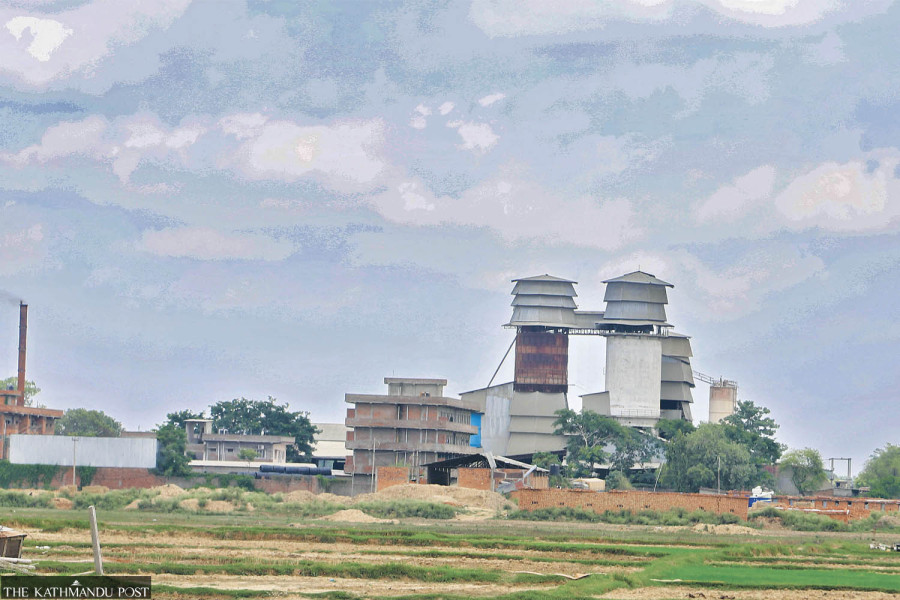
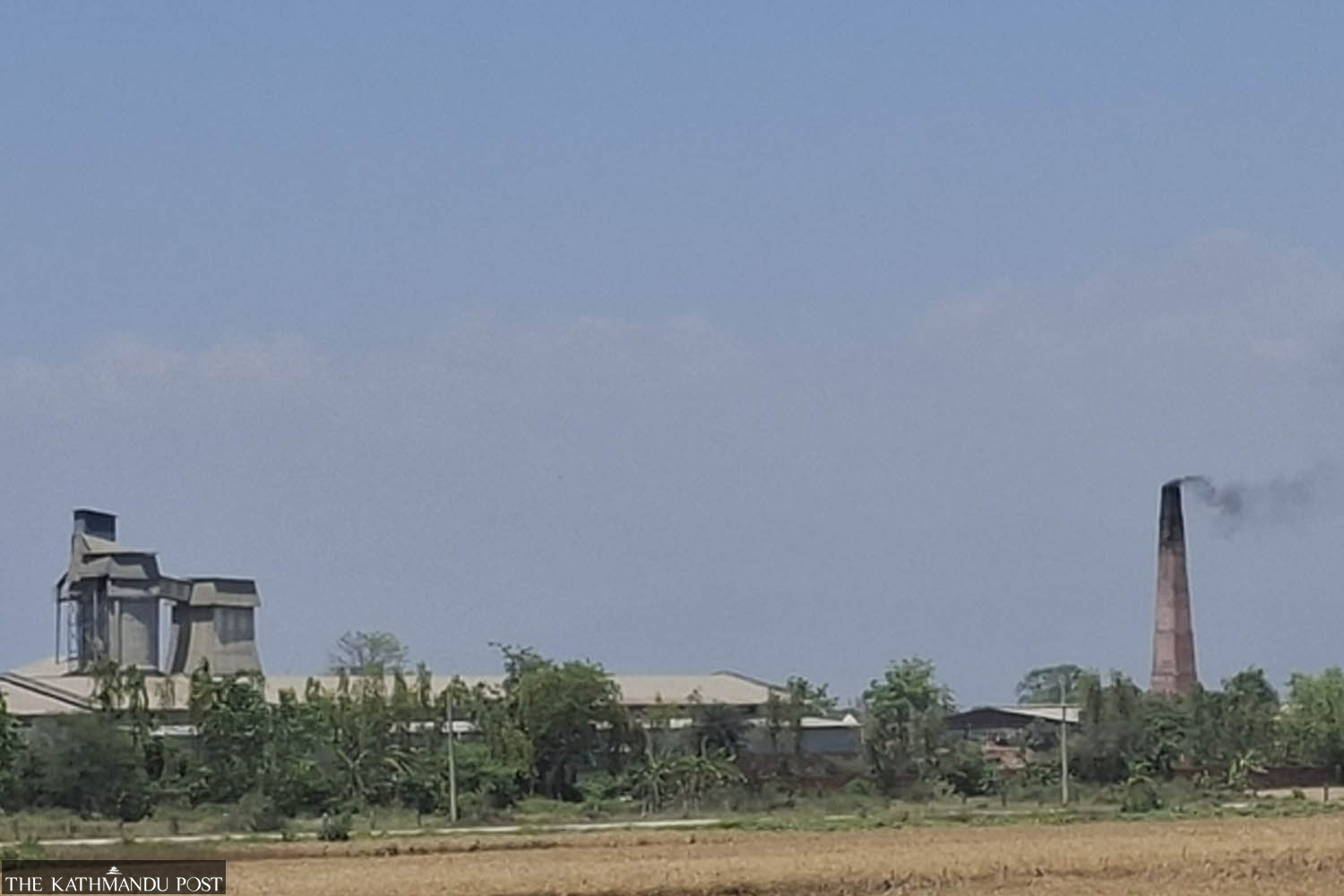
Environmentalists contend the polluting factories in question are a big threat to the historical legacy of the Buddha’s birthplace. A cement plant in Bhagawanpur, Rupandehi. Pollution from factories in the Lumbini industrial corridor impact Lumbini, a UNESCO heritage site. Manoj Paudel/TKP
The Supreme Court has paved the way for the demolition of industries and manufacturing plants situated within a 15-kilometre radius of Lumbini. The apex court stated that activities endangering the existence of the Buddha’s birthplace—a globally revered UNESCO World Heritage site—under the guise of economic development are unacceptable.
Following the release of the full text of the verdict last Tuesday, initially issued on August 27 last year, questions have emerged over its implementation. Furthermore, this landmark judicial decision has instilled anxiety among investors, workers, and industrialists operating within the designated corridor.
The legal proceedings were initiated in 2019 when senior advocate Prakash Mani Sharma filed a writ petition, arguing that the haphazard construction and unregulated proliferation of industrial structures were having detrimental, irreversible impact on the archaeological integrity and spiritual sanctity of Lumbini.
Currently, the Lumbini industrial corridor—spanning a 20 square kilometre area from Bethari to Sundi in Mayadevi Rural Municipality—hosts 40 heavy and medium-scale industrial firms including 11 cement factories. According to the Siddhartha Chamber of Commerce and Industry in Bhairahawa, these operational enterprises represent an approximate capital investment of Rs70 billion, providing direct employment to at least 10,000 individuals. Industrialists are concerned that a strict implementation of the Supreme Court’s ruling will devastate their businesses and shatter the local economy.
Lumbini is a major tourist destination in Nepal. In the last fiscal year of 2024-25, a total of 1,462,000 Nepali people, 570,000 Indians and more than 252,000 tourists from other countries visited Lumbini.
The environmental degradation first gained prominent international attention in 2014, during an international Buddhist conference held in Lumbini. Delegates from 32 nations actively participated, ultimately issuing a declaration that called for immediate, sweeping interventions to halt the industrial pollution afflicting Lumbini’s heritage.
According to Gyanin Rai, a senior director of the Lumbini Development Trust, the trust formally addressed this escalating crisis in February, 2011. A formal correspondence was dispatched to the United Nations Environment Programme headquarters in Nairobi, Kenya, detailing the pollution’s severe effects on the archaeological monuments. Subsequently, representatives from the United Nations Environment Programme regional office in Bangkok, Thailand, travelled to Lumbini to conduct an in-depth environmental assessment.
A division bench of Justices Kumar Regmi and Sunil Kumar Pokharel issued a four-point mandamus, highlighting the importance of conserving the environmental and archaeological sanctity of the Lumbini area. The full text explicitly addresses industrial firms that are already registered within the 15-kilometre radius but have not yet commenced operations. These entities are now mandated to install necessary, state-of-the-art pollution control mechanisms, strictly adhering to designated environmental parameters and conditions, prior to initiating any industrial activities.
“It is evident that the prior decisions requiring non-compliant industries to relocate within a stipulated timeframe were not implemented; hence, strict enforcement is now a must,” reads the full text. The verdict further issues a writ of certiorari, nullifying all administrative activities, correspondences, and decisions made by the Department of Industries, federal, provincial, and local governments that contravened the Industrial Promotion Board’s initial protective measures introduced in November 2009.
The industrial firms established in this corridor have a history of three to four decades. Just 25 kilometres away from the Nepal-India border, the corridor offered highly accessible infrastructure, prompting the government to readily issue operational permits. Over time, taking advantage of the geographical proximity to India and logistical ease, industrialists continually injected fresh capital to expand their manufacturing capacities.
The industrial corridor lies in Mayadevi Rural Municipality. Dhruba Narayan Chaudhary, chairman of the local unit, confirmed that the municipality currently hosts nine large cement factories, alongside various food, plywood, yarn, and refinery units, predominantly situated across wards 3, 4, 5, 6, 7 and 8.
“As we live in close proximity to Lumbini, we naturally want Buddha’s birthplace to stay pristine and unaffected,” said Chaudhary. “On the other hand, it is also our firm stance that massive industrial investments should not be allowed to be jeopardised, and local people must not lose their jobs.”
"If the industries must be dismantled, countless locals will be unemployed. Therefore, the federal government must take the responsibility of safely and systematically relocating these industries to secure alternative zones,” he said.
The Supreme Court’s ruling extends beyond the physical presence of the factories. The transportation of raw materials and the subsequent distribution of manufactured cement necessitate the heavy utilisation of local road networks by massive trucks, greatly altering the region's physical character.
“As a single truck is permitted to carry only 19 tonnes of load, the transport of raw materials and finished goods alone demands between 83,500 and 167,000 truck trips annually,” reads the ruling. “This comes to a daily movement of approximately 225 to 450 heavy trucks plying this specific road section. The continuous transit of such a high volume of heavily laden vehicles creates immense traffic management difficulties and has caused complete structural damage to the local roads.” Furthermore, the verdict highlighted that incessant vehicular movement generates massive quantities of dust and thick smoke, degrading the local air quality.
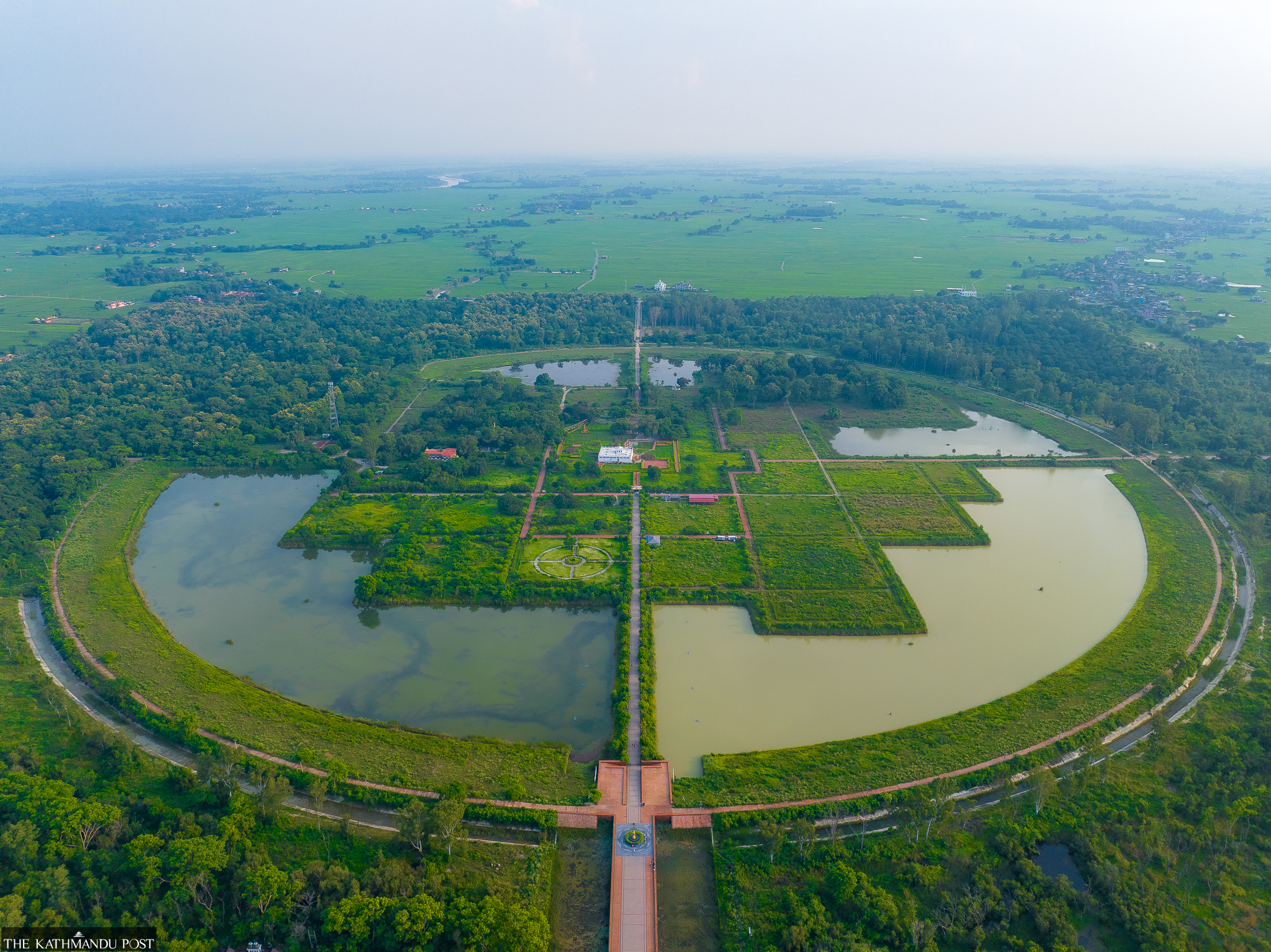
An aerial view of the Lumbini sacred garden with the Mayadevi Temple (white structure) at the centre, surrounded by a circumambulation path. Post file photo
“While the global community recognises Nepal as the birthplace of Gautam Buddha, a World Heritage site like Lumbini is not solely the property of Nepal and the Nepali people; rather it stands as a shared heritage of the entire human civilisation. Consequently, the global community retains an equal interest and responsibility in its preservation,” the full text elaborated.
“Actions that jeopardise the very existence of a World Heritage site in the name of industrial development cannot be accepted. Such monuments present living, tangible evidence of our history, culture, civilisation, and identity, serving as the foundational bridge connecting future generations with their past.”
Krishna Prasad Sharma, the outgoing president of the Federation of Nepalese Chambers of Commerce and Industry in Lumbini Province, remarked that despite the court’s definitive order, the process of industrial relocation is yet to commence.
“There has been absolutely no dialogue or strategic planning on how these massive industries can be practically removed,” said Sharma. He cautioned that a blanket ban on all carbon-emitting industries could inadvertently plunge the newly developing hospitality sector into a deep crisis.
According to Sharma, the corridor now accommodates half a dozen standard hotels, including a premium five-star property. He added that many industries have already installed pollution mitigation technologies following initial public outcry.
Senior industrialist Rajesh Kumar Agrawal suggested that the government should establish a clear transition timeframe, allowing older industries the opportunity to upgrade their pollution control mechanisms. “Pollution control standards must be strictly enforced. Removals should only target those industries that fail to comply with these benchmarks,” said Agrawal. He added that since the physical relocation of heavy industries is virtually impossible, the only remaining alternative for enforcement is permanent closure.
Recognising the escalating risks associated with the Lumbini corridor, many industrialists have proactively begun diverting their new capital investments to the alternative Bhairahawa-Parasi corridor.
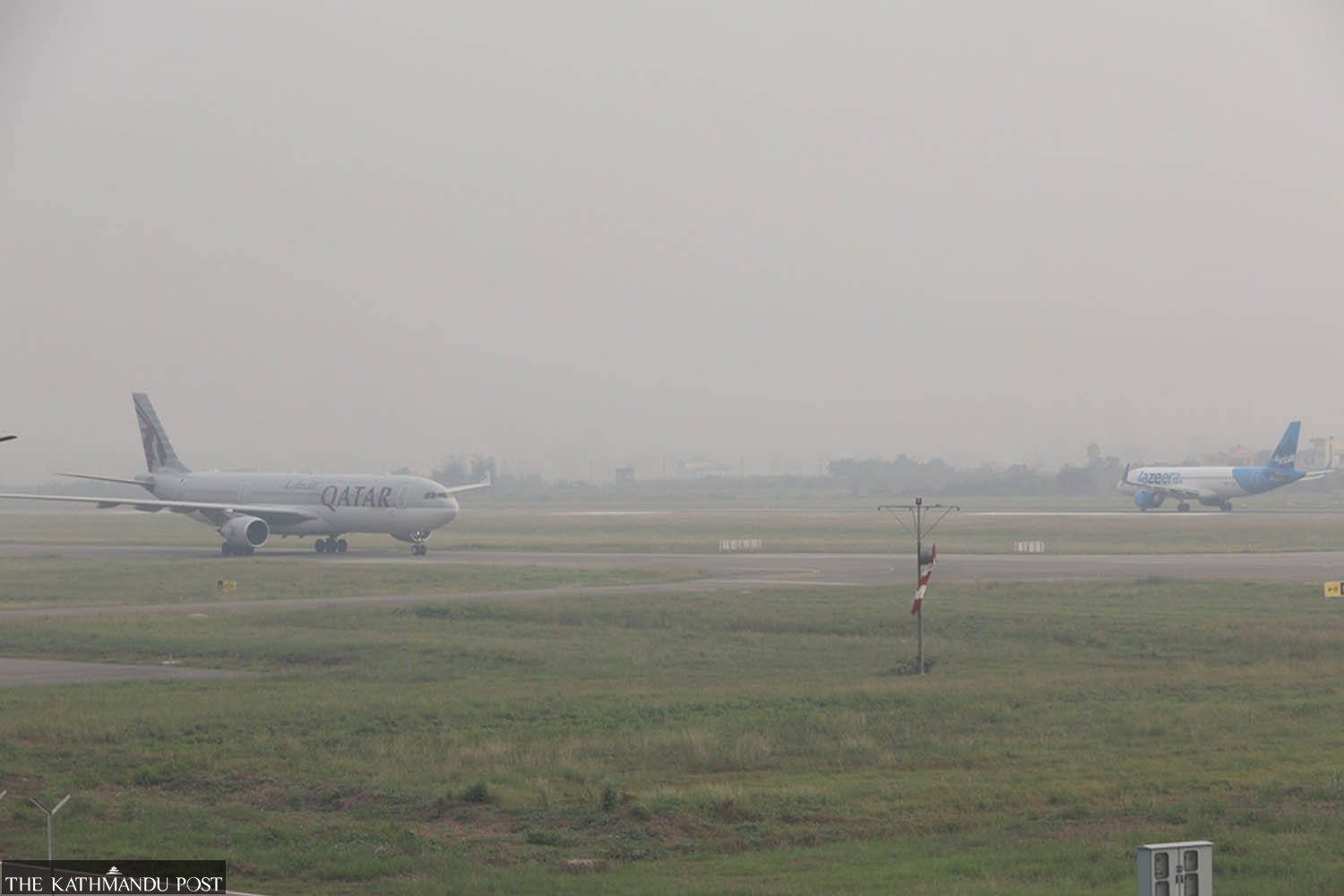
Thick haze blankets Gautam Buddha International Airport, blunting visibility. Post file photo
The brick manufacturing sector faces particularly acute vulnerabilities. According to the Federation of Nepal Brick Industries, 20 brick kilns currently operate in the vicinity of Lumbini. Ajay Kumar Gupta, the federation’s central co-treasurer, said that each factory employs between 300 and 400 workers. “If such sweeping decisions are executed without careful deliberation, investors will be ruined,” said Gupta.
Thakur Prasad Shrestha, President of the FNCCI Lumbini Province, urged the federal government to proceed with utmost sensitivity when enforcing the court’s mandate. He insisted that the administration must listen to the grievances and operational realities of the business community, rather than executing the judicial directive blindly.
“Lumbini is unequivocally our national jewel. However, aggressively displacing industrialists and businesspersons is not a constructive approach,” said Shrestha. He further said banking sector investments tied to these industries will also be hit, inevitably affecting the national economy. If relocation is absolutely unavoidable, he argued, it must be preceded by comprehensive financial compensation.
But environmentalists argue that the factories in question have pushed Lumbini’s historical legacy to the brink. In 2015, the Ministry of Science, Technology, and Environment conducted a study on Lumbini’s environmental conditions. The research determined that the toxic smoke emitted by the surrounding industries had severely affected the local air quality, accelerating the degradation of the historical monuments. “Scientific studies have already proven that industrial pollution has inflicted tangible damage on the archaeological treasures of Lumbini,” said Rai.
Smoke rises from chimneys of cement and brick factories in Motipur, Rupandehi, near Lumbini, as industrial emissions add to worsening air pollution in the area. Post file photo
Following the initial filing of the writ petition at the Supreme Court, a dedicated technical committee was formed in 2020. The Ministry of Forests and Environment appointed Joint Secretary Yagyanath Dahal to lead the on-site investigation into the operational status of the corridor's industries.
The committee meticulously measured the air pollution levels generated by the 11 cement factories, two steel plants, plywood manufacturers, refineries, and brick kilns. It concluded that the industrial emissions near the Lumbini area severely violated the permissible national standards.
The team evaluated the geographical distance of the factories from the Lumbini protected area, testing the air quality, and measured the total suspended particulates as mandated by the Government of Nepal. Furthermore, the committee inspected the solid waste management, conducted water quality tests, and measured the industrial noise pollution levels.
Senior archaeologist Basanta Bidari warns that escalating pollution and accumulation of hazardous particulates are doing grave damage to the heritage site. He asserts that the Ashoka Pillar, considered the most significant monument within the complex, is becoming increasingly fragile due to these pollutants.
Bidari referenced a pivotal study conducted in 2013, during which UNESCO consultant and stone conservation expert Constantino Meucci performed a microscopic analysis of the pillar. The findings revealed that the exterior of the monument was being corroded by sulphur and pollutants derived from industrial smoke and dust. “The level of pollution has doubled since that study was conducted. Its impact on heritage structures is greater still,” said Bidari.




 14.69°C Kathmandu