Five bridges along Bheri Corridor left incomplete for seven years
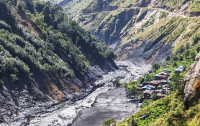
The delay along the Jajarkot-Dolpa road continues to disrupt transport, inflate prices and force travellers to risk dangerous river crossings during the monsoon. Bheri corridor is considered strategically important for linking remote mountain districts with markets in southern Nepal and the Chinese border. Post Photo
Even seven years after the track was opened, vital segments of the strategically significant Bheri Corridor remain incomplete. The failure to construct five crucial motorable bridges has severed direct connectivity, and continues to leave thousands of commuters stranded between Jajarkot and Dolpa.
The Caravan/Hirachan JV signed a contract in January 2021, to build bridges over the Nalgad and Jhirme streams in Nalgad Municipality, Jajarkot. At the same time, Rayamajhi/Caravan JV secured contracts to construct bridges over the Tatra, Maide and Tasu streams. The five bridges, together worth Rs184.3 million, have already received three deadline extensions, but construction remains unfinished as of now.
The delays have caused severe hardship for people travelling on the Jajarkot-Dolpa road, particularly during the rainy season when vehicles frequently become stranded in the streams and muddy crossings.
“Five bridges within a single municipality have been left abandoned,” said Dambar Bahadur Rawat, mayor of Nalgad Municipality. “Vehicles somehow operate during winter, but transport is disrupted every monsoon. Passengers are often forced to push stranded vehicles out of the streams.”
According to Rawat, passengers must repeatedly get on and off vehicles at river crossings where bridges are missing. Goods are carried across suspension bridges and reloaded onto waiting vehicles on the other side, increasing both costs and delays.
The Nepali Army opened a track along 113 kilometres of the 118-kilometre Jajarkot-Dolpa road section in October 2019, allowing vehicles to begin operating on the Bheri Corridor. But locals say the absence of bridges has prevented the road from becoming a reliable all-weather route.
“We have waited years believing the bridges would finally be completed, but there is still no certainty,” said local resident Dayaram Khadka. “If the bridges were built, vehicles could operate throughout the year and travel would become much easier.” He said passengers travelling from Nepalgunj to Dunai, the district headquarters of Dolpa, still face expensive fares, repeated transfers and damaged goods because transporters cannot operate direct services during the monsoon.
Kaman Khadka, another local, said travellers are paying up to Rs5,000 to cover the 272-kilometre journey between Nepalgunj and Dunai. “Transport operators charge arbitrary fares because there are no bridges,” he said. “People also have to pay extra money to porters who carry goods across rivers.”
Children, elderly people, patients and women face the greatest hardship, locals say, as they are often forced to walk across rivers or muddy stretches before boarding another vehicle.
According to the Bheri Corridor Project Office, physical progress on the five bridges ranges from only 20 percent to 50 percent. Project chief Naresh Prasad Keshari said authorities are preparing to hand over construction of three bridges to another contractor while Caravan will continue work on the remaining two.
The office has also secured funding approval for 14 additional bridges along the corridor, including crossings at Phulbarikhola, Chisapani, Khaharekhola, Ghattekhola, Manakakhola, Rijigar, Usumkhola, Kapargad, Khadang and Galligad.
Problems linked to unfinished bridges are also affecting the Karnali Corridor, the 269-kilometre road connecting Humla district to the Chinese border at Hilsa. Although Humla was connected to the national road network in July 2025 after a Bailey bridge was installed at Chuwakhola, several bridge projects along the corridor remain incomplete.
Under the Khulalu-Sallisalla section, nine bridges are still under construction while six others have yet to begin. Bridges at Bhukkakhola, Serukhola, Bandukhola, Tusarekhola, Paimakhola and Makaikhola remain unfinished.
On the Hilsa-Simkot section, work on bridges at Sallisalla, Chuwakhola and Gothikhola has stalled. Officials say contract management for two of the bridges has already been completed in the current fiscal year.
Locals in Humla say the lack of bridges continues to make travel exhausting and unreliable. “Passengers still have to get down and push vehicles when they get stuck in rivers,” said Kamal Rokaya. “Even today, the journey from Simkot to Surkhet takes two full days because of the poor road condition.”
Mohan Rokaya of Simkot Rural Municipality said transport services are routinely disrupted during the monsoon. “When rivers swell, vehicles stop operating altogether,” he said. “We are still forced to walk across rivers and change vehicles repeatedly just to complete a journey.”
The corridor is considered strategically important for linking remote mountain districts with markets in southern Nepal and the Chinese border.




 15.26°C Kathmandu