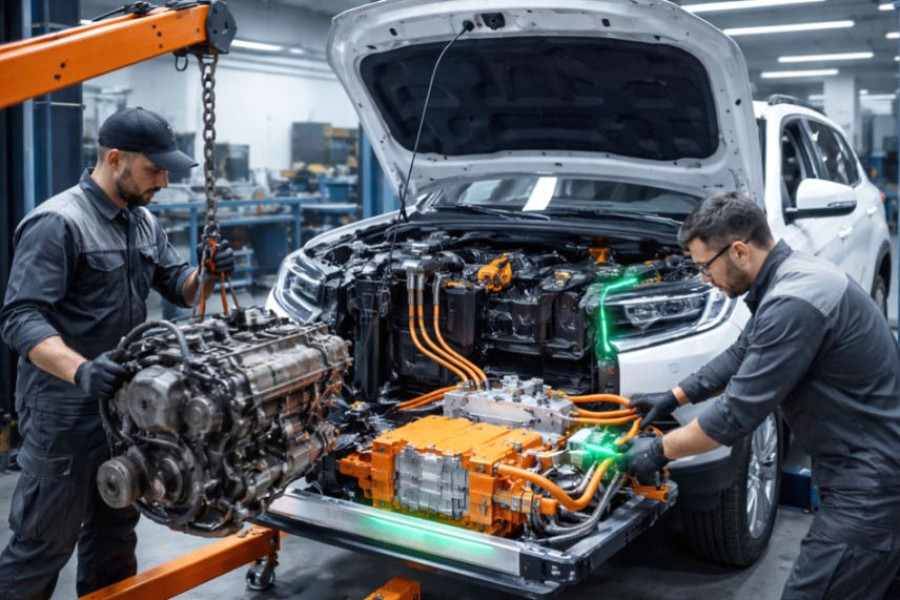
For years, Nepal has spoken about converting petrol and diesel vehicles into electric ones. In practice, nothing has moved.
The issue resurfaced after a recent Cabinet meeting chaired by Prime Minister Balendra Shah decided to make legal arrangements to enable vehicle conversion. But officials and industry say the problem is not policy intent. It is execution.
Nepal already has provisions that allow vehicles to be modified into cleaner, energy-efficient alternatives. These provisions have been repeated in policy announcements and government notices over the years. Yet, implementation has remained effectively zero.
In December 2025, the Ministry of Physical Infrastructure and Transport issued a notice granting a three-year exemption for vehicles modified for environmental or energy efficiency purposes. The notice was based on the Vehicle and Transport Management Act, 1993.
Earlier, in March 2022, the government formally adopted a policy to convert fossil fuel vehicles into electric ones. The fiscal policy for the 2023-24 budget also promised to promote such conversions.
Despite this, no functioning system has been put in place.
Some private companies, encouraged by these announcements, have already converted vehicles. But these vehicles cannot be registered or operated. They remain parked in workshops, unusable.
Transport offices have refused to process them, saying there are no defined standards. There are no clear rules on how converted vehicles should be registered, how number plates should be issued, or how ownership documents should be updated after conversion.
Existing law also complicates matters. It restricts modifications to vehicles, including engine changes, unless specifically approved. While the law allows such changes in principle, the absence of procedures has created a regulatory vacuum.
Industry players say the government’s announcements have raised expectations but delivered nothing.
Abhishek Karki, chief executive of a company involved in vehicle retrofitting, said previous government notices had also failed to translate into implementation due to the lack of operational guidelines.
His company has converted tractors and utility vehicles into electric versions. None of them can be used on the road.
Karki said the government must define standards covering business registration, certification of conversion companies, import of conversion kits, and post-conversion documentation.
Without real-world deployment, he said, there is no way to assess whether the technology is commercially viable or technically reliable.
Academic institutions have also shown that conversion is feasible.
At Kathmandu University, researchers have successfully converted vehicles, including a Maruti 800, and have even tested hydrogen-powered models. These projects have been developed and validated within controlled environments.
But they too remain limited to testing grounds.
Government officials acknowledge the gap.
Krishna Raj Pantha, joint secretary at the Ministry of Physical Infrastructure and Transport, said legal barriers have largely been removed. The focus now is on drafting the necessary standards and procedures.
He said discussions are ongoing with private sector stakeholders to move the process forward.
Globally, vehicle conversion is already regulated.
India has amended its motor vehicle rules to allow approved electric conversion kits. The United Kingdom requires converted vehicles to undergo inspection and certification. France has also introduced a legal framework governing retrofitting.
Nepal, by contrast, remains stuck between policy announcements and actual enforcement.
For now, the country’s push to convert its existing vehicle fleet into electric remains on paper.




 18.6°C Kathmandu