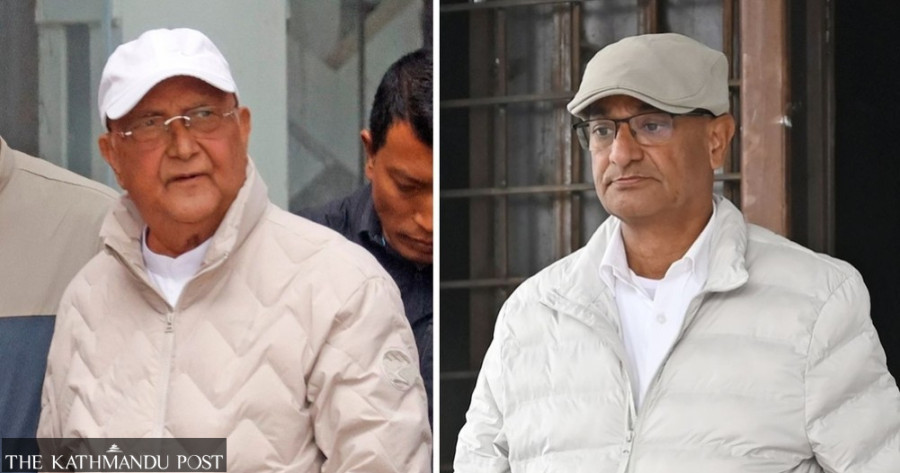
The Supreme Court has directed the government not to extend the custody of former prime minister KP Sharma Oli and former home minister Ramesh Lekhak, who were arrested on March 28 for alleged negligence that led to the deaths of protesters during the Gen Z uprising last September.
Passing a single verdict on separate writ petitions filed by the families of two leaders, the bench has asked relevant authorities to complete all investigations against them within the deadline for the third extension of the remand. The Kathmandu District Court on Sunday extended their remand until Wednesday. Oli is the chair of the CPN-UML, while Lekhak is a Congress leader.
The division bench of Justices Binod Sharma and Sunil Kumar Pokharel said that if the investigation is completed within the period allowed by the Kathmandu District Court and a decision is made on whether to file charges, further proceedings should follow accordingly. “If that is not possible within the given time, Oli and Lekhak should be released from custody immediately after the expiry of the third remand period, after completing necessary legal procedures, while allowing investigators to continue further inquiry as required,” the order states.
Rejecting the petitioners’ claim that their detention was unlawful, the court held that the arrest process and subsequent extensions of remand were legally valid. Thus, it refused to release them immediately as the petitions demanded. The court cited humanitarian and exceptional circumstances, stating that the two did not need to remain in custody during the investigation.
In directing their release, the court cited that they are currently observing mourning rituals following the recent deaths in their families. It also noted that Oli is seriously ill and undergoing treatment at the Tribhuvan University Teaching Hospital.
Oli and Lekhak were arrested as per the recommendation of the high-level inquiry commission, chaired by former justice Gauri Bahadur Karki.
The Karki commission’s report recommended that both Oli and Lekhak—then prime minister and home minister—be investigated under Sections 181 and 182 of the National Criminal Act, which deal with negligent and reckless homicide. The commission concluded that the loss of lives was a direct result of extreme negligence and a failure of command responsibility during the suppression of the protests.
Even though the report has been leaked and widely covered in the media, the government has yet to make it public. The erstwhile Sushila Karki government had announced to release the report, but never did. The incumbent Balendra Shah government has followed suit.
The first Cabinet meeting of the Shah government on March 27 passed a resolution to implement the Karki commission’s recommendations, specifically targeting the political and administrative figures while temporarily excluding security personnel from the initial crackdown. Together with Oli and Lekhak, the Karki commission recommended prosecuting Chandra Kuber Khapung, then inspector general of the Nepal Police, for similar charges of negligence.
Furthermore, it identified several other high-ranking officials for investigation into criminal negligence, including then home secretary Gokarna Mani Duwadee, Armed Police Force inspector general Raju Aryal, then National Investigation Department chief Hutraj Thapa, and then chief district officer of Kathmandu Chhabilal Rijal. However, except for Rijal, all others were spared from arrest. Rijal was released on bail the day he was arrested.
Oli and Lekhak’s lawyers had cited Rijal’s release as grounds for seeking their release.
“The order to open fire was given by the chief district officer, not by the former prime minister or the former home minister,” said Ramesh Badal, former attorney general. “The person who actually has the authority to order firing has been released on bail, but those who have no role have been held illegally.” Their lawyers had also claimed that different commissions were formed after the first and second people’s movements, but the prime ministers and home ministers of that time were never arrested.
Binod Ghimire covers parliamentary affairs and human rights for The Kathmandu Post. Since joining the Post in 2010, he has reported primarily on social issues, focusing on education and transitional justice.




 20.28°C Kathmandu