A case has been filed against 32 individuals in connection with a fake rescue scam, while charges against Rajendra Bahadur Singh, former vice-president of the Airlines Operators Association, have been dropped.
The Central Investigation Bureau of Nepal Police had recommended prosecuting 33 individuals, submitting a 1,243-page report to the government attorney’s office. However, the case filed at the Kathmandu District Court does not include Rajendra Bahadur Singh. Investigating officers have expressed dissatisfaction after the government attorney’s office decided not to proceed against him.
The charge sheet states that there is no evidence so far to establish Singh’s involvement in the crime or that he received any financial benefit. However, the CIB report had included audio recordings of conversations between Singh, also managing director of Mountain Helicopters Pvt. Ltd, and Shyam Sundar Kandel, who was arrested during the investigation, suggesting attempts to influence the probe.
According to the report, the conversations included instructions to avoid using the term “rescue” in data requested by the Civil Aviation Authority of Nepal and to instead classify all such flights as chartered operations. “This clearly indicates an intention to deliberately mislead the investigation by providing false data or withholding information,” the CIB report states.
The report also says Singh claimed he had already spoken with the director general of the Civil Aviation Authority of Nepal and reached an understanding to state that no rescue data existed. Singh had previously served as a member of a government-formed committee tasked with recommending reforms in the civil aviation sector.
An officer involved in the investigation said Singh had advised some of those earlier arrested on how to conceal evidence related to the fake rescue operations. “We had submitted audio recordings showing how he instructed others to hide evidence,” the officer said.
Although Singh has not been charged, Sandip Bhandari, assistant manager in the sales and marketing department of Mountain Helicopters, has been named as a defendant. The charge sheet accuses Bhandari of forging passenger and cargo manifests to falsely indicate that foreign tourists arriving in Kathmandu on chartered flights were part of rescue operations.
“These forged documents were then provided to Bivek Pandey of Mountain Rescue Service,” the charge sheet states.
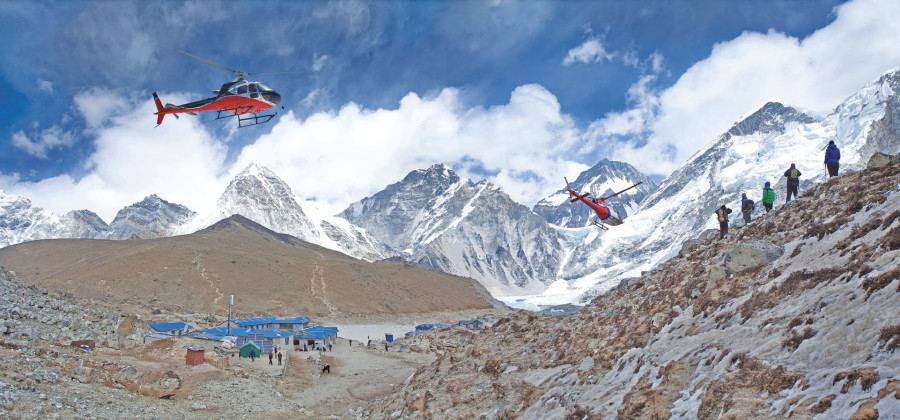
The police investigation indicates collusion among three helicopter companies, three hospitals, more than a dozen trekking companies, insurance agents and trekking guides to fraudulently claim insurance payouts through staged rescue operations involving foreign climbers and trekkers.
The helicopter companies implicated include Mountain Helicopters, Manang Air (now Basecamp Helicopter), and Altitude Air. They are accused of carrying out so-called rescue operations for tourists with minor health issues under false pretences.
Those charged include Pasang Dawa Tamang, station manager of Altitude Air; Prakash Babu Dahal, a junior marketing staff member at Manang Air; Chandra Prasad Pyakurel, also known as Sudeep, marketing manager of Altitude Air; and Sandip Bhandari of Mountain Helicopters.
Hospital operators and doctors have also been charged for allegedly fabricating treatment records. Those named include Dr Minlama Pandey of Swacon International Hospital; Dr Shyam Sundar Kandel; Shreeram KC; Dr Girban Raj Timilsina of Shreedhi International Hospital; former operator of Era International Hospital, Ganesh Silwal; current operator Jeevan Pandey; Bhanu Dhakal; Furba Chhiring Sherpa; Mamita Bhatta; and Chungla Bhutiya Sherpa.
Police had earlier arrested several individuals, including Muktiram Pandey, chairman of Everest Experience and Assistance; Subash KC, a shareholder; Bivek Pandey, manager of Mountain Rescue Service; Jayaram Rimal, chairman of the same rescue company and a shareholder of Swacon Hospital; Rabindra Adhikari, chairman of Nepal Chartered Service; and Dr Girban Raj Timilsina of Shreedhi Hospital.
Others arrested include Sandip Tiwari of Royal Holidays Adventure; Pasang Sherpa, a shareholder of Panorama Himalayan Trekking and Expedition; and Bivek Thapaliya of Nepal Chartered Service. The remaining suspects are listed as absconding.
Other defendants include Sandip Dhungana of Himalayan Masters Adventure and Travel; Shanta Kumar Baniya, director of Magic Himal Treks and Expedition and Heli On Call; Binod Sapkota, operations head and executive director of Nepal Trek Adventure and Expedition; and trekking guide Tenzing Sherpa of Himalaya Trekking and Expedition.
Also charged are Badri Lamsal and Kabindra Lamsal of Spiritual Excursion; Bishnu Prasad Lamsal of Nepal Hiking Adventure Company; Kumar Bhandari of Nepal Rescue and Assistance; Santosh Adhikari, also known as Khomraj Adhikari, a former shareholder of Nepal Chartered Service and operator of Flying Yak Kathmandu; and Ram Kumar Phuyal of WorldMed Assistance Nepal.
Deepak Kumar Shrestha, information officer at the Kathmandu District Court, said the case has been filed against 32 individuals on charges of offences against the state and organised crime. “Nine of the accused have been arrested, while others have been listed as absconding,” he said.
Investigators also uncovered communications suggesting that rescued trekkers were “enjoying chilled beer,” raising doubts over the legitimacy of the rescues. Notes written by Shanta Baniya further supported allegations that both rescues and medical treatments were fabricated.
The investigation also found messages sent to hospital doctors, including Timilsina, asking them to provide commissions to trekking companies. “Documents show that even patients transported on the same flight were issued separate bills to falsely present multiple rescues,” a CIB officer said. “These documents show inflated costs and unlawful financial gains.”
A statement from Ashok Adhikari, operator of Base Camp Trip, cited in the charge sheet, gives an example of how hospital documents were allegedly falsified. According to him, a tourist named Chandrawati was rescued from Tilicho Base Camp by Heli Everest and flown to Kathmandu. He said that although he suggested transferring the patient elsewhere, doctors insisted treatment could be handled at Era International Hospital. “Later, the hospital would take the patient to Grande City Hospital in Jamal during the day and bring her back to Era International Hospital at night,” Adhikari said. “The final bill was inflated to $3,945, far above the actual cost.”
The CIB also recovered a screenshot showing a commission payment made to Adhikari by Rabindra Adhikari of Nepal Chartered Service. Messages were also found asking him to arrange tourists in the Everest region.
The fake rescue scam first came to light in 2018. The Ministry of Culture, Tourism and Civil Aviation formed an investigation committee led by Joint Secretary Ghanshyam Upadhyaya, which recommended action under organised crime and fraud laws. Although the recommendation was forwarded to the Home Ministry and then to the police, the investigation did not progress at the time. It was only seven years later that police formally launched a probe into fraudulent rescue flights targeting trekkers and climbers.
CIB chief AIG Manoj KC said the investigation revealed multiple irregularities, including rescues conducted outside permitted areas, use of forged documents, and billing multiple rescues from a single flight. Insurance companies had also raised concerns, sending emails questioning the claims.
The Upadhyaya-led committee said that it had received many complaints that dishonest operators served adulterated food to tourists to make them sick, so they could be evacuated by helicopter and commissions collected from helicopter companies and hospitals.
The CIB recently reopened a long-running probe into a fake rescue and insurance fraud network involving helicopter companies, hospitals, trekking agencies and guides. Investigators say the scheme centred on staging or inflating emergency helicopter evacuations of trekkers in the Himalayas and turning them into fraudulent insurance claims, often supported by forged manifests, medical records and multiple billing for a single flight.
Police say the practice, first flagged in 2018 and investigated again between 2022 and 2025, has continued despite earlier government reforms meant to tighten oversight. Recent arrests and case filings allege coordinated fraud involving multiple companies, with claims totalling more than $19.6 million. Officials say fake rescues were often recorded as multiple operations or combined with fabricated hospital treatment to inflate payouts.
Authorities say the scam has damaged Nepal’s tourism reputation internationally and involved a wider network of intermediaries, including tour operators and insurance-linked service providers.




 22.6°C Kathmandu