



 13.58°C Kathmandu

Thu, Oct 22, 2026
Money
Seven years on, fake rescue racket still flies in Nepal’s Himalayas
Police reopened old case files and arrested six top executives of helicopter rescue and trekking companies this week.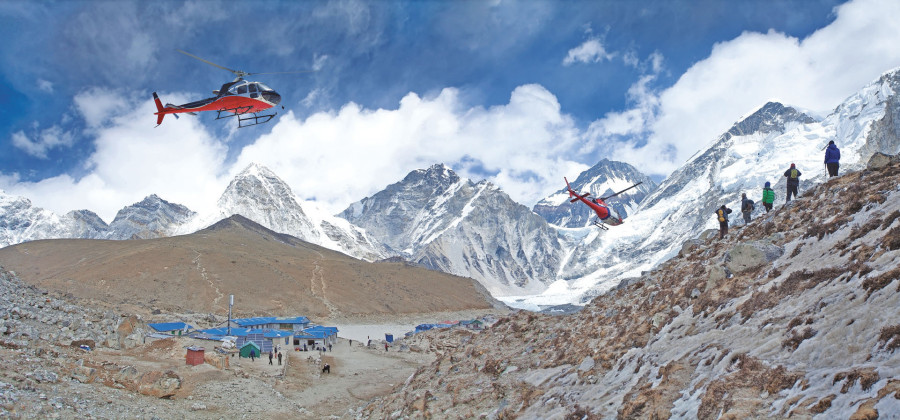
bookmark
Sangam Prasain
Published at : January 27, 2026
Updated at : January 27, 2026 06:37
Kathmandu
In 2018, the government claimed it had eliminated all “intermediaries” involved in arranging emergency evacuation services for trekkers and mountaineers, and made tour operators legally responsible for their clients from the start to the end of a trip.
The move followed revelations of large-scale insurance fraud that badly tarnished Nepal’s image as a tourist destination. Under the revised arrangement, helicopter companies, travel and tour operators, hospitals and insurance firms were required to submit details of rescue flights, medical treatment and insurance bills to the Tourist Search and Rescue Committee, the Tourist Police and the Department of Tourism.
Seven years later, however, a special unit of Nepal Police says the multi-million-dollar insurance fraud—commonly referred to as the fake rescue scam—has not stopped. Instead, it has grown.
Police have now reopened old files related to the insurance fraud.
“The scam continued due to lax punitive action,” said Manoj Kumar KC, chief of the Central Investigation Bureau (CIB), the police’s specialised unit for organised crime.
“When there is no action against crime, it flourishes. The insurance scam too flourished as a result,” KC said. He is an additional inspector general (AIG) and has taken charge of the high-profile case.
On Sunday, the CIB arrested six people: Jayaram Rimal and Bibek Pandey of Mountain Rescue Service Pvt. Ltd.; Rabindra Adhikari and Bibek Raj Thapaliya of Nepal Charter Service Pvt Ltd; and Mukti Pandey and Subhash KC of Everest Experience and Assistance Pvt Ltd.
All of them served as directors or senior managers of their respective companies and were allegedly involved in producing fake insurance documents to make fraudulent claims.
“This is just the beginning of the action,” KC said. Sunday’s arrests are based on investigations conducted by the CIB between mid-2022 and 2025.
The development underscores that despite the government’s claims following the 2018 probe committee report into the multi-million-dollar insurance fraud, the practice never truly stopped.
KC said crime thrives when strong action is not taken. “This insurance scam kept growing as there was no legal action even though there was a strong report on it,” he said.
Police estimate that various travel and rescue companies defrauded international insurance firms of more than $19.65 million during the two-and-a-half-year period under investigation.
According to police, Mountain Rescue Service conducted 171 fake rescues out of 1,248 charter flights, claiming around $10.31 million from insurers. Nepal Charter Service carried out 75 fake rescues out of 471 such flights, claiming about $8.2 million.
Everest Experience and Assistance was linked to 71 suspicious rescues out of 601 flights, with insurance claims totalling $11.04 million.
In one instance, police say a helicopter charter rescued four tourists on the same flight, on the same date, using the same helicopter and manifest. However, insurance claims were submitted using multiple invoices, falsely showing the rescues as separate flights. The total claim amounted to $31,100 for the rescue, along with a separate hospital bill of $11,890.
“We have hard evidence of the companies and individuals involved in the fake rescue scam. All of them will be prosecuted, but it will take time,” KC said. “We estimate that many companies identified by past probe committees and those currently under investigation by the CIB are still active.”
The fake rescue operation, investigators say, is a well-established nexus involving trekking guides, trekking agencies, helicopter rescue companies, tour operators and hospitals.
“They colluded. They prepared forged and manipulated documents, including passenger and cargo manifests, fabricated or altered invoices, and falsely claimed that rescues had been conducted,” the CIB said in a statement.
“They also prepared documents showing that rescued foreign tourists were mandatorily treated in hospitals in Kathmandu, as required by insurance policy conditions. These documents included hospital bills, admission and discharge summaries, and medical reports that were either fabricated or manipulated.”
An official from a UK-based insurance company told the Post that most tourists later said they did not even stay in hospital for an hour.
“All of it begins with the tour or trekking guide,” the official said. “The guide convinces foreign trekkers that if they pretend to be sick, a helicopter will rescue them. Exhausted after returning from Everest base camp and unwilling to walk further, trekkers often give consent.”
“The guide gets a commission—a certain percentage—for arranging this,” the official added.
Investigators say rescue companies reclassified charter flights as emergency evacuations and paid commissions through intermediaries.
During trekking and mountaineering activities in Nepal’s high Himalayan regions, certain individuals were found to have illegally obtained financial benefits by falsely claiming insurance payouts after showing that foreign tourists with minor health problems had been rescued.
Even in situations where tourists had genuine accidents, health complications or faced natural disasters that required legitimate rescue operations, companies operating rescue helicopters—Mountain Rescue Pvt. Ltd., Everest Experience and Assistance Pvt. Ltd., and Nepal Charter Service Pvt. Ltd.—were found to have misused the system.
On July 30, 2018, a government fact-finding committee submitted a 700-page report to the late tourism minister Rabindra Adhikari. The report stated that unscrupulous operators had pocketed thousands of dollars from insurance companies by making multiple claims for a single helicopter ride or putting pressure on trekkers to agree to airlifts for minor illnesses.
The committee investigated 10 helicopter companies, six hospitals and 36 travel, trekking and rescue agencies following complaints from tourism entrepreneurs. It recommended further investigation into the companies involved.
The report advised the government to probe transactions of eight agencies—Kailash Charter Rescue, Alpine Rescue, Mountain Heli Charter Service, Eagle Heli Charter Service, Easy Heli Charter Service, Flight Connection Domestic, Mountain Rescue Service and Himalayan Social Journey Trekking—all of which provided chartered helicopter services for trekking and rescue operations.
Four Kathmandu-based hospitals—Swacon International Hospital, Era Health Centre, CIWEC Hospital and Vayodha Hospital—and three helicopter companies—Heli Everest, Manang Air and Air Dynasty Heli Services—were also scrutinised for quoting “exorbitant rates” and making claims against tourist insurance policies.
The committee said it had received many complaints that dishonest operators served adulterated food to tourists to make them sick, so they could be evacuated by helicopter and commissions collected from helicopter companies and hospitals.
In one case cited in the report, a local agent billed an insurance company 50,000 euros ($57,972) for evacuating a group of trekkers.
In another instance, a local agent issued two separate bills for a single rescue, billing the insurance company 86,248 euros, along with an additional $24,000 for minor hospital treatment.
Due to the fake rescue scam, foreign insurance companies and international tourism organisations circulated information portraying Nepal negatively, including describing it as a “no-go destination for tourists,” police said.
International agencies also published reports and statements with headlines such as “A scam on the roof of the world.”
“These developments harmed Nepal’s national image, dignity, sovereignty, independence and international reputation,” police said. “As such acts fall under offences detrimental to national interests under Section 51 of the National Penal Code, 2017, legal action has been initiated.”
In 2019, following completion of its probe, the tourism ministry helped the CIB to investigate Traveller Assist and its operator, Danny Kaine.
The Kathmandu Post had earlier published a long investigative report showing how Traveller Assist threatened the government through emails, claiming it would stop tourists from travelling to Nepal if the fake rescue scam was not abolished. The investigation also found that Traveller Assist simultaneously wrote to helicopter and rescue agencies, urging them to sign up for its services.
While Kaine communicated with Nepal government officials, he was also corresponding with private helicopter companies, trying to persuade them to join Traveller Assist.
During a 2019 press conference organised by the Helicopter Society of Nepal, an umbrella body of private helicopter companies, representatives of 10 companies said they had received emails from Kaine.
In one email sent on July 15, 2018, to FCI Heli Charter Service, Kaine claimed the Nepal government was working with Traveller Assist to finalise standard rescue charges and suggested it could recommend FCI as a preferred network provider.
Kaine allegedly misled companies and threatened them to join Traveller Assist or face government action. Traveller Assist also falsely claimed it represented two dozen global insurance companies.
Of the 14 insurance groups Kaine claimed as clients, 13 denied any association with Traveller Assist in separate emails to the Post.
CIB chief KC said that based on the investigation, Traveller Assist and Kaine no longer operate in Nepal.
“But we are keeping an eye on it,” he said.
A CIB spokesperson confirmed to the Post in February 2019 that Kaine was under investigation and that data—including financial records from hospitals and rescue agencies—was being collected.
However, Kaine fled Nepal after learning he was under investigation.
Tourism Minister Rabindra Adhikari, along with six others, died in a helicopter crash while returning from Pathibhara Devi Temple in Taplejung on February 27, 2019. Following the tragedy, the fake rescue scam file was closed.
Two UK-based insurance companies recently told the Post that they are now filing fraud cases against Kaine in the United Kingdom.
Sangam Prasain
Sangam Prasain is Business Editor at The Kathmandu Post, covering tourism, agriculture, mountaineering, aviation, infrastructure and other economic affairs. He joined The Kathmandu Post in October 2009.



Most Read from Money

Nepal travel agents threaten to stop selling Thailand trips over visa rules

Why does an hour long flight to Dhangadhi cost more than a flight to New Delhi?
Malaysia rejects Nepal’s demand to open recruitment to all manpower agencies

No school, but a graduation cap for women dairy farmers
Nepal arrests four medical service providers as Malaysia recruitment row deepens
Editor's Picks




E-PAPER | October 22, 2026

×