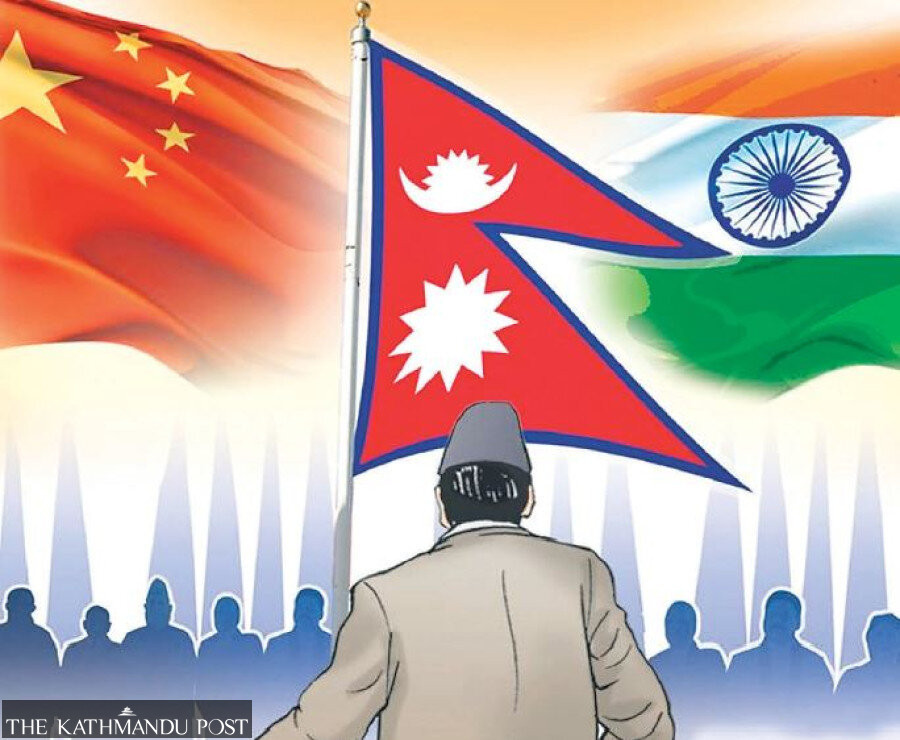
On Friday, India’s premier news agency, the Press Trust of India, reported that, after a six-year gap, border trade between China and India via the Lipulekh Pass in the Pithoragarh region of Uttarakhand is expected to resume this year.
Quoting the District Magistrate Ashish Bhatgai, the report claims that preparations for the trade session, which normally spans from June to September, have started in accordance with orders from the Union government.
The Lipulekh Pass, known as Pulang-Gunji in the local Tibetan dialect, is one of three villages located in the Kalapani area. Though currently under Indian control, Nepal has consistently asserted its claim over the area.
Nepal has previously protested India and China making bilateral arrangements over Lipulekh, in 2015 and 2020. The new announcement has reignited concerns about Nepal’s sovereignty and put pressure on the outgoing prime minister, Sushila Karki, as well as the incoming Rastriya Swatantra Party (RSP) government to raise this issue with both India and China.
Nepal has been claiming that the Lipulekh pass belongs to it and has written several diplomatic notes to India and China, in addition to raising the issue with leaders of both countries multiple times. The Ministry of Foreign Affairs has also repeatedly issued statements asserting that the Lipulekh pass is an inseparable part of Nepal. It was also incorporated into Nepal’s official map in 2020 through an amendment to the constitution.
Now, the onus will lie on the new and powerful RSP government to resolve the territorial dispute with the two neighbours.
Experts and observers said that the Nepal government should take up the matter with India and China immediately to avoid further complications, as a new government is set to be installed soon in Kathmandu.
The RSP is going to form the next government, and its senior leader, Balendra (Balen) Shah, who is projected as the prime minister, is set to be sworn in on March 27.
On August 19 of last year, during Chinese foreign minister Wang Yi’s visit to India, the two neighbours agreed to reopen the Lipulekh pass for border trade. The agreement triggered widespread opposition in Nepal, and the RSP condemned the move in the strongest terms, stating that the Lipulekh pass belongs to Nepal and that neither India nor China can conduct trade through it without Nepal’s consent.
Issuing a statement on August 26, 2025, the party firmly maintained that Limpiyadhura, Lipulekh, and Kalapani are integral parts of Nepal’s sovereign territory, based on the country’s statute, the Sugauli Treaty of 1816, and subsequent historical agreements and evidence. The party had said Nepal’s claim over these areas is clearly established on historical, geographical, political, and legal grounds.
“The party has taken serious note of recent developments concerning the reopening of traditional trade routes through Lipulekh, involving agreements between the Republic of India and the People’s Republic of China. Such developments, made without Nepal’s participation, have raised concerns. The party emphasises that it is the responsibility of the government of Nepal to address this sensitive issue as a top priority. While discussions have been held in Parliament, lack of clarity and transparency from the government has created doubts and concerns among the public,” the statement, signed by Sishir Khanal, head of the international department of the party, had mentioned.
“When India and China renewed their agreement to trade through the Lipulekh pass, then prime minister, Sushil Koirala, telephoned Indian Prime Minister Narendra Modi and expressed reservations,” Dinesh Bhattarai, who was Koirala’s adviser at the time, told the Post. The Koirala government also sent a diplomatic note to China stating that Lipulekh belongs to Nepal.
“Without Nepal’s facilitation,India and China cannot conduct trade via Lipulekh because the territory belongs to us. But, without taking our prior consent, both India and China have been entering into new agreements despite our strong reservations and protests. The new government should take up the matter with both India and China in the strongest terms. Their actions set a bad precedent,” said Bhattarai, who is also Nepal’s former representative to ambassador to the UN in Geneva, Switzerland.
Bhattarai calls this a diplomatic test for the new RSP government. During his visit to China at the end of August last year, former Prime Minister KP Oli had also raised the matter with Chinese President Xi Jinping at the Shanghai Cooperation Organisation (SCO) summit in Tianjin. On August 20, 2025 the Ministry of Foreign Affairs issued a statement stating that Lipulekh is an inseparable part of Nepal.
“The Nepal government is clear that Limpiyadhura, Lipulekh and Kalapani, situated East of the Mahakali river, are inseparable parts of Nepal. These are also officially incorporated in the Nepalese map, included in the Constitution as well,” the foreign ministry had said.
India, in response, rejected Nepal’s claim, asserting that trade through Lipulekh has been happening for decades. “We have noted the comments of the Ministry of Foreign Affairs of Nepal related to the resumption of border trade between India and China through the Lipulekh Pass,” Randhir Jaiswal, spokesperson for India’s Ministry of External Affairs, had said.
“Our position in this regard has been consistent and clear. Border trade between India and China through Lipulekh pass commenced in 1954 and has been going on for decades.”
The spokesperson had further claimed that the trade had been disrupted in recent years due to Covid and other developments, and both sides had now agreed to resume it. On Nepal’s territorial claims, Jaiswal said such claims were “neither justified nor based on historical facts and evidence,” while describing them as “untenable.”
India has also said it remains open to “constructive interaction” with Nepal on outstanding boundary issues.
Bhattarai urged the government to strongly raise the matter with both neighbours.
The RSP, which last year called on the government to present a clear and confident position on the issue, now shoulders the responsibility of addressing it.
According to PTI, the Ministry of External Affairs of India issued a No Objection Certificate (NOC), prompting action to reopen trade between India and China.
The District Magistrate Bhatgai states that Uttarakhand Chief Secretary Anand Bardhan received a letter from Foreign Secretary Vikram Misri requesting the reopening of trade along the Himalayan route.
“The Ministry of Home Affairs and the Ministry of Commerce and Industry have also issued permissions,” according to the letter.
According to Bhatgai, the state administration has been requested to instruct the relevant departments to ensure that trade resumes for the 2026 session. To improve coordination between the two sides, Chinese counterparts would receive the contact information of local officials,” said the PTI report.
Preparations cover trade passes, banking services, currency exchange, customs, transit camps, communication, security, and medical facilities for traders, according to the PTI.
Former ambassador Tapas Adhikari said that the government should revive the position taken by the Koirala government in 2015 and assert Nepal’s claim publicly before the new government takes office.
“This issue should not be left to the incoming government. Once the present government establishes a clear position, it will be easier for the next government to take up the matter with both the neighbours,” said Adhikari.
Anil Giri is a Chief Sub Editor covering diplomacy, international relations and national politics for The Kathmandu Post. Giri has been working as a journalist for more than two decades, contributing to numerous national and international media outlets.




 15.34°C Kathmandu