Women’s Day rally calls for protection of rights and recognition of unpaid labour
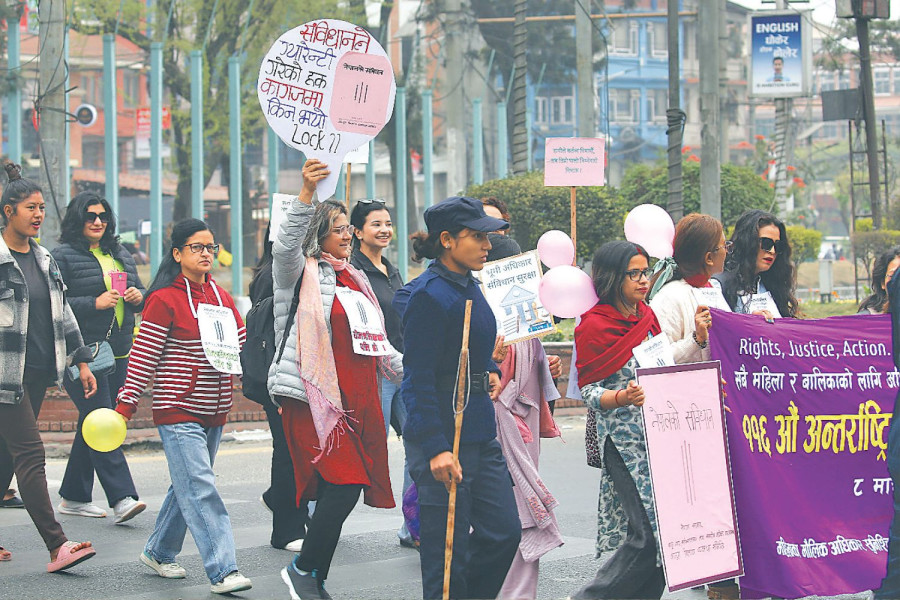
Around 150 participants, including women’s organisations and human right advocates, join a march in Kathmandu led by NAWHRD, calling out prejudices against women. Women march in Kathmandu on Sunday on the occasion of the International Women’s Day. Photo: courtesy of Sunil Sharma
Over 150 women activists, human rights advocates and community members took part in a rally in Kathmandu on Sunday, calling for stronger unity and the proper implementation of rights guaranteed to women by the constitution.
The march, held under the banner ‘Access to Justice to Ensure Women’s Fundamental Rights,’ began at Maitighar Mandala and ended at Hotel Everest in New Baneshwar. Participants carried copies of the Constitution of Nepal and chanted slogans highlighting gaps between constitutional guarantees and lived realities. “Why is a right guaranteed by the constitution locked on paper?” read one. They also demanded proper recognition of women’s labour.
The rally also focused on changing how International Women’s Day is observed in Nepal.
“Earlier, this day was called ‘Nari Dibas’ during the monarchy,” said Srijana Pun, vice-president of the National Alliance of Women Human Rights Defenders. “We now observe it as International Working Women’s Day to reflect our democratic system and recognise women’s contributions in all sectors.”
Pun said the event also highlighted the challenges women face every day. “Women’s work is often not respected—at home or in workplaces,” she said.
Organisers said the rally was also meant to warn lawmakers that women’s legal rights must be protected.
“We are worried that Article 38, which guarantees women rights such as equal lineage, safe motherhood, and other fundamental rights, might be weakened,” said Sulochana Khanal, programme manager at Women’s Rehabilitation Center (WOREC). “With the new government likely to have a two‑thirds majority and talk of changing the constitution, we must make sure women’s rights are not suppressed and new provisions are added.”
Khanal added they carried copies of the constitution as a symbolic measure. “We wanted to show the long struggle women have fought for legal rights,” she said. “This is also a warning to lawmakers that women’s labour rights and other legal protections must not be ignored. We are ready to support them, but if these rights are attacked, we will stay united and our movement will continue.”
During the programme concluding the march, participants also paid tribute to Prime Minister Sushila Karki for her leadership of the interim government and overseeing elections.
Meanwhile, speakers said that even with laws in place, society still has strong biases against women.
“The biggest problem is the perception that women are less capable than men,” Pun said. “This thinking stops women from getting opportunities and makes inequality worse.”
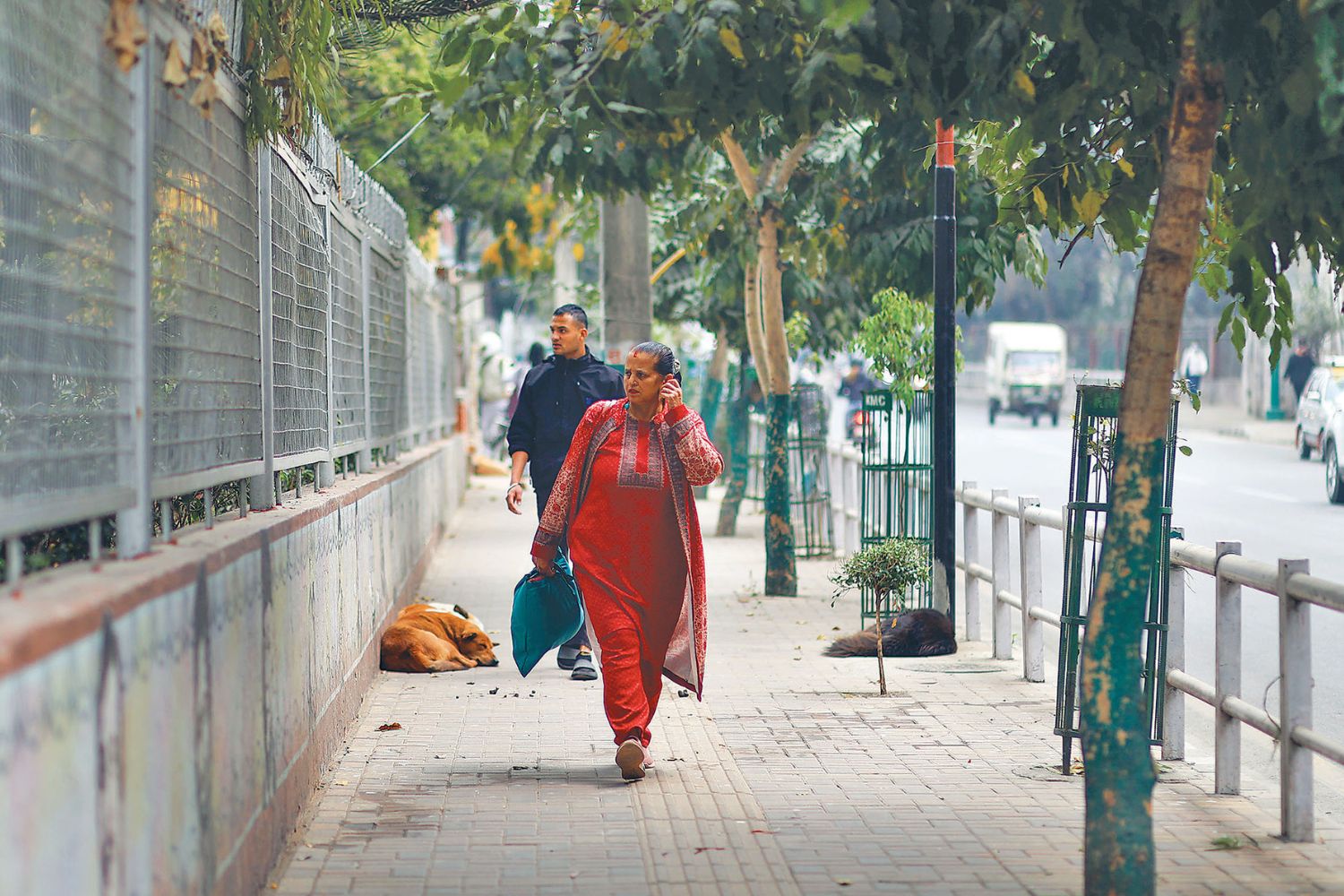
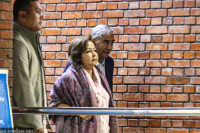
A woman walks on the Exhibition Road pavement as a Women’s Day event is held in the adjoining Rastriya Sabha Griha on Sunday morning. Post photo:Suryams Upreti
Adding on this, Nistha Shrestha, general secretary of Project Abhaya, said women need to work together to fight these barriers. “Many systems were not made with women in mind,” she said. “So when women support each other, it becomes easier to change these systems.”
Pun also highlighted past women leaders who fought for rights.
“Because of their work, we can speak openly about our rights today,” she said, referring to figures such as women rights activist Yogmaya Neupane and senior economist Meena Acharya.
Looking ahead, Pun said unity and cooperation are essential for progress.
“Older and younger leaders need to come together and listen to each other,” she said. “We must stay united without prejudice.”
She added that even though the feminist movement has different strands, there is a need for a single, strong voice to hold leaders accountable.
Women across Nepal, from Karnali to the East, West, North and South, face similar struggles, Pun said.
“The movement should focus on shared goals rather than individual gain,” she said. “It shouldn’t be about competition, but about helping everyone.”
Pun added, “If we stay united and organised, a bright future for women’s movements is possible.”
Aarya Chand is a reporter at The Kathmandu Post covering social issues. Before moving to the social beat, Chand was an intern covering culture and lifestyle for the Post.




 20.12°C Kathmandu