IT industry urges double taxation avoidance expansion, tax reforms to attract global investment
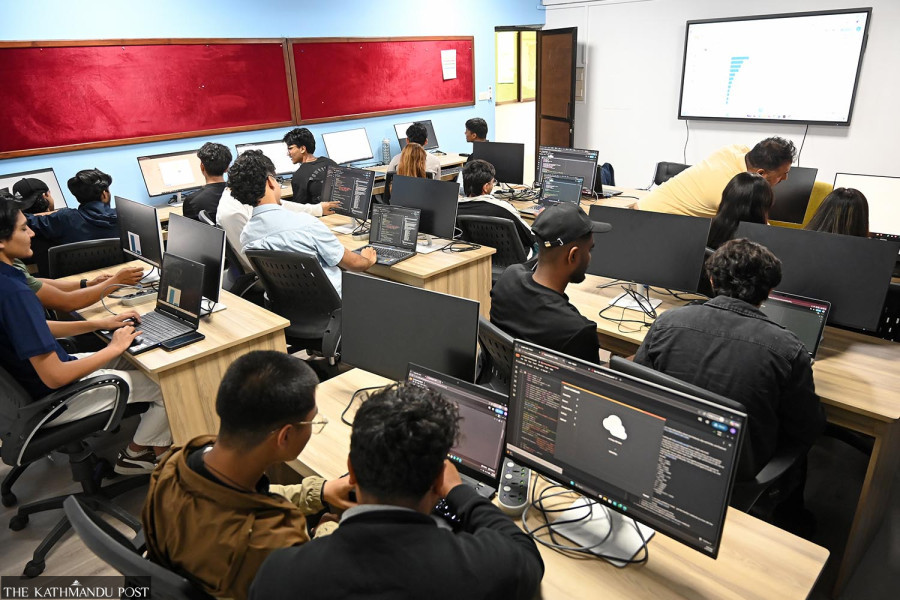
NAS-IT calls for preferential tax regime, legal overhaul and policy support in pre-budget recommendations. There are calls to promote secure domestic cloud infrastructure to reduce reliance on foreign providers and to minimise data privacy risks. Post file photo
Industry experts have urged the government to expand double taxation avoidance agreements (DTAA) and introduce targeted tax reforms to position Nepal as a trusted and cost-effective destination for global information technology (IT) services and investment.
Speaking at an interaction titled Pre-Budget Recommendations for Strengthening Nepal’s IT Sector, organised by the Nepal Association for Software and IT Services Companies in Kathmandu on Sunday, stakeholders stressed that policy clarity and tax incentives are key to attracting multinational companies.
Deepen Chapagain, vice-president of NAS-IT, said that expanding DTAA coverage in the upcoming budget for the fiscal year 2026-27 would make Nepal more attractive for global firms seeking to establish development centres, outsourcing hubs and joint ventures.
“Nepali IT companies and foreign tech companies investing in Nepal face the risk of double taxation when engaging with key international markets such as the United States, the United Kingdom and Australia,” said Chapagain.
He added that a robust DTAA framework would eliminate double taxation, reduce withholding taxes and provide a predictable environment for international business, ultimately boosting foreign direct investment, technology transfer, startup funding and jobs creation.
Nepal signed its first DTAA with India in 1987, followed by Norway in 1996. So far, the country has tax treaties with 11 nations, including Thailand, Sri Lanka, Mauritius, Austria, China, Qatar, Bangladesh, South Korea and Pakistan.
However, investors have raised concerns about policy distortions, noting that some businesses establish operations in India and then operate in Nepal to avoid double taxation complexities.
Gaurav Raj Pandey, president of NAS-IT, said the private sector remains optimistic as the government has prioritised IT development. “We are hopeful that the upcoming budget will incorporate key recommendations to accelerate growth and global competitiveness,” he said.
Among its proposals, NAS-IT has called for a preferential income tax regime, including a reduced corporate tax rate of 1 percent on net profits for registered IT companies for a fixed period of 10 years. The measure, it said, would encourage reinvestment in innovation, talent development and infrastructure while ensuring long-term policy stability.
The organisation also recommended an 8 percent export rebate for IT companies to offset cost disadvantages and improve competitiveness against countries such as Bangladesh and Vietnam, where similar incentives are already in place.
“If implemented, this will enable better pricing, drive export growth, increase foreign currency inflows and support business scaling and job creation,” Chapagain said.
In addition, NAS-IT has proposed reforms in the taxation of sweat equity shares, suggesting that they be taxed at the time of disposal rather than at the time of grant or vesting, which currently creates liquidity challenges for employees.
The industry body has also called for the establishment of a statutory National IT Promotion Board to streamline institutional efforts in promoting Nepal’s IT sector.
Legal reforms were another major focus. NAS-IT recommended revising the Electronic Transactions Act and introducing a comprehensive legal framework covering information technology, cybersecurity, data governance and data protection.
The updated law, according to stakeholders, should clearly define provisions for digital transactions and data handling, with strong emphasis on privacy protection and effective mechanisms to prevent and investigate cybercrime.
To support emerging segments, the organisation highlighted the need for targeted policies in areas such as Artificial Intelligence and Software as a Service (SaaS), a cloud-based model where applications are delivered over the internet on a subscription basis.
It also urged the government to promote secure domestic cloud infrastructure to reduce reliance on foreign providers and minimise data privacy risks, particularly in sensitive sectors like banking and public services.
Investments in AI models and digital solutions tailored to Nepali languages and local contexts were also recommended to ensure inclusive and effective service delivery.
Finally, NAS-IT called for a review of existing labour laws to better align with the operational realities of the IT industry, enabling flexibility in workforce management and preparing the domestic talent pool for global markets.
Krishana Prasain is a business reporter for The Kathmandu Post covering markets. Before joining The Kathmandu Post in 2018, she spent 3 years in New Business Age magazine covering business.




 20.58°C Kathmandu