West Asia conflict puts Nepal’s remittance inflows at risk, raises economic concerns
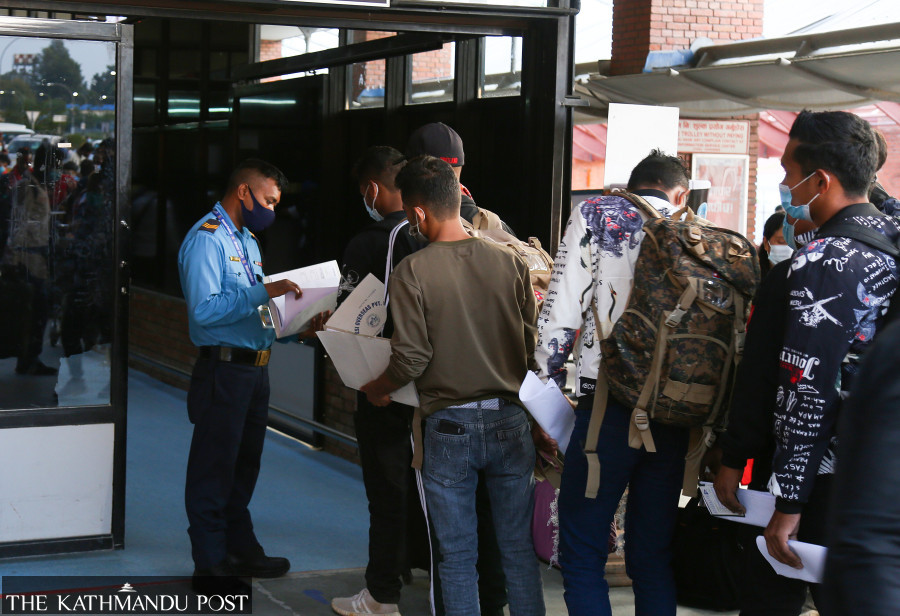
Escalating tensions threaten remittance from Gulf countries, which account for nearly 40 percent of Nepal’s total inflows, along with jobs, trade and foreign exchange reserves. Nepali youths at Tribhuvan International Airport preparing to depart for foreign employment. Post file photo
Worsening conflict in West Asia is putting nearly half of Nepal’s remittance inflows at risk, with prolonged tensions in Qatar, Saudi Arabia, Bahrain, Kuwait, the UAE and Oman expected to affect jobs, tourism and trade.
After joint military strikes by the United States and Israel on Iran, Tehran has launched a series of retaliatory missile and drone attacks across the Gulf region, including on US military facilities and infrastructure in several Gulf states. These ongoing exchanges have heightened fear and instability across the region, disrupting daily life, business activity and employment.
Around 1.9 million Nepali workers are currently employed in West Asia. Of the roughly 700,000 people who leave Nepal each year for foreign employment, about 65 percent, or around 450,000, head to Gulf countries. At least one Nepali worker has been killed and 20 others injured in Iranian attacks so far. Ongoing missile strikes have left many Nepali workers living in fear. With losses already reported, there are growing concerns that disruptions in remittance flows could have wider consequences for Nepal’s economy.
According to data from Nepal Rastra Bank, around 40 percent of Nepal’s total remittances come from Gulf countries. In the first seven months of the current fiscal year, Nepal received Rs1.261 trillion in remittances, including Rs444 billion from the Gulf region. In fiscal year 2024-25, total remittance inflows stood at Rs1.702 trillion, with Rs673 billion from Gulf countries. The Gulf’s share of total remittances was about 39 percent in 2024-25, 38.9 percent in 2023-24, and 45.1 percent in 2022-23.
Suman Pokharel, former president of the Nepal Remitters Association, said it is too early to gauge the full impact of tensions in West Asia on remittance inflows. He noted that remittances often rise in the early months of a crisis. “Inflows may increase for a few months. Even if the situation continues, there may not be an immediate drop, as Nepali workers abroad send money from savings or by borrowing,” he said. “However, if the crisis drags on, inflows could start declining after three to four months.”
Pokharel said prolonged tensions could slow new labour migration from Nepal and may even push some workers already abroad to return, creating a dual challenge for the economy. “On one hand, around Rs40 to 50 billion in remittances could be affected. On the other hand, returning workers will increase pressure on the government to create employment opportunities,” he said.
He stressed that the government should prepare in advance for a possible decline in remittances. “Nepal receives about Rs150 billion in remittances each month on average, of which around 40 percent—around Rs61 billion—comes from Gulf countries,” he said. “As the conflict in West Asia could affect both remittance inflows and foreign employment, the government needs to assess the risks early and respond accordingly.”
Economist Gunakar Bhatta said Nepal’s economy could come under significant pressure if the conflict continues, as remittances have been supporting imports. “With around 40 percent of total remittances coming from the Gulf, it is unrealistic to expect no impact. If the conflict continues, it could significantly affect the economy,” he said. “Tourism, services and oil exports are key sectors in that region. Any disruption will affect Nepal’s remittance inflows and fuel supply, and will also impact foreign exchange reserves.”
Tourism and exports are other sources of foreign exchange for Nepal. According to Nepal Tourism Board data, 20,504 tourists from Gulf countries visited Nepal in the last fiscal year, up from 16,648 a year earlier. Visitors from the Gulf accounted for 1.8 percent of total tourist arrivals, which stood at 1,158,459.
Trade with Gulf countries is also likely to be affected. In the first seven months of the current fiscal year, Nepal imported goods worth Rs48.76 billion from the region, while exports stood at Rs1.64 billion, according to the Department of Customs. In the previous fiscal year, imports from the Gulf totalled Rs50.31 billion, while exports reached Rs3.45 billion.
Nepal depends on Gulf countries not only as a labour market but also for key imports, including raw materials such as plastics and metals, agricultural inputs like fertiliser, and construction materials like gypsum. Experts warn that ongoing tensions could disrupt industrial production and pose risks to food security.
According to customs data, the UAE is Nepal’s largest source of imports such as gold, silver, jewellery and copper wire. In the first seven months of the current fiscal year, Nepal imported gold, silver and copper wire worth Rs37.06 billion from the UAE, with total imports from the country reaching Rs41 billion.
Saudi Arabia supplies key raw materials for Nepal’s plastic, packaging and pipe industries, with imports from the country totalling Rs3.72 billion during the same period. From Qatar, Nepal imports chemical fertiliser, gold jewellery and televisions, with fertiliser imports alone exceeding Rs2.5 billion; total imports from Qatar reached Rs3.34 billion in seven months of the current fiscal year. Oman is a major source of gypsum, with imports worth Rs3.208 billion during the period.
Nepal’s foreign exchange reserves have crossed Rs3.3 trillion. According to Nepal Rastra Bank, the reserves are sufficient to cover 21.3 months of imports of goods and 18 months of combined goods and services.
Remittance accounts for nearly 67 percent of Nepal’s foreign currency inflows. In the last fiscal year, it made up 66.9 percent of total foreign currency earnings, compared to 67.4 percent a year earlier. Over the past five years, remittances have consistently accounted for more than 60 percent of Nepal’s foreign currency inflows on average.
Bhatta said that while tourism and exports contribute to foreign exchange reserves, Nepal remains heavily dependent on remittances. “A decline in remittances would not only put pressure on foreign exchange reserves but also make imports more expensive,” he said. “The impact of the West Asia conflict will be felt across fuel supplies and the broader flow of goods and services. However, the scale of the impact will depend on how long and how intense the conflict becomes.”
Finance Secretary Ghanshyam Upadhyaya said the ministry is closely monitoring the situation and adjusting resources as needed. “We are monitoring the situation closely. The main impact is likely to be on fuel supply, remittances, foreign employment, tourism and construction materials,” he said. “This could push up consumer prices and increase construction costs.” He added that the extent of the impact will depend on the duration and intensity of the conflict.




 14.94°C Kathmandu