



 26.93°C Kathmandu
Tue, Jun 23, 2026
Money
EV imports fall 14.5 percent in first half as China border disruption hits supply
Prolonged closure of northern trade points curbs electric vehicle inflow despite strong domestic demand, while imports of conventional vehicles also decline.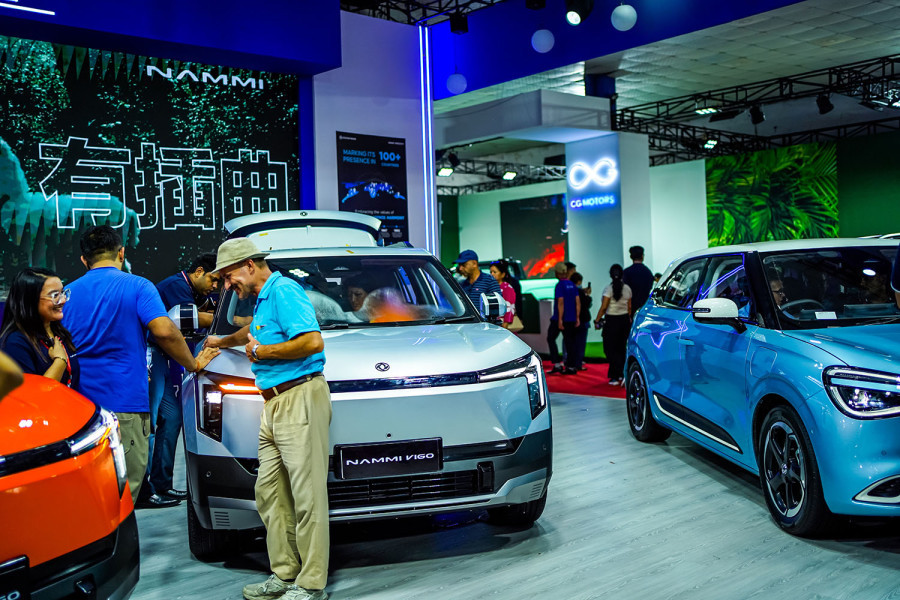
bookmark
Krishana Prasain
Published at : February 7, 2026
Updated at : February 8, 2026 07:03
Kathmandu
Electric vehicle (EV) imports to Nepal continued to decline in the first half of the current fiscal year despite growing demand among Nepali consumers, largely due to prolonged disruptions at key northern border points with China.
Nepal saw EV imports fall by 14.47 percent in the first six months of the fiscal year compared to the same period last year, according to the Department of Customs. The drop has been attributed mainly to the extended closure and irregular operation of northern trade routes.
During the review period, Nepal imported 5,698 units of EV buses, mini and microbuses, cars, jeeps and vans worth Rs14 billion. Imports of internal combustion engine (ICE) vehicles also declined. The country imported 2,600 units of ICE vehicles worth Rs3.89 billion, marking a 10.59 percent fall compared to the same period last fiscal year.
Imports of EVs from China, Nepal’s primary source market, fell sharply by 22.64 percent. Nepal imported 4,360 EV units worth Rs10.76 billion from China, while the remaining vehicles were sourced from countries including Thailand, the United Kingdom, Germany, South Korea, the United States and Austria.
Imports from India stood at 913 EV units worth Rs1.95 billion in the first half of the fiscal year.
EV dealers said business was severely affected by the disruption of northern border trade, which created persistent supply problems over the past six months.
On July 8, 2025, a flash flood in the Lhende river swept away the Miteri Bridge at Kerung, one of Nepal’s major trade gateways with China. China took nearly six months to construct a temporary bridge.
Although the Kerung border point reopened in January with the installation of a temporary Bailey bridge, operations have not returned to normal due to winter conditions and heavy snowfall along the route, importers said. Nepal’s customs point at Rasuwagadhi lies about 24 kilometres south of Kerung.
“The import and business were badly affected due to the closure of the Kerung border point for almost six months. Almost all EV dealers faced major obstacles importing vehicles from China,” said Yamuna Shrestha, managing director of Cimex Inc Pvt Ltd, the authorised distributor of BYD in Nepal.
According to Shrestha, BYD imported more than 2,000 vehicles through the Korala trade point in Mustang since September after seeing no immediate prospect of Kerung and Tatopani reopening. She said importing EVs through Korala was also challenging, as alternative trade points were not fully viable for large shipments.
Dealers said imports were further slowed because many companies had stocked large volumes of EVs ahead of the national budget on May 29 last fiscal year amid fears of possible tax changes. This advance stocking reduced the need for fresh imports in subsequent months.
EV dealers who had planned to launch new models during the Dashain and Tihar festive season were unable to do so due to border disruptions, Shrestha said. Despite these challenges, BYD recorded 10 percent growth in Nepal in 2025 compared to 2024.
Traders said the prolonged closure of major trade points widened the demand-supply gap, even as consumer interest in EVs continued to grow.
“Adoption of EV passenger vehicles has not slowed despite lower imports. We imported nearly 2,000 units of Atto 1 and Atto 2 within three months and almost all were sold,” Shrestha said. “We are unable to deliver vehicles based on customers’ preferred design and colour due to supply constraints.”
Industry insiders said demand is growing not only for mid-range EVs but also for high-end electric models.
Akash Golchha, senior vice president of the Nepal Automobiles Dealers Association, said that some people still go for ICE, especially for long drives where charging networks are not available and also replacements for some ICE vehicles have not arrived in EVs.
“People have shown preference for EVs to ICE vehicles as it covers 75 percent of the automobile market. For the upcoming decade, I think EVs will have an 80 percent market share,” he said.
Golchha said the Gen Z movement of September impacted the import and sales of automobiles for around six months. Now it’s improving.
Internationally, BYD has been facing headwinds. According to international media reports, the Chinese EV maker’s vehicle sales fell by 30.1 percent in January from a year earlier, marking the fifth consecutive month of decline amid intensifying competition and external uncertainties. The company sold 210,051 vehicles globally in January, with exports of new energy vehicles reaching 100,482 units during the month.
BYD narrowly met its revised global sales target of 4.6 million units last year and has yet to announce its target for 2026. Analysts expect China’s auto market to face stagnation this year as the government scales back subsidies for lower-priced models, affecting manufacturers focused on budget segments.
During the Nepal-China Coordination Mechanism on Border Trade and Cooperation held in Lhasa on January 20-21, the Nepali side raised concerns over easing trade through major border routes to ensure smoother cross-border commerce.
Krishana Prasain
Krishana Prasain is a business reporter for The Kathmandu Post covering markets. Before joining The Kathmandu Post in 2018, she spent 3 years in New Business Age magazine covering business.



Most Read from Money

Nepal moves to tax local staff of UN agencies, diplomatic missions
Inside the mission of Everest’s first mountain rangers
Trouble brewing for Nepali tea industry as exports to India remain halted
15 ministers, 15 years later, Nepal’s aviation overhaul remains grounded

Why did finance minister revise tax rates after presenting Economic Bill to Parliament?
Editor's Picks
Inside the mission of Everest’s first mountain rangers
Weak arbitration defence costs government billions

Nepalis making treacherous trip to Europe through the Balkan route

Women are often at the centre of Nepali films. Why are men still telling most of their stories?

What old newspapers reveal about Kathmandu’s World Cup fever in the 80s and 90s
E-PAPER | June 23, 2026

×