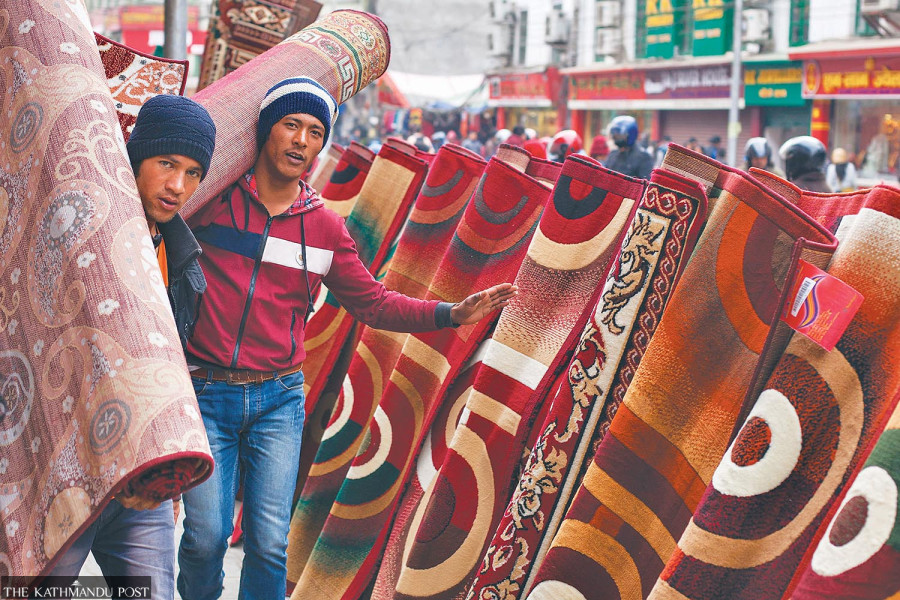
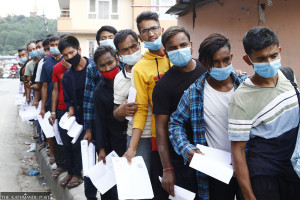
Shipments to China fell over 41 percent in the first 10 months of the fiscal year, largely due to a steep decline in carpet exports amid rising costs, labour shortages and growing competition from machine-made products. An official at one of the country’s largest carpet exporters to China said the shortage of skilled workers, particularly handloom weavers, has become another major challenge. Post file photo
Nepal’s exports to China have sharply declined despite steady growth in shipments to India. This has exposed the widening gap in the country’s trade performance with its two largest neighbours.
Exports to China fell by 41.71 percent year-on-year during the first 10 months of the current fiscal year ending in mid-May, largely due to a collapse in carpet exports, according to trade officials and exporters. Exports to India, however, grew 16 percent to Rs204.37 billion.
The decline contrasts with Nepal’s export growth to India, which has been largely driven by edible oil re-exports. While exports of products such as steel, iron, cement and tea continue to struggle, edible oils have sustained overall export growth to the southern neighbour.
Nepal’s edible oil trade benefits from a substantial tariff differential under the South Asian Free Trade Area (SAFTA) agreement and the India-Nepal Trade Treaty. Traders import crude oils from non-SAARC countries such as Argentina, Ukraine and Indonesia, process or repackage them in Nepal and re-export them to India duty-free, avoiding Indian tariffs that can reach up to 45 percent.
Trade with China, however, tells a different story.
Nepal’s hand-knotted woollen carpets, long regarded as one of the country’s most successful export products, have lost ground in the Chinese market due to rising costs, increasing competition from cheaper machine-made alternatives, labour shortages and logistical disruptions.
According to the Trade and Export Promotion Centre (TEPC), Nepal exported goods worth Rs1.39 billion to China during the review period. Major exports included carpets, copper products, apparel and clothing accessories, felt goods, bedding, textiles, oilseeds, raw hides and skins, musical instruments, coffee, tea and spices.
Krishna Raj Bajgain, information officer at the Trade and Export Promotion Centre, said the sharp decline in carpet exports was the main factor behind the overall drop in exports to China.
Carpet exports to China plunged by 75.63 percent to Rs214 million during the first 10 months of the fiscal year.
Carpet had emerged as Nepal’s largest export item to China in fiscal year 2023-24, accounting for Rs391 million of total exports worth Rs2.58 billion.
Exporters say the industry has steadily lost competitiveness over the years.
Bharat Kumar Shrestha, proprietor of Ganapati Rug House in Jorpati, said the imposition of value-added tax (VAT) on carpet exports and raw materials has made Nepali carpets more expensive in the Chinese market.
“Since Nepal imposed VAT on carpet exports a few years ago, our products have become costlier. As a result, orders from China have declined significantly,” he said.
According to Shrestha, his company’s exports to China have fallen by half in recent years.
“Raw materials are also taxed, which further raises production costs,” he added.
An official at one of the country’s largest carpet exporters to China said the shortage of skilled workers, particularly handloom weavers, has become another major challenge.
“Machine-made carpets have overtaken much of the market because they are cheaper and can be produced faster,” the official said. “At the same time, taxes on imported raw materials and exported products have pushed up prices, making Nepali carpets less competitive.”
Nima Dorje Sherpa of Everest Sherpa Carpet Industries said he stopped exporting carpets to China seven years ago.
“Nepali carpets have become too expensive and buyers in China have largely disappeared,” he said.
The decline is not limited to carpets.
Exports of copper goods fell by 46.59 percent to Rs201.63 million during the review period, while apparel exports declined by 4.32 percent to Rs155 million.
Exports of wadding, felt and nonwoven products, special yarns, twine, cordage, ropes and cables dropped by 14.67 percent to Rs117.12 million. Textile fabric exports fell by 46.85 percent to Rs68.46 million, while oilseed exports declined by 31.68 percent to Rs62.8 million.
Despite the recent setback, Nepal’s exports to China had shown gradual growth in previous years. Exports reached Rs2.63 billion in the last fiscal year, up from Rs2.58 billion in 2023-24. They stood at Rs1.76 billion in 2022-23, Rs808.8 million in 2021-22 and around Rs1 billion in 2020-21.
Trade expert Purushottam Ojha said multiple structural issues continue to undermine Nepal’s export prospects in China.
“The competitiveness of Nepali products has been eroding, while Chinese non-tariff barriers and Nepal’s limited production volume have further constrained exports,” he said.
Ojha pointed to the failure to operationalise agreements signed for the export of oranges from Syangja and Sindhuli districts. Nepal and China signed export agreements in 2011-12 and again in 2021-22, but commercial exports have yet to materialise.
Certification and quality testing remain another unresolved issue.
In 2005, Nepal and China signed an agreement under which China’s certification authority was expected to support Nepal in strengthening its testing and certification systems and eventually move towards mutual recognition.
“It has now been more than two decades, but implementation has been very limited,” Ojha said. “We still do not know how much support was actually provided or how much trade facilitation resulted from the agreement.”
Connectivity remains another major bottleneck.
Most of Nepal’s exports to China move through the Tibet region via the Tatopani and Rasuwagadhi border points. However, these trade routes have repeatedly faced disruptions due to earthquakes, landslides and other natural disasters.
The 2015 earthquake severely affected cross-border infrastructure, and both major border points remained closed or partially operational for extended periods.
“Our production capacity itself is weak,” Ojha said. “We have not increased productivity in manufacturing as required. We have also failed to focus on producing exportable goods that can compete in the Chinese market.”
China currently provides duty-free access to around 8,700 Nepali products, but the concession has done little to improve Nepal’s export performance.
Ojha said several products, including yarsagumba, chiraito, bodhichitta and medicinal herbs, are exported informally in significant quantities, so their value is not fully reflected in official trade statistics.
Weak financial linkages between Nepali and Chinese banks also pose challenges.
“Letters of credit are still not widely used in Nepal-China trade, and this creates difficulties for exporters,” Ojha said.
He also pointed to weaknesses in Nepal’s trade negotiation capacity. Frequent transfers of bureaucrats involved in trade discussions prevent the development of institutional memory and expertise.
“As officials are regularly transferred, specialised knowledge is lost. Nepal’s negotiating capacity remains weak compared to larger countries,” he said.
Despite persistent challenges, Nepal is seeking new opportunities in the Chinese market.
One of the most promising prospects is buffalo meat exports. During then-prime minister KP Sharma Oli’s visit to China in December 2024, Beijing agreed to allow imports of Nepali buffalo meat.
The government and private sector are now preparing for large-scale exports backed by an estimated Chinese investment of Rs27 billion.
Officials believe buffalo meat exports alone could eventually generate up to $1.5 billion annually. They say the sector could become a new pillar of Nepal-China trade and help reduce the country’s dependence on a narrow range of traditional export products.
Krishana Prasain is a business reporter for The Kathmandu Post covering markets. Before joining The Kathmandu Post in 2018, she spent 3 years in New Business Age magazine covering business.




 16.18°C Kathmandu