CIAA files Rs10.13 billion passport graft case against 18
Anti-graft body accuses officials and two German firms of rigging the e-passport contract. Concerns grow over dwindling passport stocks and future supplies.Post file photo
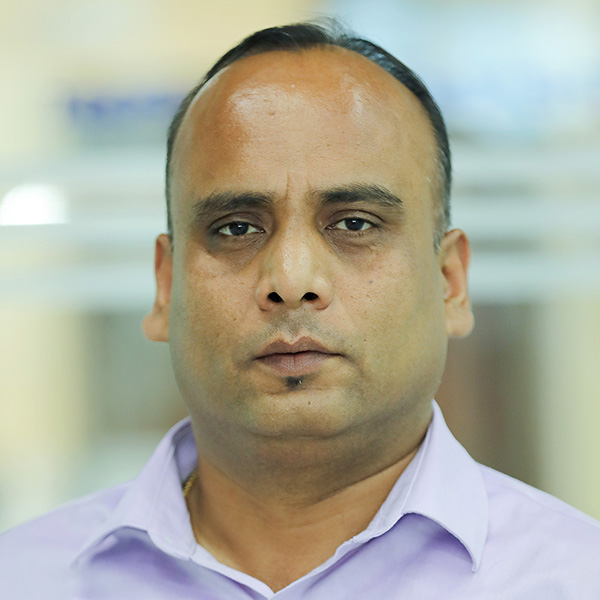
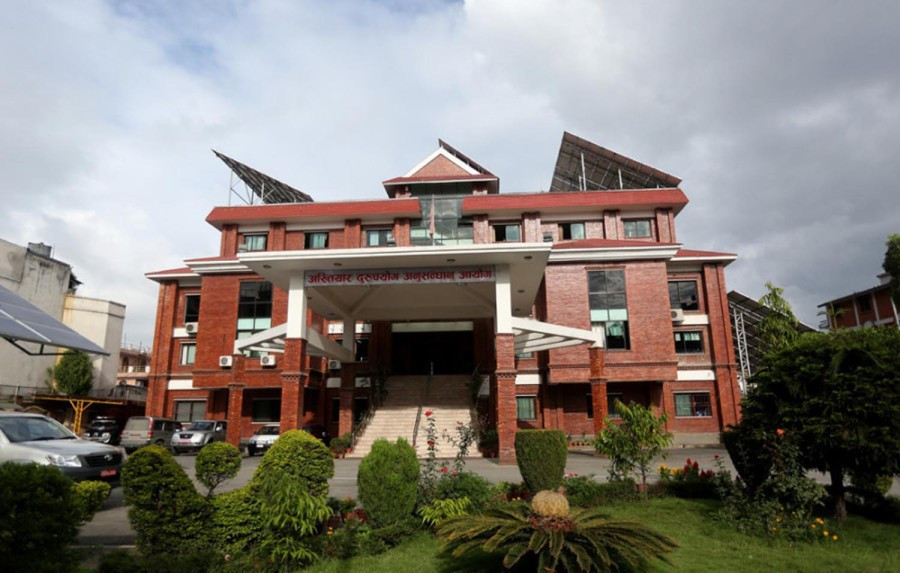
Nepal’s anti-graft body, the Commission for the Investigation of Abuse of Authority (CIAA), has filed a corruption case against 18 defendants, including the Director General of the Department of Passports Tirtha Raj Aryal, over alleged irregularities in the procurement of e-passports.
The case, filed on Monday at the Special Court, names 10 government officials, two German companies that were awarded the passport printing contract, four executives of the two companies, and two Nepal-based representatives. The constitutional anti-graft body has sought recovery of Rs10.13 billion, along with fines and prison terms for the accused.
According to CIAA spokesperson Suresh Neupane, investigators found that officials and representatives of German firms Muehlbauer ID Services and Veridos GmbH colluded from the outset of the bidding process to ensure the contract would be awarded to the two companies. The anti-graft body alleges that tender criteria and evaluation standards were altered in violation of procurement laws to provide unlawful advantage to the companies and cause financial losses to the state.
The charge sheet states that the accused manipulated technical and financial evaluations, made improper recommendations and decisions, signed contracts contrary to legal provisions, and facilitated partial payments, causing losses of Rs10.13 billion to the department.
Those charged include Aryal; Information Technology Director Sunil Kumar KC; former directors Shatrudhan Prasad Sharma Pokharel and Rabindra Raj Bhandari; former accounts officer Tulsi Prasad Acharya; computer engineer Bipin Prasai; former section officer Somesh Thapa; and several officials from the Ministry of Foreign Affairs. CIAA has sought fines equivalent to the alleged losses and prison sentences for them. It has also sought recovery of Rs184.4 million already paid under the contract. Aryal faces an additional penalty as head of the department.
The anti-graft body has also named Veridos GmbH, Muehlbauer, and their executives and local agents as defendants. Muehlbauer, its executives Gerard Maurer and Pavel Rikis, and Nepal representative Manindra Raj Malla face claims amounting to Rs1.90 billion. Veridos, its executives Fabiola Bellersheim and Florian Paquelin, and Nepal agent Siddhartha Thapa face claims totaling Rs8.22 billion. CIAA alleges they acted as accomplices in the corruption scheme.
On June 15, CIAA detained Aryal, KC, and Malla for questioning. The investigation accelerated after concerns were raised about delays and irregularities in the passport procurement process.
Even as former foreign minister Arzu Rana Deuba was drawn into the investigation, she has not been named as a defendant in the case. The commission had summoned her for questioning and even served a three-day notice at her Budhanilakantha residence after she failed to appear before investigators. The day after the notice was posted, Rana informed the anti-graft body via email that she was abroad undergoing medical treatment and therefore unable to attend. According to an official involved in the investigation, the CIAA has kept its inquiry into her role open and a separate investigation is continuing.
The department awarded the e-passport contract to Veridos and Muehlbauer on June 6, 2025. The contract covers registration systems, data management, passport booklet production, personalization, quality control, and packaging. The procurement later drew complaints from a competing bidder, triggering the CIAA investigation.
Following an investigation, the anti-graft body concluded that public procurement laws had been violated and that the contract had not been executed in accordance with its terms. The CIAA alleged that officials and company representatives colluded to alter bidding criteria, manipulate technical and financial evaluations and secure unlawful benefits for the contractors at the expense of the state. The corruption case filed on Monday against 18 defendants represents the first phase of the investigation, while supplementary inquiries into other individuals and aspects of the procurement process remain ongoing.
Under the contract, the German firms were required to deliver the first batch of passports within 240 days and establish personalization centers in all 77 districts and Nepali missions abroad. However, the project reportedly failed to progress as agreed, leading to scrutiny from the Prime Minister’s Office and eventually the CIAA.
The procurement had been controversial from the beginning. After losing the bid, French company IDEMIA, Nepal’s previous passport supplier, challenged the process, alleging irregularities in technical evaluations, foreign exchange calculations, and bidder qualification assessments. The case remains under review at the Supreme Court, even as the CIAA has moved ahead with criminal prosecution.
With the filing of the case, there is now a great degree of uncertainty over the future of passport printing and distribution.
As passport stocks are dwindling and are expected to last less than three weeks, concerns are growing over how the Ministry of Foreign Affairs will handle the situation and mitigate the challenges, said a joint secretary at the ministry.
There is also a clear divide between the Prime Minister's Office (PMO) and the Ministry of Foreign Affairs over the passport issue. It was the PMO that initially looked into the matter and later brought it to the attention of the CIAA. The PMO team subsequently informed the political and administrative leadership of the Foreign Ministry that the passport contracts awarded to the German companies were problematic and warranted a thorough investigation. The aides to Prime Minister Balendra Shah later summoned CIAA chief Prem Kumar Rai and other officials to the PMO and pressed them to investigate the matter last Monday. Several officials, including Foreign Secretary Amrit Rai, were also summoned by the commission on the day.
“Since passport stock has fallen below 47,000 ordinary passports and is expected to last only a few more weeks, there is now a sense of urgency regarding how the situation will be managed,” said a joint secretary at the ministry. “On the one hand, cases have been filed against the two German companies, as well as our senior and junior officials. As a result, there is a vacuum within the Foreign Ministry, and it is unclear who would be willing to take the risk of leading the passport department.”
Demand for passports averages around 6,000 per day. If the government continues printing passports at the current pace, the existing stock will meet demand for only a limited period. There is no new agreement with the French company IDEMIA for passport procurement, another Foreign Ministry official said. With uncertainty surrounding the two German companies, concerns are growing that the passport crisis could deepen from next week.
“We will procure a limited number of passport booklets from the French company to bridge the current gap,” said a PMO official. “Then we will either negotiate with the French company or call a fresh tender.”
Anil Giri is a Chief Sub Editor covering diplomacy, international relations and national politics for The Kathmandu Post. Giri has been working as a journalist for more than two decades, contributing to numerous national and international media outlets.




 25.92°C Kathmandu