Manpower companies threaten to halt overseas job placement unless policy reforms implemented
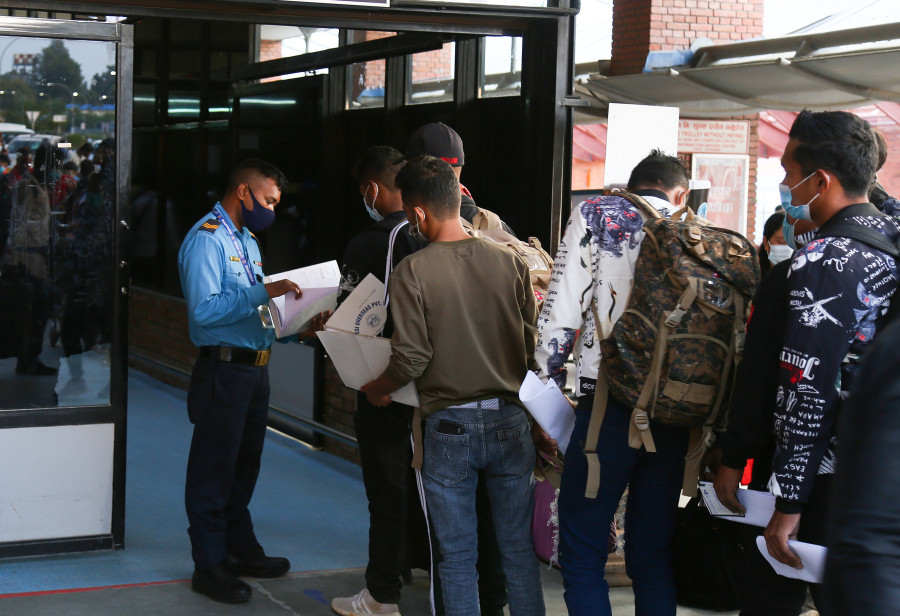
Industry leaders cite unsustainable fee structures and high airfares as 15-day reform ultimatum approaches its deadline. As many as 406,404 Nepalis obtained new labour permits in the fiscal year of 2025–26, down 19.7 percent from 505,957 in the previous year. Overall labour permit issuances—including renewals—dropped 5.6 percent to 792,187. Post file photo
Foreign employment recruitment agencies have warned that they will stop placing migrant workers abroad if the government fails to introduce urgent policy reforms to address key operational challenges, as a 15-day deadline given to the government ends on Friday.
The ultimatum, issued by the Nepal Association of Foreign Employment Agencies, demands transparent recruitment fee structures, lower airfares, the reopening of institutional migration to European countries, and broader market diversification.
Recruiters argue that current government policies have created an unsustainable environment, leaving them unable to conduct business ethically or legally while migrant workers continue to suffer the consequences.
“If this sector cannot be reformed, it is simply not viable to continue operating,” said Dik Bahadur Khatri, president of the association. “The business is facing a severe crisis. The government must step in and create a healthy, transparent environment that allows us to work legally.”
At the core of the dispute is the government’s existing fee structure. Under current rules, recruitment agencies are barred from charging any fees to workers migrating to major destination countries such as Saudi Arabia, the United Arab Emirates and Malaysia. According to bilateral labour agreements, employers are required to cover all expenses, including airfare, visa fees, and agency service charges—a policy widely known as ‘free ticket, free visa.’ For other destinations like Qatar, Kuwait, and Bahrain, agencies are permitted to charge a maximum service fee of just Rs10,000.
In practice, however, these bilateral provisions remain largely unenforced. Migrant workers routinely pay between Rs300,000 and Rs500,000 out of pocket to secure job placements abroad, creating a thriving illicit fee market.
Meanwhile, the Department of Foreign Employment has intensified monitoring efforts, penalising recruitment agencies caught charging excess fees and forcing them to refund the money. Agencies claim that this enforcement creates a double standard, leaving them legally vulnerable while failing to fix a broken system. They are demanding a scientifically determined, transparent service fee structure that reflects actual operational costs.
Another of their major demands is to control the high airfares. Recruitment agencies claim that price gouging by airlines and select travel firms has significantly inflated costs, placing an unfair financial burden on departing workers.
“Airfares are excessively high due to collusion between airlines and a limited number of travel agencies,” said Khatri. “Furthermore, because there are no direct international flights operating from Gautam Buddha International Airport in Bhairahawa or Pokhara Regional/International Airport, workers are forced to seek cheaper tickets by flying out of Indian airports.”
The department strictly prohibits workers from departing via foreign airports without prior approval. In recent months, officials have launched audits into air travel records of workers who received labour permits between March 14 and June 14. During that process, manpower agencies found guilty are being penalised.
On August 4, the department fined 39 recruitment agencies Rs50,000 each for placing workers via Indian airports without authorisation—marking the second penalty for several firms. Another 124 agencies were issued seven-day show-cause notices asking why they should not be fined Rs50,000 for failing to submit flight details. Under the Foreign Employment Act, three consecutive violations can result in the revocation of an agency’s license.
Khatri urged the government to address the root cause rather than penalising agencies. “The government must take responsibility to reduce airfares,” he said. “When workers are forced to use Indian airports because tickets are cheaper there, penalising recruitment agencies is unfair.”
Agencies are also pushing for the formal reopening of institutional labour migration to European nations. Under the current demand letter attestation guidelines, labour demand documents from European employers must be verified by local Nepali embassies. However, Nepali diplomatic missions in Europe have expressed an inability to handle the verification workload, effectively halting institutional placements through recruitment agencies for the past two years.
Despite the halt, individual migration to Europe has surged, often mediated by informal networks and educational consultancies. In the last fiscal year of 2025-26, a total of 60,338 workers—representing 14.8 percent of all newly issued labour permits—migrated to Europe individually.
“The biggest abuses and malpractices are occurring in individual migration to Europe,” said Khatri. “By forcing workers to migrate individually, the current system fuels human trafficking. The government must permit agencies to process European demand institutionally.”
Recruiters also stressed the urgent need to diversify labour markets beyond traditional destinations in the Gulf and Malaysia. “When it is concentrated in just one place, it continually suffers contractions,” Khatri said. “The labour market is impacted sometimes by natural disasters, sometimes by wars, and at other times by policies brought in to balance domestic manpower structures. The tension in the Middle East that has been ongoing since February confirms this.”
According to department data, 406,404 Nepalis obtained new labour permits in the fiscal year of 2025–26, down 19.7 percent from 505,957 in the previous year. Overall labour permit issuances—including renewals—dropped 5.6 percent to 792,187.
The association has urged the government to end monopolies that inflate expenses for migrant workers. “We have been raising these issues repeatedly, but the government only listens without acting,” said Khatri. “If our demands are wrong, tell us. Otherwise, we need a clear government plan to sustain this industry.”
Responding to the concerns, the Ministry of Labour, Employment and Social Security maintained that it is actively working on comprehensive reforms. Pitambar Ghimire, ministry spokesperson, said that a government task force is finalising recommendations for a revised recruitment fee policy. “The task force under my leadership is in the final stages of determining a scientific service fee to eliminate illegal charges paid by workers,” Ghimire said. “We will submit our report to ministry leadership soon.”
Ghimire added that amendments to the Foreign Employment Act have been drafted and sent to the Foreign, Law, and Finance ministries for feedback before submission to the Cabinet. “We recognise the need for reforms and are committed to addressing these issues,” he said.
Hom Karki is a reporter with two decades experience covering migrant workers issues and the Nepali diaspora. He was previously based in the Gulf for Kantipur Daily.




 14.65°C Kathmandu