New Kathmandu transport master plan proposes metro rail linking Ratna Park and Bhaktapur
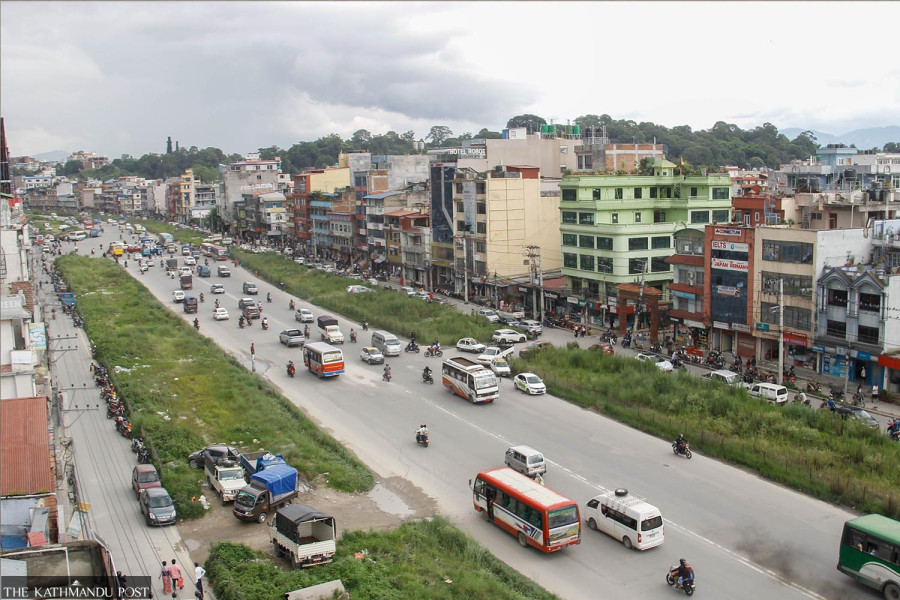
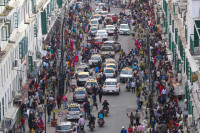
The 25-year blueprint also envisions Bus Rapid Transit, car-free zones, road upgrades and major junction improvements to tackle worsening congestion. A section of the Ring Road pictured recently. The master plan proposes upgrading 23 major intersections and traffic signals. Post file photo
The government has prepared a new master plan to reshape Kathmandu Valley’s road infrastructure and urban transport system over the next 25 years, proposing major investments in mass transit, road upgrades and traffic management to cope with rapid urban growth.
Prepared by Ministry of Physical Infrastructure and Transport with technical assistance from the Japan International Cooperation Agency (JICA), the blueprint is the fourth comprehensive transport master plan for the Valley after similar studies in 1993, 2012 and 2017. Unlike earlier versions, officials expect the latest report to receive Cabinet approval, allowing it to guide transport development until 2050.
The plan projects Kathmandu Valley’s population to reach 4.3 million by 2050 and outlines new urban expansion areas, traffic demand forecasts, transport mode shifts, mass transit corridors, tunnels, junction improvements and reforms to public bus services.
However, discussions on Thursday revealed concerns over the Kathmandu-Tarai Expressway, with officials acknowledging inadequate coordination between the government regarding the alignment of the starting point and other technical aspects, JICA experts and the Nepali Army, which is constructing the strategic expressway.
During a presentation of the ‘Kathmandu Valley Urban Transport System Master Plan’, representatives of the Department of Roads asked how traffic generated by the expressway had been incorporated into the proposal.
Responding to the query, Hideo Tsuji, head of JICA’s expert team, said the consultants had formally requested discussions with the Nepali Army on projected traffic demand and future planning but had received no response.
“Construction of the expressway is being carried out by the Nepali Army,” said Tsuji. “We formally sent a letter seeking discussions on future traffic demand and planning during the study, but we did not receive any response.”
He added that a consultant’s latest assessment estimated traffic volume on the expressway would reach around 27,000 passenger car units by 2045. “Since the expressway is designed as a four-lane highway, it should be able to accommodate that level of traffic,” said Tsuji.
National Planning Commission member Arjun Jung Thapa said the expressway would begin at the Chobhar dry port and acknowledged that coordination challenges had emerged while the master plan was being prepared.
Thapa said the Army, which had earlier targeted completing the expressway by mid-April 2027, had now sought another extension until mid-April 2030. Despite differences over planning and implementation, he expressed confidence that both sides would reach a mutually acceptable solution within the next few months.
“Although the Army has been moving ahead in its own way, we are trying to coordinate and provide the necessary support,” said Thapa. “We are optimistic that this issue will be resolved through a fair, win-win agreement.”
Sushil Babu Dhakal, joint secretary at the Ministry of Physical Infrastructure and Transport and project director, said the master plan proposed 22 major infrastructure projects and 13 transport improvement programmes aimed at increasing road capacity and making travel safer.
“Acquiring land for new roads inside the Ring Road is no longer practical,” said Dhakal. “Instead, we have focused on improving the capacity of existing roads and developing a 160-kilometre emergency road network to ensure hospitals and security facilities remain accessible during emergencies.” He said that the new master plan would be implemented effectively soon after the Cabinet approved it.
JICA representative from its headquarters said Kathmandu’s worsening congestion required immediate action, adding that the focus should now shift from planning to implementation. He expressed hope that the government would soon endorse the report and begin executing priority projects.
The master plan’s flagship proposal is a 14.6-kilometre east–west metro rail linking Ratna Park and Bhaktapur. It proposes constructing the section through the city centre and around Koteshwar Junction underground, while the remaining stretches would be built as elevated structures within the existing road right of way. The plan envisages 1.9 kilometres of underground track and 12.7 kilometres of elevated alignment. It also suggests that the Gaushala-Chabahil section, which carries heavy traffic and passes through an area of historical and cultural significance, could be developed as an underground tunnel. A Bus Rapid Transit (BRT) system along the Ring Road has also been proposed.
The master plan further includes the construction of an underpass at Maharajgunj Junction, along with upgraded roads and bridges along the Dhobikhola and Bishnumati corridors. It proposes widening the Gaushala-Tinkune section of the Ring Road and building a new river corridor road between Thapathali and Tripureshwar. The plan also calls for widening the UN Park Bridge and constructing new bridges over the Bishnumati, Dhobikhola, Karmanasa and Bagmati rivers, including at Gwarko and Thapathali. In addition, it proposes upgrading 23 major intersections and traffic signals to improve traffic flow and developing dedicated cycle lanes along selected roads.
The plan also recommends consolidating more than 65 public transport committees into five or six large operating companies to improve efficiency and encourage commuters to shift from motorcycles to public transport. It further proposes car-free zones in Thamel, Kathmandu Durbar Square and Patan Durbar Square.
Officials said suggestions collected during Thursday’s consultation and previous meetings would be incorporated before the report is finalised and submitted to the Cabinet. They stressed that the proposals remain open to refinement and that detailed feasibility studies and engineering designs must be completed before individual projects move into implementation.




 15.26°C Kathmandu