



 16.84°C Kathmandu
Tue, Oct 20, 2026
Money
Nepal earns record Rs12 billion from large cardamom exports
Export earnings rose despite modest production growth. Traders urge diversification beyond India and stronger direct access to Middle Eastern and South Asian markets.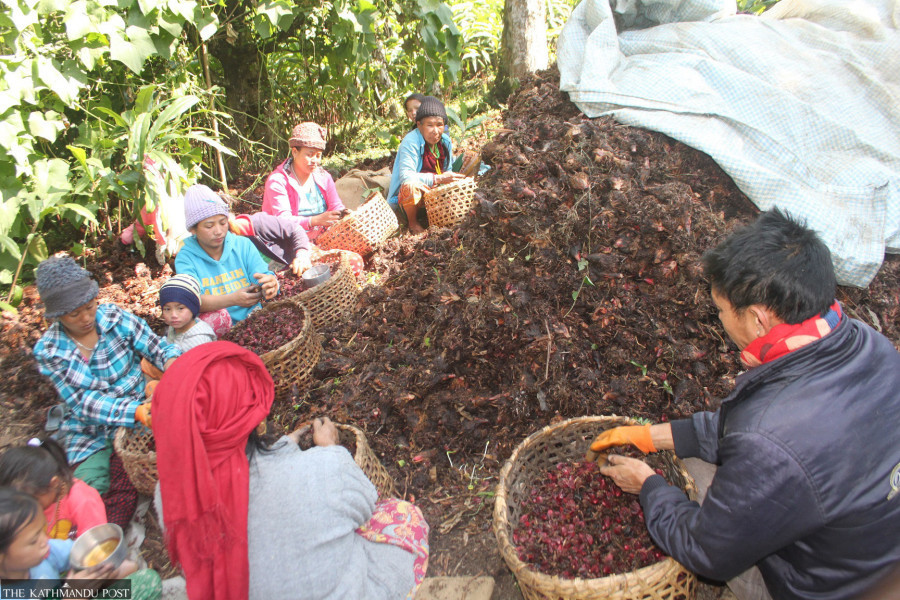
bookmark![]()
Sangam Prasain
Published at : June 23, 2026
Updated at : June 23, 2026 06:53
Kathmandu
Nepal’s large cardamom exports have reached an all-time high in value, driven by tighter global supplies, stable prices and sustained demand from South Asian and Middle Eastern markets.
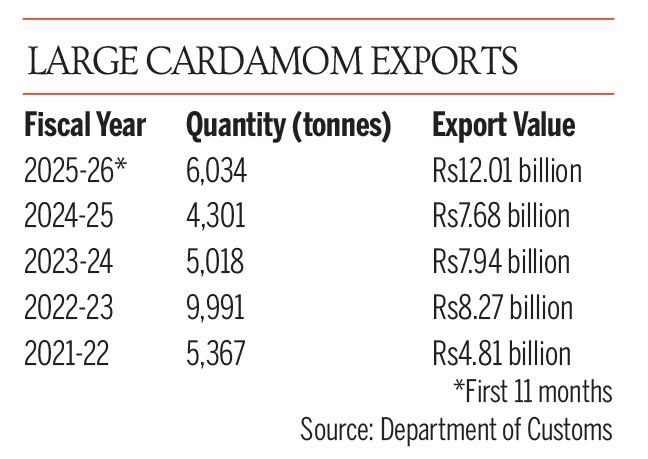
In the first 11 months of the current fiscal year ending in mid-June, Nepal exported 6,034 tonnes of large cardamom worth Rs12.01 billion, according to customs data. The export value is the highest ever recorded for the spice, although export volumes remain below the levels seen in some previous years.
Large cardamom, also known as black cardamom, is among the world’s most expensive spices and one of Nepal’s leading agricultural export products.
India remains the dominant buyer, absorbing around 99 percent of Nepal’s exports. From India, the spice is re-exported to Pakistan and countries in the Middle East, where Nepali cardamom commands premium prices because of its distinctive flavour and quality.
Pakistan is the largest importer of cardamom through India, accounting for roughly 60 percent of India’s exports. The spice is widely used in biryani and other savoury dishes and is particularly sought after during religious festivals and celebrations.
Nepali black cardamom is renowned for its distinctive smoky aroma, produced through a traditional drying process in bhattis, or ovens. The method gives the spice a deep roasted flavour that is highly valued in culinary markets.
Dipak Nepal, president of the Federation of Large Cardamom Entrepreneurs Nepal, said the country has achieved a historic milestone in export earnings.
“This is the highest export value ever recorded,” he said. “The export quantity has not been exceptionally high, but stronger prices have pushed earnings to a record level.”
According to traders, cardamom prices remained unusually stable this year at around Rs2,500 per kg, encouraging farmers to sell their produce rather than hold stocks in anticipation of further price increases.
“Unlike previous years, prices did not fluctuate significantly,” Nepal said. “Because farmers were confident about the market, most of the produce entered the trading system without being hoarded.”
Despite the export boom, producers say productivity remains a major concern.
Government data show Nepal’s average large cardamom productivity stands at just 531.31 kg per hectare, significantly lower than India’s average yield of around 2,000 kg per hectare.
Price volatility has long troubled farmers. Large cardamom prices surged to Rs2,700 per kg in 2014 and later climbed to an all-time high of Rs3,000 per kg in 2016. However, prices subsequently fell sharply, dropping to Rs850 in 2018 and reaching a low of Rs700 per kg in mid-July 2022.
Birtamod in Jhapa serves as the country’s principal trading hub for large cardamom.
Traders say buyers in key overseas markets are already preparing for next year’s Ramadan season (Feb-March 2027), which could boost demand and send prices even higher in the coming months.
According to the Trade and Export Promotion Centre (TEPC), Nepal remains heavily dependent on India for exports. More than 99 percent of shipments are routed through the southern neighbour before reaching final destinations.
The TEPC’s report notes that Nepal is the world’s largest exporter of large cardamom. However, as a landlocked country, it continues to face high transportation and logistics costs that reduce profits for exporters despite strong international demand and premium product quality.
Some traders quoted in the report said retail prices in Qatar, the United Arab Emirates and other Gulf countries can reach as high as Rs150,000 per kg, pointing to the substantial value added along the supply chain after the product leaves Nepal.
Large cardamom is cultivated across 16,382 hectares in Nepal. The country accounts for approximately 52 percent of global production, followed by India with 37 percent and Bhutan with 11 percent.
The crop is grown in 46 districts, with major production concentrated in Ilam, Panchthar, Taplejung, Sankhuwasabha, Terhathum, Bhojpur and Dhankuta.
Taplejung is Nepal’s largest producing district, with around 4,500 hectares under cultivation and annual production exceeding 2,500 tonnes.
A separate report by the Food and Agriculture Organization (FAO) says Nepal has considerable opportunities to increase export earnings through better logistics, processing and market diversification.
The report suggests that Nepal can utilise export assistance programmes to offset high freight costs and take advantage of flexibilities available to least developed countries under World Trade Organization rules on agricultural export subsidies until 2030.
The FAO also recommends expanding processing facilities, investing in value addition, improving transportation infrastructure and pursuing geographical indication (GI) certification for Nepali cardamom.
The report further highlights the potential of blockchain-enabled traceability systems and stronger quality certification mechanisms to help Nepali exporters overcome non-tariff barriers and access premium markets in the Middle East, Europe and North America.
Strategic investments in Good Agricultural Practices (GAP) training, certification readiness programmes, agro-processing zones and the implementation of the Nepal Trade Integration Strategy could help Nepal secure a larger share of the growing global cardamom market, the report says.
TEPC has also warned that Nepal’s dependence on Indian importers limits returns for domestic exporters. Indian traders often re-export Nepali cardamom to third-country markets, capturing much of the value addition that could otherwise remain within Nepal.
“The chain effect ultimately impacts farmers as well,” the report said..
To address the problem, TEPC has recommended reviewing export logistics costs and strengthening direct market access in overseas destinations.
The centre says Bangladesh could become an important alternative market despite current barriers.
Although the South Asian Free Trade Area (SAFTA) framework provides a preferential duty rate of 5 percent, Bangladesh currently imposes a 35 percent customs duty on Nepali large cardamom.
TEPC has urged the government to conduct a market assessment in Bangladesh, citing its population of more than 160 million and proximity to Nepal. The report notes that exports can reach Bangladesh within four days at relatively low transportation costs.
Pakistan also presents significant potential, but Nepali exporters currently lack direct access to the market. Most exports reach Pakistan through Indian intermediaries, leaving Nepal with limited information about actual demand, pricing and import requirements.
The report recommends conducting detailed market studies and establishing warehousing facilities in Pakistan and Gulf countries. Such facilities would allow exporters to ship larger volumes and gradually release products into target markets rather than relying on fragmented consignments.
TEPC has additionally identified the China-Pakistan land route as a potentially competitive alternative. According to the report, shipments could travel from Kerung (Gyirong) through China into Karachi over a distance of approximately 4,876 kilometres, with an estimated transit time of 19 days.
While air cargo remains suitable only for small consignments, improved regional connectivity could eventually provide Nepali exporters with more direct and cost-effective access to key international markets.
Sangam Prasain
Sangam Prasain is Business Editor at The Kathmandu Post, covering tourism, agriculture, mountaineering, aviation, infrastructure and other economic affairs. He joined The Kathmandu Post in October 2009.

Most Read from Money

Nepal travel agents threaten to stop selling Thailand trips over visa rules

Why does an hour long flight to Dhangadhi cost more than a flight to New Delhi?
Malaysia rejects Nepal’s demand to open recruitment to all manpower agencies

No school, but a graduation cap for women dairy farmers

Nepal arrests four medical service providers as Malaysia recruitment row deepens
Editor's Picks




E-PAPER | October 20, 2026

×