Trouble brewing for Nepali tea industry as exports to India remain halted
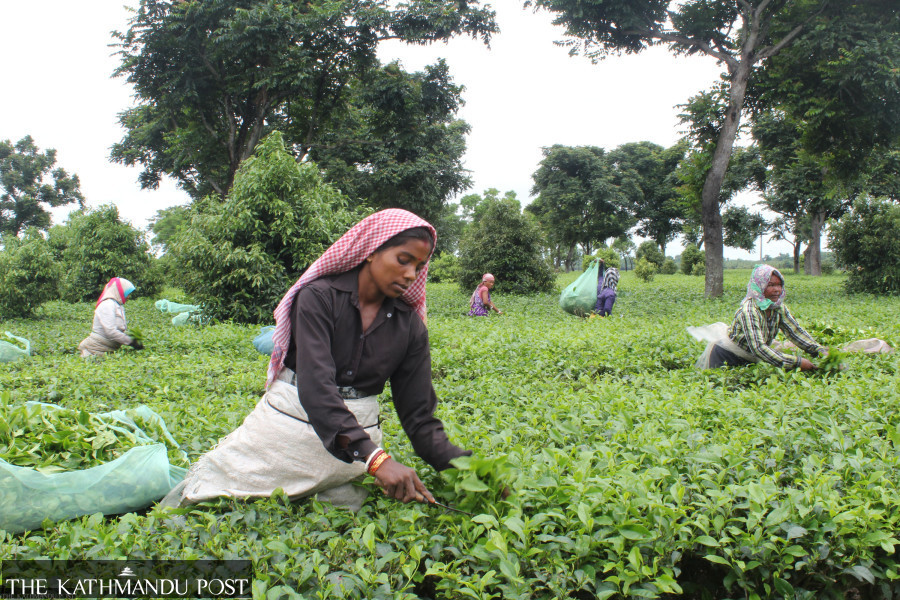
All tea factories in Ilam and Jhapa suspend production as exporters warn of mounting losses, stranded consignments and a deepening crisis in Nepal’s key export industry. Garden owners say frequent trade barriers placed by India have hampered Nepali tea exports. Post file photo
Nepal’s tea industry, one of the country’s most important export sectors, has once again become entangled in trade tensions with India after the southern neighbour imposed what Nepali producers describe as restrictive new requirements on tea imports.
In a dramatic show of protest, all 83 tea factories in the eastern districts of Ilam and Jhapa shut down operations on Thursday, while representatives of the Nepal Tea Producers Association travelled to Kathmandu to press the government for urgent diplomatic intervention.
Tea producers say recurring trade barriers imposed by India have long hampered Nepal’s tea exports, often following pressure from tea growers in West Bengal, India’s second-largest tea-producing state and home to the globally renowned Darjeeling tea industry.
“We have come to Kathmandu after shutting down all tea factories,” said Aditya Parajuli, president of the Nepal Tea Producers Association. “We are scheduled to meet officials from the ministries concerned. In the past too, we submitted memorandums explaining our problems, but the issues remained unaddressed.”
According to producers, exports were first disrupted for 21 days after the Tea Board of India introduced a raft of measures in mid-April, including compulsory laboratory testing of all consignments beginning May 1.
The restrictions halted exports until May 20, when India relaxed the requirement and allowed random sampling instead of testing every truckload following criticism from Nepal.
However, exporters say the relief proved short-lived.
Soon after, the Tea Board of India introduced another layer of inspection under which samples are collected from every bag of Nepali tea at importers’ warehouses in Kolkata for laboratory testing.
According to complaints from Indian buyers, weeks have passed since the sampling process began, but laboratory reports have not been issued, preventing tea from being sold or distributed in the Indian market.
Nepal produces more than 27,000 tonnes of tea annually, including around 8,000 tonnes of orthodox tea and 19,000 tonnes of crush-tear-curl (CTC) tea.
The association estimates that around 1,000 tonnes of Nepali tea is currently stranded in warehouses inside Nepal, with another 300 tonnes stuck in India. Producers warn that prolonged storage could compromise quality and result in significant financial losses.
They say the non-tariff barriers threaten not only exporters but also thousands of farmers and workers who depend on the tea industry for their livelihoods.
An official at the Ministry of Industry, who spoke on condition of anonymity, said the government formed an inter-agency task force on Thursday to address the issue.
The task force includes representatives from the ministries of agriculture and industry, the Office of the Prime Minister and Council of Ministers, and the Department of Food Technology and Quality Control.
“The task force will meet on Friday,” the official said.
Given the long-standing nature of the dispute and its diplomatic implications, the issue is expected to be addressed through a high-level government-to-government mechanism, the official added.
Another Industry Ministry official said Nepal had received communication through the Ministry of Foreign Affairs, via the Consulate General of Nepal in Kolkata, indicating that the Tea Board of India was willing to resolve the issue through diplomatic channels.
On May 1, India made laboratory testing mandatory for all tea consignments entering the country, including imports from Nepal. Indian authorities said the move was intended to strengthen quality control and prevent adulteration.
Under the new system, Indian importers are required to submit detailed information on consignments through the Tea Council portal, including arrival dates, warehouse locations, container details and pro forma invoices. An application fee of INR11,120, excluding applicable taxes, is charged for each sample.
Tea Board officials are authorised to randomly select containers and collect two sets of 500-gram samples within 24 hours of arrival. Laboratories are then required to upload test results within 14 days and classify consignments as either “pass” or “fail”.
Nepali exporters say the procedures effectively halted tea exports.
Although exports resumed on May 20 after India relaxed the rules, testing obligations were shifted to Indian importers rather than Nepali exporters. Producers argue that the change has had little practical effect because Indian buyers remain responsible for undergoing the same testing procedures before tea can enter the market.
As a result, many Indian buyers have stopped purchasing tea from Nepal.
The Federation of Nepalese Chambers of Commerce and Industry (FNCCI), the country’s apex private-sector body, has urged the government to take immediate action to resolve the crisis and address broader challenges facing the tea industry.
“Nepal’s tea sector has become an important and strategic industry in terms of agriculture, manufacturing, exports and employment,” the FNCCI said in a statement.
“Taking into account the latest situation and concerns raised by the Tea Producers Association of Nepal, FNCCI strongly urges the government, particularly the Ministry of Industry, Commerce and Supplies, to take concrete diplomatic and policy measures to protect the sector.”
The federation noted that the tea industry generates annual turnover of approximately Rs12–14 billion and exports tea worth more than Rs5 billion to India each year, making a significant contribution to reducing Nepal’s trade deficit.
The sector directly employs more than 60,000 workers and contributes around Rs1 billion annually in government revenue.
“However, the sector is now on the verge of collapse due to impractical policy changes introduced by the neighbouring country,” the FNCCI said.
According to the federation, exporters are facing lengthy testing procedures, waiting periods of up to 20–25 days for laboratory reports, mandatory warehouse charges and the risk of consignments being destroyed if they fail quality tests.
These requirements have effectively brought exports to a standstill, it said.
With shipments blocked, tea factories are facing severe cash-flow problems. Industry leaders warn that many producers are struggling to pay farmers for green tea leaves, provide wages to workers and meet obligations such as taxes and electricity bills.
FNCCI has also renewed its call for the establishment of an internationally accredited laboratory in Nepal to address quality certification issues that frequently affect exports.
The federation said it has repeatedly urged the government to establish such a facility, arguing that it would provide a long-term solution to quality-related barriers and strengthen the competitiveness of Nepali products in international markets.
“We believe that an accredited laboratory would provide a long-term solution to quality certification challenges faced by Nepali exporters and strengthen the competitiveness of Nepal’s export sector,” the FNCCI said.
Krishana Prasain is a business reporter for The Kathmandu Post covering markets. Before joining The Kathmandu Post in 2018, she spent 3 years in New Business Age magazine covering business.




 24.28°C Kathmandu