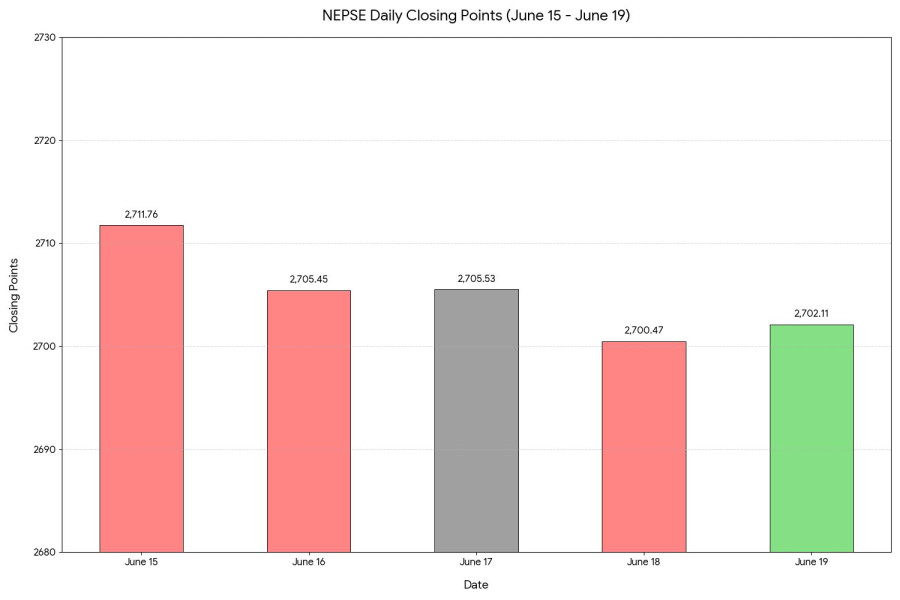
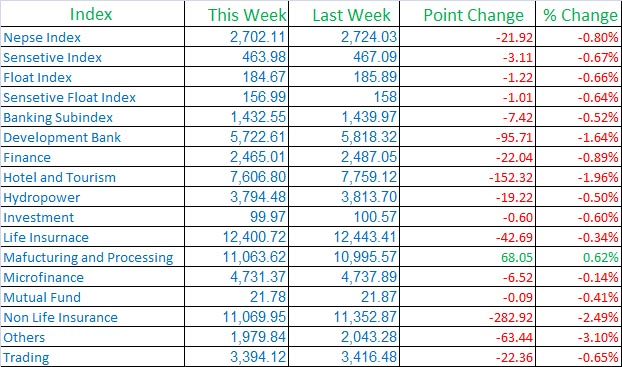
The Nepal Stock Exchange (Nepse) index extended its losses during the trading week of June 15 to 19, falling 21.92 points, or 0.80 percent, to close at 2,702.11, down from 2,724.03 a week earlier.
Broad-based profit booking and weaker trading activity dampened investor sentiment, wiping out around Rs40 billion in paper wealth over the five trading days. Total market capitalisation declined from Rs4.65 trillion at the end of the previous week to Rs4.61 trillion.
The Sensitive Index, which tracks the performance of class ‘A’ stocks, also fell 3.11 points, or 0.67 percent, to 463.98.
Trading activity slowed markedly during the week. Total turnover dropped 13.13 percent to Rs20.04 billion from Rs23.07 billion in the previous week. Average daily turnover stood at Rs4.008 billion, down from Rs4.614 billion.
Twelve of the 13 sectoral subindices ended the week in negative territory. The Others subindex posted the steepest decline, dropping 63.44 points, or 3.10 percent. The Non-Life Insurance subindex fell 282.92 points, or 2.49 percent, while the Hotel and Tourism subindex lost 1.96 percent.
The Manufacturing and Processing subindex was the only gainer, rising 68.05 points, or 0.62 percent, to close at 11,063.62.
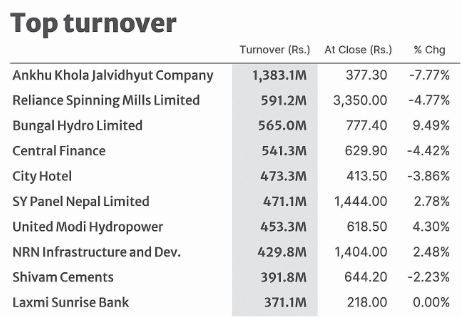
Ankhu Khola Jalvidhyut Company was the most actively traded stock by volume, with 3.525 million shares changing hands. It also led weekly turnover, recording Rs1.383 billion worth of transactions, despite its share price falling 7.77 percent to Rs377.30. Reliance Spinning Mills followed with a turnover of Rs591.2 million.
Among the week's top gainers, Appolo Hydropower surged 101.05 percent to Rs916, while Sopan Pharmaceuticals climbed 99.36 percent to Rs1,060. Green Development Bank was the biggest loser, shedding 11.51 percent to Rs1,069.90, followed by Rawa Energy Development, which declined 10.04 percent.
Market analyst Ramhari Nepal said he does not expect the market to rebound in the short term despite policy measures remaining favourable.
“The overall market is fundamentally weak,” he said. “Most listed companies have weak balance sheets and have not distributed dividends for years. How can investors be attracted to buy such companies?”
He argued that the market remains overvalued relative to the performance of listed companies, particularly when compared with foreign markets.
Nepal also said ongoing investigations into high-profile figures linked to the stock market have undermined confidence among market operators.
“Investors are not ready to enter the market as they fear they may be the next target for investigation,” he said.
He added that an imbalance between supply and demand is also holding back the market.
“New companies continue to be listed, increasing supply, while demand remains weak. As a result, the market is oversupplied,” he said.
Market analyst Jagannath Dhungel, however, said the market could see a short-term rebound in the coming weeks as the dividend season begins in mid-July.
He said the index holding above the psychological level of 2,700 points could indicate that the market may have found short-term support.
For sustained long-term growth, however, he agreed that stronger corporate performance is essential.
“For long-term growth, the performance of listed companies should be strong,” he said.
The stock market also came under discussion in the House of Representatives on Friday.
Responding to lawmakers, Finance Minister Swarnim Wagle acknowledged that ongoing legal action and investigations into major financial irregularities may have triggered psychological panic among investors.
He said investigations involving financial irregularities worth more than Rs100 billion were underway, with the capital market and insurance sector at the centre of the probes.
“As this process of investigation and action progresses, some investors may have experienced confusion or fear of being caught up in it. We believe that once the budget's objectives and roadmap begin to deliver results, it will encourage the private sector,” Wagle said.
He said the country is currently passing through “a phase of trust deficit and crisis of confidence” as the investigations continue, adding that the government is working on long-term policies to support sustainable growth in the stock market.




 25.12°C Kathmandu