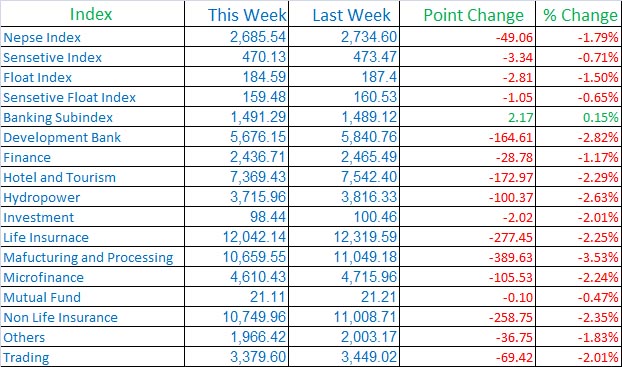
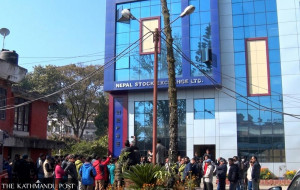
The Nepal Stock Exchange (Nepse) index snapped its recent rally this week, falling 49.06 points, or 1.79 percent, to close at 2,685.54 points during the trading week from July 27 to July 31.
Market activity also weakened as investors turned cautious, with weekly turnover dropping to Rs21.67 billion, down 23.51 percent from Rs28.33 billion in the previous week. Average daily turnover fell to Rs4.33 billion from Rs5.66 billion.
The decline wiped out Rs80 billion in market value, with overall market capitalisation shrinking to Rs4.62 trillion from Rs4.70 trillion.
Other major indices also ended lower. The Sensitive Index declined 3.34 points, or 0.71 percent, to 470.13 points, while the Float Index dropped 2.81 points, or 1.50 percent, to 184.59 points. The Sensitive Float Index fell 1.05 points, or 0.65 percent, to close at 159.48 points.
The downturn was broad-based, with 12 of Nepse’s 13 sub-indices ending the week in negative territory. The Commercial Banking sub-index was the only sector to post gains, rising 2.17 points, or 0.15 percent, to 1,491.29 points.
The Manufacturing and Processing sub-index recorded the steepest fall, declining 389.63 points, or 3.53 percent, to 10,659.55 points. Development Banks and Hydropower also saw sharp losses, dropping 2.82 percent and 2.63 percent respectively.
Newly listed Everest Colour Limited led the gainers, surging 101.09 percent to close at Rs1,309.30. Saptakoshi Development Bank gained 6.56 percent to Rs858.90, while Global IME Bank rose 5.01 percent to Rs262.
Corporate Development Bank was the biggest loser, falling 27.70 percent to Rs1,120. Aatmanirbhar Laghubitta and Reliance Spinning Mills declined 15.17 percent and 14.17 percent respectively.
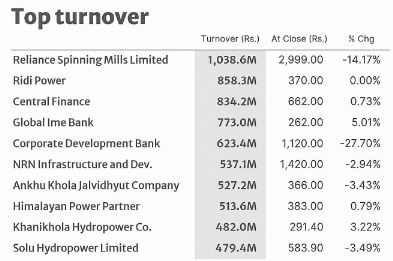
Reliance Spinning Mills recorded the highest turnover during the week at Rs1.038 billion, followed by Ridi Power with Rs858.3 million and Central Finance with Rs834.2 million. Global IME Bank had the highest trading volume, with 2.988 million shares changing hands.
Market analyst Jagannath Dhungel said profit booking contributed to the decline, as some traders opted to exit after the recent rise. However, he said institutional investors had started entering the market gradually.
“Companies’ financial performance is expected to improve. But investors are waiting for government policies and assurances to translate into results,” Dhungel said.
An experienced investor, who requested anonymity, said unrest in the Tarai may have affected market sentiment, but it was only one of several factors behind the decline. He said institutional investors, considered the backbone of the capital market, remained unconvinced about the government’s commitment to implementing policies supporting the market.
He also pointed to ongoing investigations into capital market-related incidents as a factor weighing on investor confidence.
“Investor confidence remains weak due to oversupply, uncertainty surrounding investigations, and poor financial health of many listed companies,” he said.
The investor said investigations into market-related issues should be carried out through established regulatory channels. The Securities Board of Nepal is the designated market regulator and should be allowed to perform its role, he said.
He cautioned that investigations launched in the name of good governance should also consider their wider impact on the economy.
Despite the short-term pressure, he said the recent movement in the banking sector, which is considered a fundamental driver of the market, suggests institutional investors may be gradually returning, which could support the market over the longer term.




 20.4°C Kathmandu