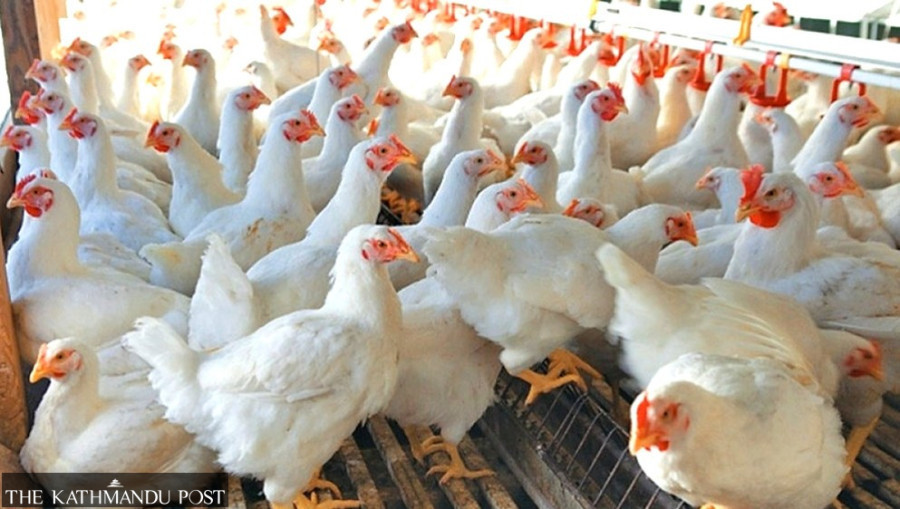
As many as three separate teams of veterinary technicians were deployed to Panauti Municipality of Kavrepalanchowk district on Tuesday to cull chickens at bird flu-hit poultry farms.
The deadly disease has been also confirmed at a poultry farm of Suryabinayak Municipality in Bhaktapur and in Tarakeshwar Municipality.
However, due to a shortage of manpower, authorities have been unable to promptly dispatch rapid response teams to cull infected chickens and disinfect affected farms.
“We have been facing acute shortage of manpower to cull the remaining chickens at bird flu-hit poultry farms,” said Dr Mukul Upadhyaya, a senior veterinary officer who is also a lead focal person for avian influenza control programmes and disease surveillance at the Department of Livestock Services. “Reports confirming bird flu outbreaks are coming from multiple places, but we are unable to dispatch rapid response teams immediately.”
Of late, districts of the Kathmandu Valley—Kathmandu, Lalitpur and Bhaktapur—and Kavrepalanchowk have been witnessing a massive outbreak of avian influenza. Outbreaks have been reported at 58 places across the Valley and Kavrepalanchowk district, according to officials at the department.
As avian influenza virus is highly contagious, rapid response teams must be deployed immediately to affected farms to prevent transmission of the virus to humans, cross-species transmission, and outbreaks at other poultry farms.
Officials say most labourers are unwilling to take part in poultry culling, and the government offers only Rs1,200 a day, another reason many reject the work.
“Labourers earn more from their regular work than what we offer,” said Upadhyaya. “Under government rules, we can pay only Rs1,200 a day. As a result, we have been facing an acute labour shortage.”
Experts warn that delays in containing the virus pose serious risks to humans and other species, as the H5N1 strain of avian influenza currently spreading in the Valley is highly pathogenic, spreads rapidly and can cause nearly 100 percent mortality in the infected birds. They say swift culling and disposal of infected birds, along with restrictions on the movement of poultry and poultry products to and from affected farms, are the only effective ways to contain the outbreak.
The risk of infected poultry and poultry products reaching markets also increases when authorities delay action at affected farms. Farmers may also sell their birds to minimise losses.
Officials say they have urged farmers to properly bury dead chickens, but many have instead discarded the carcasses in the open, where they are scavenged by stray dogs, crows, and eagles.
“We have not carried out testing on dogs and other animals,” said Upadhyaya. “Dogs could also get infected, but the greater risk is that they carry infected carcasses to other places, and this increases the risk of transmission."
The bird flu outbreak that started from Koshi Province in March is at its peak in Kathmandu Valley. The outbreaks in Koshi province were largely responsible for the spread of A(H9N2), a subtype of the influenza virus. The virus caused heavy economic losses in the poultry industry and wiped out a large number of chickens. Outbreaks in the Kathmandu Valley involve A(H5N1), according to officials.
The government usually culls all birds, poultry products, and feeds from outbreak-hit firms, seals the sites and restricts movement for 42 days. However, ongoing outbreaks in the Valley have occurred among local poultry kept in small numbers in households. It is not possible to restrict public movement in such areas, which makes containment more challenging.
Nepal first recorded a bird flu outbreak in January 2009. Since then, the country has experienced disease outbreaks almost every year, in which hundreds of thousands of fowls and huge quantities of poultry products were destroyed. Many farmers abandoned poultry farming due to a lack of compensation and continue to struggle to obtain reimbursement.
Officials say that despite the outbreak and the loss of farmers, the government has not yet provided compensation to any poultry farmers affected by the bird flu outbreak.
Nepal previously reported a human death from the virus in 2019. A 21-year-old man from Kavrepalanchok district, who worked as a truck driver transporting poultry, died of a respiratory infection while undergoing treatment. The WHO Collaborating Centre for Influenza in Japan confirmed A(H5N1) infection after his death.
Arjun Poudel is a health reporter for The Kathmandu Post. Before joining the Post, he worked for Sagarmatha Television, Naya Patrika, Republica and The Himalayan Times.




 17.95°C Kathmandu