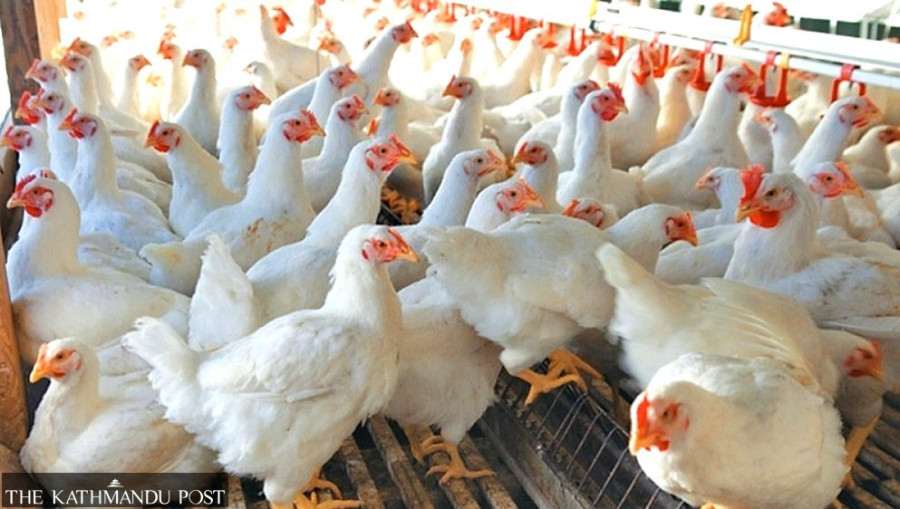
The Department of Livestock Services on Monday deployed four separate rapid response teams of veterinary technicians to cull chickens and ducks, in firms hit by avian influenza virus A (H5N1). As all three districts of the Valley—Kathmandu, Bhaktapur and Lalitpur—are currently witnessing a major bird flu spread, and outbreaks have been reported from multiple places at once, officials say they are racing to contain the spread.
“Over 50 bird flu outbreaks have been reported so far in the Valley,” said Dr Mukul Upadhyaya, a senior veterinary officer, who is also a lead focal person for avian influenza control programmes and disease surveillance at the department. “The spread is currently at its peak in the Valley, we are busy with control measures.”
Avian Influenza viruses also called bird flu viruses A (H5N1), A(H9N2), and A(H5Nx), among others, are highly pathogenic viruses that primarily affect fowls, including domestic chickens and ducks. The outbreak, which started from eastern Nepal in March, has now spread to the Valley, affecting a lot of people who keep small numbers of chickens for income.
What concerns experts is that the virus has reached the Central Zoo, where it has already killed scores of birds, including vultures, owls, swans, and cranes. Zoo officials said the virus has also been detected in some animals, including civets.
Following confirmation of the outbreak, officials shut the zoo from Friday. They say this is the first time A(H5N1) has spread among birds and animals at the Central Zoo.
“We cannot say how long it will take for the zoo to reopen,” said Ganesh Koirala, spokesperson of the Central Zoo. “We are closely monitoring the situation and taking measures to contain further spread of the infection.”
Officials suspect crows and other wild birds may have transmitted the virus inside the zoo.
Officials at the Department of Livestock Services under the Ministry of Agriculture, Forest, and Environment blamed negligence in maintaining bio-safety measures at the zoo, which housed rare and endangered wild animals and birds, for the outbreak.
They also accused zoo officials of trying to conceal the incident even after the deaths of scores of wild birds kept on display.
“Zoo officials make the incident public only after a large number of birds start dying at once,” an official at the department said, asking not to be named, as he is not authorised to speak to the media. “Lab tests confirmed the outbreak. Details will be known only after the probe team formed by the government submits its report.”
The government usually culls all birds, poultry products, and feeds from outbreak-hit firms, seals the sites and restricts movement for 42 days.
Asked about the fate of the remaining birds and infected animals at the zoo, officials said wild birds and animals would not be culled. They say it may take several weeks to decide whether reopening the zoo would be safe.
So far, over 600,000 chickens have been culled since the outbreaks began. Hundreds of thousands of eggs and large quantities of poultry feed stored at affected farms have been destroyed.
Outbreaks have been reported from at least 10 districts.
Officials say bird flu outbreaks in Koshi province were largely responsible for the spread of A(H9N2), a subtype of the influenza virus. The virus caused heavy economic losses in the poultry industry and wiped out a large number of chickens. Outbreaks in the Kathmandu Valley involve A(H5N1), according to officials.
“We used to destroy poultry, poultry products, feeds, manure, disinfect the disease-hit firms and restrict movements at least for 42 days,” said Upadhyay. “But ongoing outbreaks have occurred among local poultry kept in small numbers in households. It is not possible to restrict public movement in such areas, which makes containment more challenging.”
Officials say they will decide whether to allow households in densely populated areas to keep small numbers of poultry once the ongoing outbreaks are contained.
Nepal first recorded a bird flu outbreak in January 2009. Since then, the country has experienced disease outbreaks almost every year, in which hundreds of thousands of fowls and huge quantities of poultry products were destroyed. Many farmers abandoned poultry farming due to a lack of compensation and continue to struggle to obtain reimbursement.
Officials say that despite the outbreak and the loss of farmers, the government has not yet provided compensation to any poultry farmers affected by the bird flu outbreak.
Experts warn that there is also a risk of the infected poultry reaching the market, as farmers may sell their fowls to minimise losses.
Nepal previously reported a human death from the virus in 2019. A 21-year-old man from Kavrepalanchok district, who worked as a truck driver transporting poultry, died of a respiratory infection while undergoing treatment. The WHO Collaborating Centre for Influenza in Japan confirmed A(H5N1) infection after his death.
Arjun Poudel is a health reporter for The Kathmandu Post. Before joining the Post, he worked for Sagarmatha Television, Naya Patrika, Republica and The Himalayan Times.




 12.62°C Kathmandu