The 48-year-old from Chandragiri could not get anti-rabies vaccine on time due to shortages in his locality and reached Sukraraj Hospital only after symptoms appeared. Rabies is preventable if the anti-rabies vaccine is administered on time, but once clinical symptoms appear, the disease is almost always fatal, doctors say. Reuters
A 48-year-old man from Chandragiri Municipality who was admitted to Sukraraj Tropical and Infectious Disease Hospital on Friday, succumbed to rabies infection on Saturday.
Doctors treating the patient said that he had been bitten by a puppy a few weeks ago and had not been administered the rabies vaccine.
Family members told doctors that they could not find the vaccine at nearby health facilities and that they also did not pursue vaccination because they thought a bite from a puppy would not be serious.
“We all thought that it was not necessary to administer a vaccine since it was just a puppy,” a health worker quoted a member of the victim’s family as saying. “If the vaccine had been available at the nearby health facilities, we might not have lost him.”
The health worker requested anonymity, saying officials quoted by the Post a few days ago were later interrogated by the Ministry of Health and Food Safety and warned against speaking to the media about the ongoing vaccine shortage.
The official said that vaccine supplies have not resumed despite the acute shortage and that dog bite victims must buy the vaccine from private pharmacies when they cannot get them at government facilities.
“The reality is that we don’t have doses to administer to dog bite victims, and we are strictly restricted from speaking about the vaccine shortage,” another health worker serving in a hospital’s emergency department told the Post, asking not to be named for fear of government action.
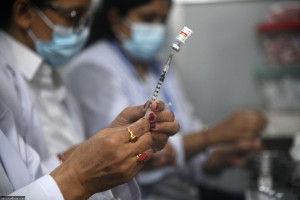
Rabies is preventable if the anti-rabies vaccine is administered on time, but once clinical symptoms appear, the disease is almost always fatal, doctors say. Like the Sukraraj Hospital, state-run health facilities across the country have been experiencing an acute shortage of rabies vaccines for months, and this has put the lives of dog bite victims at risk.
Sukraraj Hospital officials said that more than 500 dog bite victims visit the hospital every day for anti-rabies vaccination. Due to shortages at health facilities in the districts, dog bite victims have been left with no choice but to travel to Kathmandu for vaccination or pay out of pocket at private pharmacies.
Earlier, the Sukraraj Hospital had requested the Gandaki provincial government and the Kathmandu Metropolitan City for vaccine doses. The hospital, which used to provide anti-rabies vaccines round-the-clock, has now stopped administering a second dose of the vaccine in its emergency department due to the shortage. It now asks patients to receive the second dose during OPD hours.
Doctors say delays in vaccination could lead to a rise in rabies deaths, especially among working-class people who are more exposed to stray dog bites and less able to afford treatment at private facilities. The anti-rabies vaccine normally requires a four-dose course.
Rabies is a deadly viral disease that spreads through the saliva of infected animals, especially dogs and jackals. Dog bites are responsible for almost all rabies deaths in Nepal.
Nepal aims to eliminate dog-transmitted rabies by 2030, a target set by the World Health Organisation. However, the Health Ministry’s data show that dogbite cases have been rising every year. Over 60,000 people receive rabies vaccinations at state-run health facilities every year, while thousands more seek treatment at private centres.
Officials estimate that over 100 people die of rabies every year throughout the country.
Rabies, according to the World Health Organisation, kills 59,000 people globally every year—one person every nine minutes—mostly children and the poor.
Arjun Poudel is a health reporter for The Kathmandu Post. Before joining the Post, he worked for Sagarmatha Television, Naya Patrika, Republica and The Himalayan Times.




 23.14°C Kathmandu