Most mountain districts including Humla of Karnali province have reported infection of dengue virus this year.
Infection of dengue virus is not a new thing in Nepal; the disease has already become endemic in the country. But experts say infection before the start of monsoon and before the temperature reaches its peak is concerning.
“So far this year, dengue infections have been reported from 66 districts, including from Humla and some other districts of Karnali Province,” said Dr Gokarna Dahal, chief of Vector Control Section at the Epidemiology and Disease Control Division. “We have alerted concerned health agencies of respective districts about the risk of further spread of the viral disease.”
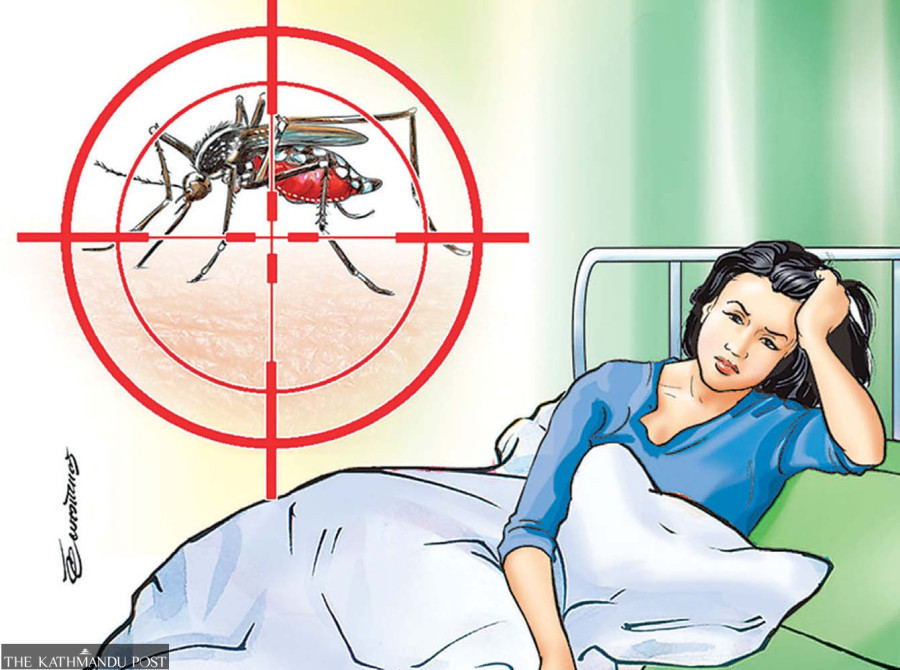
Dengue is a viral disease transmitted by female Aedes aegypti and Aedes albopictus mosquitoes. According to the World Health Organisation, the same vectors also transmit chikungunya, yellow fever, and the Zika virus.
Health officials say that the viral disease has already become endemic in the country, meaning that people get infected throughout the year. Data from the division shows that people from various districts got infected with dengue during winter months—149 in January and 155 in February.
Experts say that the reported cases of dengue is just a tip of the iceberg, as around 90 percent of the infected patients remain asymptomatic. Some people infected with the virus take medicine at home and do not seek treatment.
The division keeps records of only those who sought treatment at health facilities or of only those notified by hospitals. All hospitals, especially private ones, do not report to the agencies under the health Ministry.
Doctors say it is concerning that dengue virus has spread in almost all districts across the districts and even in most of the mountainous districts before the start of monsoon season.
“This is a wake up call for concerned health agencies, health facilities and also to the general public,” said Dr Sher Bahadur Pun, chief of Clinical Research Unit of the Sukraraj Tropical and Infectious Disease Hospital.
Experts say dengue has become a neglected tropical disease in Nepal, as neither the general public nor authorities concerned take the problems seriously. Even infected people take the problem lightly and stay at home without seeking medication and reach hospitals only after the problems become severe.
Pun said that this is high time an awareness drive be launched against the dengue virus but none of the agencies are doing anything to lessen the infections. Past data shows the infection of the viral disease increased every alternative year or in two to three years. When new outbreaks are caused by new serotypes of the virus, more people get infected and with worse severity.
Nepal has recorded all four serotypes of dengue virus—DENV-1, DENV-2, DENV-3 and DENV-4. There are five serotypes of dengue, numbered 1 through 5.
“Infection of dengue virus in premonsoon season in the mountainous areas shows that there is presence of the vector transmitting the virus in those areas and are surviving in the cold temperatures,” said Pun. “People from mountainous districts are at risk of getting infected.”
It was previously believed that dengue-spreading mosquitoes could not survive in very cold climates, and there was no risk of dengue in mountain districts. What alarms experts is that the monsoon is approaching, during which vector borne disease will rise significantly.
In 2025, at least six people died, and around 9,000 were infected with the dengue virus, which has spread to 76 out of 77 districts of the country.
Several scientific reports, including the United Nations’ ‘Climate Change 2022: Impacts, Adaptation and Vulnerability’ report, state that at least six major vector-borne diseases influenced by the climate drivers have recently emerged in Nepal and are now considered endemic.
Global warming has extended the elevational distribution of Anopheles, Culex, and Aedes mosquito vectors above 2,000 metres in Nepal. Of about 460 species of Anopheles, over 100 transmit malaria. Over 950 species of Aedes spread dengue, chikungunya, Zika, yellow fever, and the West Nile virus.
Dengue spreading mosquitoes breed in clean water and bite during the daytime. Uncovered water tanks and discarded objects such as plastic cups and bottles can serve as breeding grounds.
Symptoms of the disease include mild to high fever, severe muscle pain, rashes, severe headache and pain in the eyes, among other things. Doctors advise those with these symptoms to seek immediate treatment. While there is no specific cure for the disease, early detection and access to proper medical care can lower fatalities.
Arjun Poudel is a health reporter for The Kathmandu Post. Before joining the Post, he worked for Sagarmatha Television, Naya Patrika, Republica and The Himalayan Times.




 17.29°C Kathmandu