Two-day weekend at government hospitals from next week sparks alarm for surgery patients
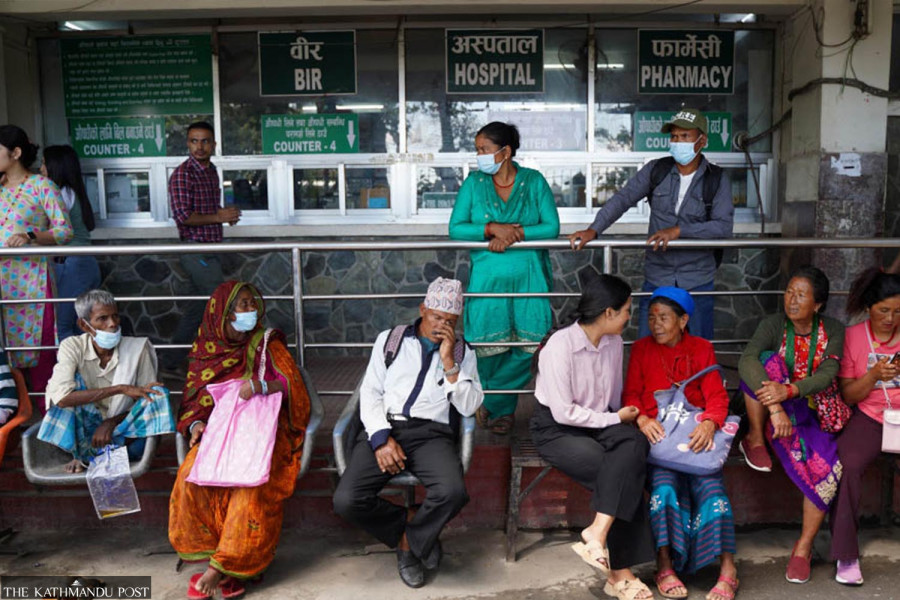
Patients and consumer rights activists say the move hits the poor hardest, urge the government to reconsider the decision. TU Teaching Hospital has already decided on the two-day weekend, and Bir is set to follow suit. Post file photo
Doctors at Bir Hospital placed a urinary catheter on Nura Prasad Neupane in January and told him that he needed to undergo prostate surgery to address urinary leakage. However, due to the long queue for surgeries, the 80-year-old resident from ward 2 of Belkotgadhi Municipality, Nuwakot, now has to wait until mid-May.
But it is unclear whether the surgery will take place as scheduled, because the government, citing the global fuel crisis, has introduced a two-day weekend—Saturday and Sunday—which could further delay scheduled surgeries at state-run hospitals.
“We were told that patients with urinary problems have to wait at least a year for surgery at Bir Hospital,” said Harisharan, Nura Prasad’s son. “We managed to prepone the date of surgery with the help of our neighbour, who works at the hospital. Now, as the government has given two-day public holidays, we fear more delays.”
In a bid to address the ongoing fuel crisis triggered by the West Asian conflict, the government has decided to close offices for two days a week instead of the usual one (Saturday), and keep them open from 9 am to 5 pm on the remaining days.The first Sunday under the new policy is still ahead, but most hospitals in the Kathmandu Valley are expected to follow the new schedule. Doctors warn that the change will hit mostly poor patients, many of whom have already been waiting months, or even a year, for surgery.
“We have been running our out-patient department from 8:30 am to 4:30 pm everyday,” said Dilip Sharma, director at the hospital. “We have not yet implemented the government’s two-day weekend, but the new provisions apply to us. We will decide soon about the government's decision on the two-day weekend.”
Dr Sharma concedes that some patients have to wait up to a year for surgeries in certain departments at the hospital.
“We perform emergency surgeries immediately, but general surgeries have long queues,” said Sharma. “Patients have to wait for their turn.”
Officials at the hospital said that patients generally wait at least three months for an MRI, three days for an ultrasound, and one week to 15 days for a CT scan. Waiting times for surgeries are longer—up to a year for urology surgeries, two months for neurosurgeries, six months for ENT surgeries, and two to six months for other general surgeries.
“The suffering of patients will worsen, if the two-day public holidays are implemented at big hospitals, including Bir Hospital,” said a doctor at Bir Hospital, who wished not to be quoted in the news, as he is not authorised to speak to the media. “We don’t have outpatient urology services today (Thursday). Visit the hospital on an outpatient day, and you will see how serious the problem is.”
The Tribhuvan University Teaching Hospital, which provides outpatient services to around 4,000 patients a day, has decided to implement the two-day weekend rule. Patients there also have to wait weeks for surgeries. The hospital administration said it will provide service for a full day on Friday and manage surgeries on other days.
Doctors say it is impossible to reduce the number of patients overnight at tertiary hospitals, like Bir and TU Teaching. To ease pressure on central hospitals, referral mechanisms must be improved, meaning minor surgeries must be carried out at local health facilities. However, many health facilities at the local levels lack trained staff and equipment and this forces patients to travel to the Capital for basic health services.
“Patients have to either pay huge amounts at private hospitals or endure pain and live with ailments for prolonged periods,” said Jyoti Baniya, chairman of the Forum for Protection of Consumer Rights-Nepal. “Even when doctors do not consider a condition an emergency, patients suffer.”
Baniya urged the government to rethink the two-day weekend decision, especially in public hospitals, as it will hit the majority of poor patients.
“Not all decisions work everywhere,” he said. “Patients from outside the Kathmandu Valley will now have to stay more days in hotels or with relatives just to see doctors. This decision will hit patients harder.”
The Ministry of Health and Population, meanwhile, said that the Cabinet decision on two-day weekend will stand for now, and no changes are under consideration.
“We will hold a meeting soon and take a decision regarding the two-day holiday policy,” said Dr Samir Kumar Adhikari, joint spokesperson at the health ministry. “Patients will not be deprived of care, as emergency services will remain available round-the-clock.”
However, emergency services are only for true emergencies, and doctors do not treat every case as urgent.
Arjun Poudel is a health reporter for The Kathmandu Post. Before joining the Post, he worked for Sagarmatha Television, Naya Patrika, Republica and The Himalayan Times.




 14.72°C Kathmandu