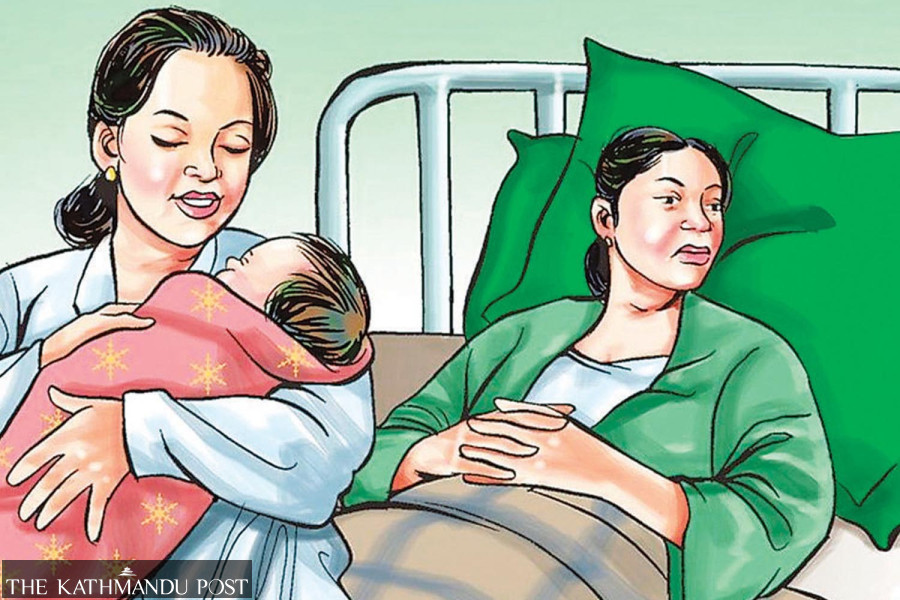
Gaps in Lumbini province’s referral system became clear last fiscal year when a woman in her early 30s from Kapilvastu district died on the way to the fourth hospital she was sent to.
She had been taken to a nearby birthing center after prolonged labour at home, and from there health workers referred her woman to the Butwal-based Siddhartha Children and Women Hospital. Doctors there sent her to Lumbini Provincial Hospital, whose doctors then referred her to the Bhairahawa-based Universal College of Medical Sciences.
“If we had developed a proper referral system, the woman would not have to die due to maternity-related complications,” said Kumar Thapa, maternal and child health focal person at the Health Directorate under the Ministry of Health and Population of Lumbini Province. “Due to delays in treatment, she died even after reaching multiple health facilities.”
Lumbini Province has the highest maternal death rate in the country, and referral delays and mismanagement are considered among the main culprits.
Data from the Family Welfare Division under the Department of Health Services show that 94 women died due to maternity related complications in the last fiscal year. Of them, 51 died in the health facilities and 43 died at home. The number of maternal deaths in both health facilities and at home is highest compared to other provinces across the country.
According to the division, there were 30 maternal deaths in hospitals in Bagmati province, followed by Koshi province with 26, Madhesh province 13, Sudurpaschim and Karnali 9 each, and Gandaki province 8. Likewise Sudurpaschim recorded 20 maternal deaths at home, followed by 18 each in Koshi and Madhesh provinces, Karnali 9, Gandaki 5 and Bagmati 3.
Health workers in Lumbini province said that along with referral delays and mismanagement, delays in reaching health facilities and delays in providing treatment are equally responsible for high maternal deaths.
The Ministry of Health and Population, however, does not consider the gap in the referral system responsible for high maternal deaths. According to the ministry, hypertensive disorders in pregnancy, childbirth, and puerperium (the period of about six weeks after childbirth during which the mother’s reproductive organs return to their original non-pregnant condition) are responsible for maternal deaths. Non-obstructive complications, obstructive complications, pregnancy-related infections, pregnancies with abortion, and unanticipated complications are among the other reasons.
Health officials in the districts say that poor health education, service-seeking behaviour, low priority for women’s health within families, and poor service quality in health facilities all contribute to high maternal deaths.
“Lumbini Province is far behind in overall health indicators, and the reasons vary,” said Roshan Lal Chaudhary, acting director of the Health Directorate of the province. “A floating population, scattered slums, high density of working-class people, lack of awareness and poor access to health services all contribute to poor health indicators.”
Nepal has reduced maternal deaths by over 70 percent since 2000, according to the World Health Organisation.
The UN health body, in its report released in April, stated that 142 Nepali women die from maternity-related complications per 100,000 live births.
A previous study carried out by the National Statistics Office in 2021 had shown 151 maternal deaths per 100,000 live births.
Earlier, in 2016, Nepal had reduced the maternal mortality rate from 539 per 100,000 births in 1996 to 239 per 100,000 births—for which the country even received the Millennium Development Goals award.
The health target under the UN’s Sustainable Development Goals is to reduce the maternal mortality rate to 75 per 100,000 births by 2030.
Maternal health experts say that it is impossible to meet the target without knowing the root cause of the problems and launching targeted interventions.
Experts said non-health interventions—awareness drives, improved financial conditions of people, their education levels, and sanitation conditions—can go a long way in improving health indicators.
To improve the indicators, they added, authorities must carry out micro-planning and ensure coordination among all stakeholders, including agencies of all three tiers of government as well as international aid agencies.
Arjun Poudel is a health reporter for The Kathmandu Post. Before joining the Post, he worked for Sagarmatha Television, Naya Patrika, Republica and The Himalayan Times.




 21.77°C Kathmandu