Durga Prasai’s repetitive arrests raise question over the state’s intention
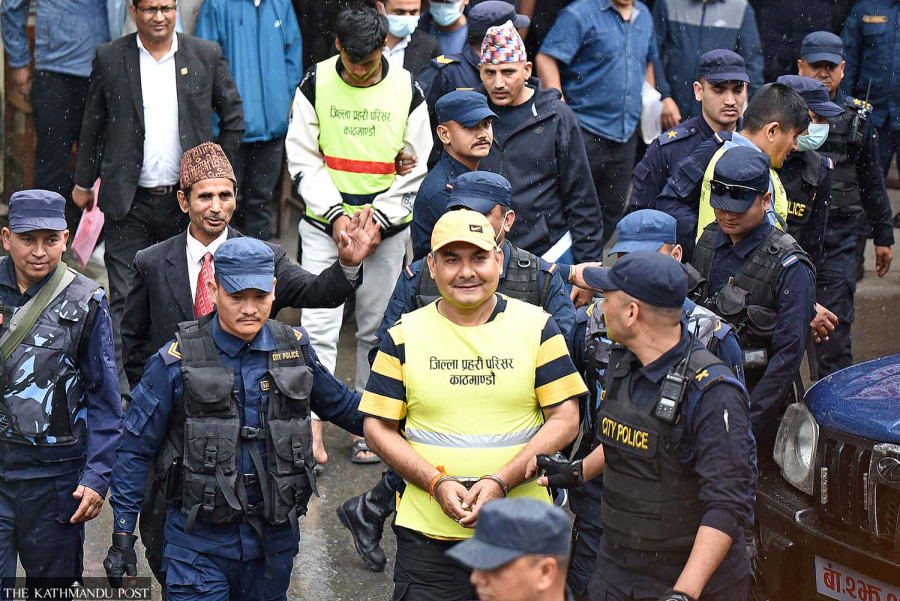
Police have detained him 14 times on various charges in two years, half of them under the current government. Prasai was arrested on the charge of inciting violence during the deadly pro-monarchy protests in April last year. Post file photo
Controversial medical college owner Durga Prasai was arrested on Sunday for the seventh time since the formation of the Sushila Karki government in September.
Most recently, he was detained on February 16 and released from custody on February 25. However, he was re-arrested on Sunday by the Bhaktapur district police.
Police have detained him 14 times on various charges over the years, half of them under the Karki-led interim government tasked with holding the elections on March 5.
“Including Sunday’s arrest, the government led by Sushila Karki has detained him seven times. Total arrests reach 14 if the previous ones too are taken into account,” said Madhav Kalpit, his close associate.
During this period, Prasai has been arrested on charges of attempting to incite revolt against the state and possessing illegal firearms.
Demonstrating an indecent and insulting manner towards women, and, more recently, attempting to disrupt the elections, are the other allegations that have sent him behind bars. On most occasions, he got released by the court.
Prasai is also the coordinator of the Nation, Nationalism, Religion, Culture, and Citizens’ Protection Campaign.
With March 5 vote days away and the entire state machinery mobilised to ensure its smooth conduct, any individual making statements that could undermine the electoral process must be taken into custody and investigated, according to Nepal Police officials. They say this is the reason Prasai was re-arrested on Sunday.
On Saturday, Prasai had posted a video on social media addressing the public in a manner that authorities claim could spoil the election environment.
Police officials said that on Sunday itself, they obtained a five-day remand from the Kathmandu District Court to keep Prasai in custody. As a result, they say there is little likelihood of his release before the elections.
The arrest warrant states that he is being investigated in connection with an alleged offence against public order, according to police officers.
Earlier, after his wife, Uma, filed a habeas corpus petition at the Supreme Court, claiming he had been unlawfully detained in February, a division bench of Justice Manoj Kumar Sharma and Meghraj Pokhrel ordered his release.
The repeated arrests and releases have fuelled allegations that authorities may be using detention as a tool of pressure rather than relying solely on long-term legal proceedings.
Legal analysts note that repeated short-term detentions can occur when multiple complaints are filed in different jurisdictions. However, they also caution that if arrests are not backed by strong prosecutable evidence, they risk being perceived as harassment.
The existing laws and the constitution clearly define what an individual is permitted to do and what is prohibited. If someone violates the law, each count is treated as a separate offence, and it is the state's responsibility to take the individual into custody and investigate in accordance with applicable legal provisions, says Nepal Police spokesperson Abhi Narayan Kafle.
Kafle adds that citizens also have responsibilities. In the name of freedom of expression, one cannot act in violation of prevailing laws or, in the current context, breach the election code of conduct. Therefore, when someone is arrested repeatedly for alleged violations, it may appear that the police administration is targeting a single individual. However, Kafle maintains that such arrests are made solely to enforce the law whenever it is breached.
“On previous occasions, Prasai was not released because he was found innocent. Rather, he was released on bail, which means he remains legally implicated in the alleged offences,” Kafle said. “He was granted bail because the law allows investigations to continue without keeping a suspect in custody, where detention is deemed unnecessary.”
However, Kafle adds that even after being released on bail, Prasai allegedly continued to engage in activities that violated the law, which led to his repeated arrests.
However, constitutional law expert Bipin Adhikari claims that the state appears to have used excessive force in Prasai’s case.
Adhikari argues that an arrest generally occurs either for an individual’s own protection or because of a crime they have committed. In Prasai’s case, however, Adhikari suggests that the arrests seem to stem largely from the harsh and provocative nature of his expressions.
Since our constitution guarantees freedom of speech and expression, an individual can only be arrested if their expression actually violates the law. Simply speaking in a harsh or provocative manner should not be grounds for detention, Adhikari said.
“In Prasai’s case, he has been repeatedly arrested, often released without being taken to court or released under court orders. For this reason, the repeated detentions appear to reflect the exercise of state power more than solid legal evidence,” Adhikari told the Post.




 15.26°C Kathmandu