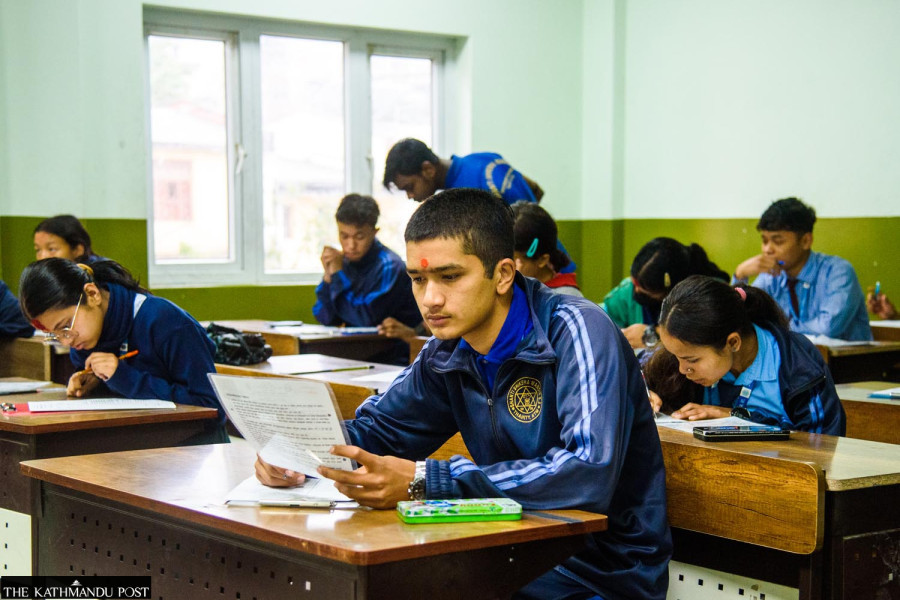
In 2016, school enrollment campaigns across Nepal celebrated a historic milestone when 1,053,824 children proudly registered for grade 1. Ten years later, during the Secondary Education Examination (SEE) administered in March-April 2026, that group had dwindled to just 430,667 students.
According to data from the Education Ministry, a staggering 623,157 children—amounting to 59.14 percent of the original group—disappeared from the formal school pipeline over the decade. This drastic dropout rate means fewer than 41 percent of primary school entrants managed to complete their secondary education on schedule, exposing critical cracks in the state's multi-billion-rupee educational infrastructure.
To compound the crisis, out of the small minority who reached the examination halls, 146,500 students failed the initial SEE grading, rendering them ineligible to enroll in grade 11. These students are now awaiting make-up examinations scheduled for June.
While successive governments have championed legislation ensuring free and compulsory basic education up to grade 8, statistical realities compiled by the Center for Education and Human Resource Development (CEHRD) paint a contradictory picture. Data reveal that by 2023, only 621,848 of the original million-plus students had reached grade 8.
Ananda Prasad Neupane, Director General of CEHRD, argues that the metrics reflect complex systemic trends rather than outright dropouts alone. "The phenomenon of students repeating grades due to academic failure outweighs the absolute dropout rate," said Neupane. "Furthermore, we track a massive subterranean cycle where children abandon their classrooms for a year or two, only to re-enroll later, which severely scrambles our long-term tracking of student groups."
The historical breakdown shows that the 2016 grade 1 cohort was nearly balanced by gender, comprising 530,176 girls and 523,648 boys. However, the education ministry’s reportfrom that exact academic cycle indicates that only 927,993 children actually completed the first year. This means 125,831 children walked away from their classrooms within months of their very first enrollment. While CEHRD insists many returned the following year, the structural bleed never truly stopped.
Educational expert Sambedan Koirala, who conducted an extensive field study tracking 27,000 out-of-school children across all 77 districts of Nepal, notes that the catalysts for abandonment shift dramatically depending on the age of the child. "The reasons for school dropouts are highly stratified by educational tiers, driven by distinct economic, individual, and social pressures," said Koirala.
According to his research, dropout rates in grades 1 to 5 are primarily dictated by acute financial distress. Impoverished families frequently pull young children out of classrooms, a problem intensified if the local school requires long, hazardous walks. In contrast, in grades 6 to 8, individual and institutional frustrations take over. "At this intermediate stage, we observe children quitting due to chronic academic failure, a profound lack of interest, unsupportive teacher behaviour, language barriers, and a fundamental breakdown in comprehension," said Koirala.
By the time students reach the high school tier grades 9 to 12, deep-seated social traditions dictate their exit. "In the secondary tier, structural dropouts skyrocket due to child marriages, domestic responsibilities, and the overwhelming allure of foreign labor markets among teenage boys," Koirala added.
The chronic depletion of classrooms persists despite decades of highly publicised student enrollment campaigns led by federal, provincial, and local authorities. Critics point out that while the state infuses billions of rupees into educational subsidies, questions and complaints persist over students’ learning outcomes and examination results.
The national educational crisis is also highly regional. During the last academic cycle, the national SEE pass rate hovered at a mediocre 66 percent. However, peripheral regions like Sudurpashchim, Karnali, and Madhesh provinces consistently fall far below the national average. In the most recent evaluation, Sudurpashchim registered a dismal 51 percent pass rate.
This data aligns with a comprehensive report published by the National Statistics Office under the Prime Minister's Secretariat. The audit revealed that an estimated 770,000 children across the country remain completely outside the formal school network. The report indicated that roughly 350,000 of these children have never stepped inside a classroom, while the remainder dropped out prematurely. In total, nearly 10 percent of all school-age children in Nepal are completely alienated from the country’s 7 million children in the public education framework.
The ministry’s Educational Indicators 2025-26 report states that the grade 8 completion rate stands at 82 percent, with a retention rate of 86.5 percent. These figures pose a direct challenge to the statutory mandate established under the landmark Act Relating to Compulsory and Free Education, 2018.
The law dictates that every Nepali citizen must complete basic education (up to grade 8) by May 2028. Under Section 19 of the act, any individual who fails to meet this minimum academic threshold will be legally barred from public, private, or non-governmental employment. Furthermore, non-compliant individuals will be disqualified from contesting elections, receiving political appointments, or holding organisational memberships. With the legal deadline less than two years away, hundreds of thousands of youth are on track to be functionally disenfranchised from the formal economy.
The situation becomes even more alarming beyond the basic tier. The enrollment rate for grades 9 to 12 plummets to 56 percent, while retention rates for grade 10 and grade 12 sit at a bleak 67 percent and 41 percent, respectively.
The National Statistics Office report shows that Madhesh Province suffers from the highest concentration of out-of-school children, with an illiteracy rate of 14 percent among minors. The document explicitly links school abandonment to marginalization. "In terms of demographics, children from Madhesi, Madhesi Dalit, and religious or linguistic minority communities exhibit the highest rates of zero-schooling. Conversely, hill-origin castes and hill indigenous groups show remarkably low dropout rates."
Economic disparity remains the ultimate divider. Statistics prove that only 11 percent of children from low-income families complete their secondary education, compared to 22 percent from affluent households. Domestic environments also dictate academic survival. Only 42 percent of children working as domestic laborers for external employers attend school, whereas enrollment rises to 89 percent for children living with both parents, and tops 92 percent for those raised by single mothers.
To counter these systemic leaks, the government offers incentives including free textbooks, midday meals up to grade 5, targeted scholarships, and free sanitary pads for female students.
However, the Nepal Living Standards Survey 2024, which evaluated approximately 10,000 households, determined that structural incentives fail when academic quality collapses. The national survey identified nine primary reasons for dropping out, with poor learning outcomes topping the list at 28.1 percent.
Education ministry officials admit that public school students routinely abandon their studies out of sheer frustration after failing examinations. The survey also revealed that 21.4 percent of dropouts left to support household survival through manual labour, while 19.2 percent abandoned their education due to early marriage. Other prominent factors included high hidden costs of ‘free’ schooling, the immediate necessity to seek low-wage employment, parental discouragement, and the complete absence of higher-secondary institutions in remote rural municipalities.




 25.15°C Kathmandu