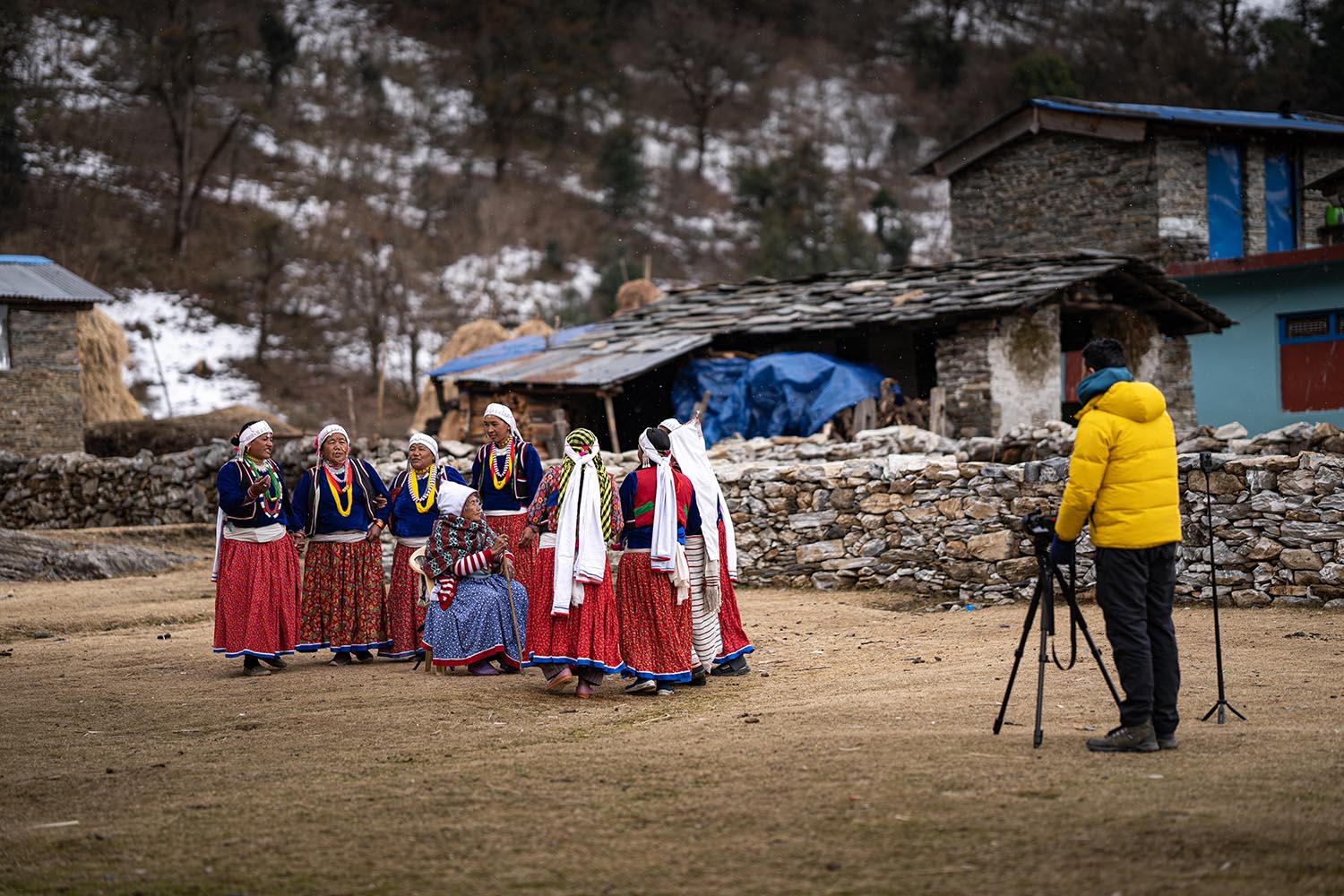
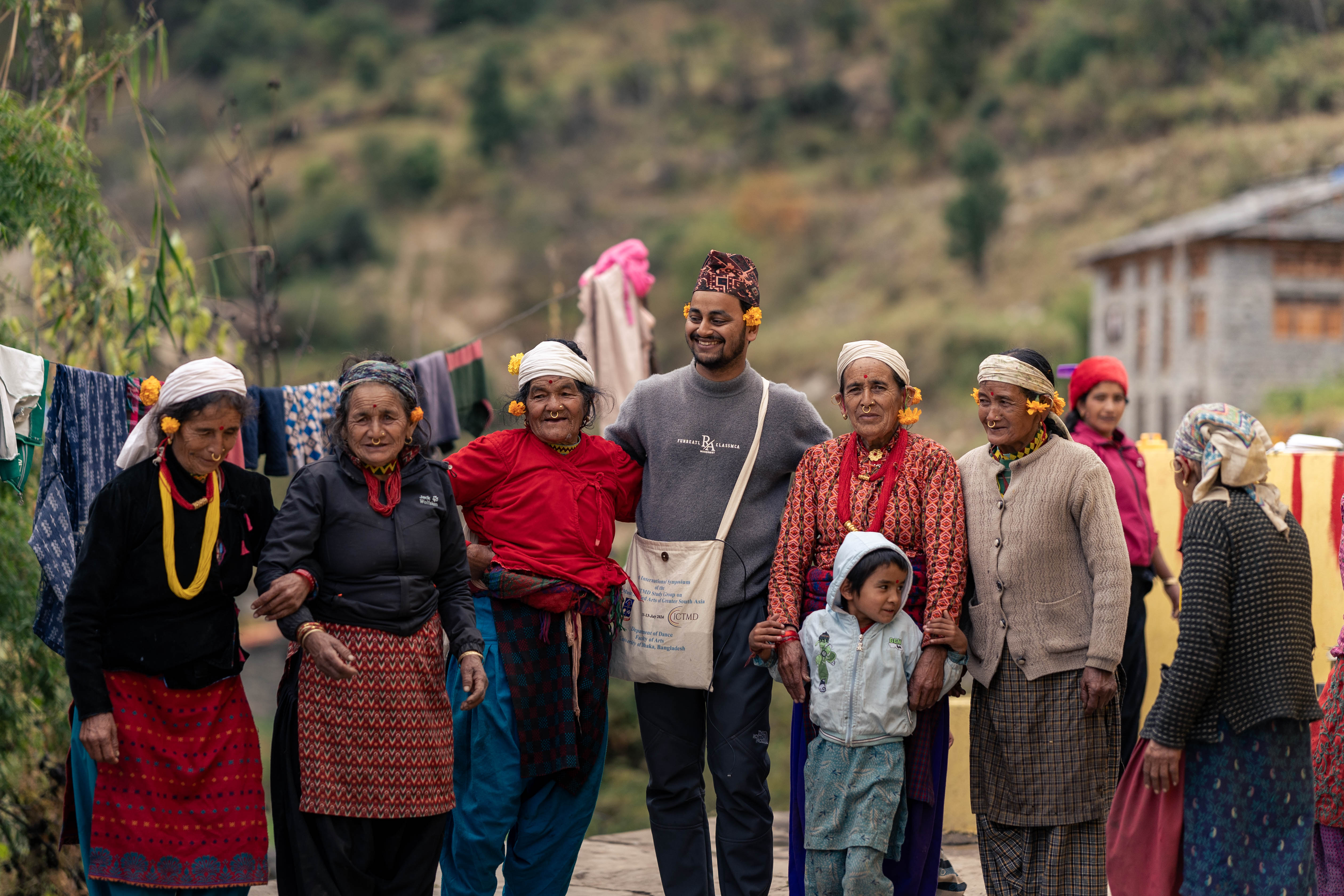
Through Bhalābhali, researcher Dinesh Raj Upadhyay travels across Far-West Nepal, archiving women’s voices, caste-shaped traditions and songs at risk of fading away. Bajhang-born Upadhyay grew up listening to traditional melodies sung by women. Photos: Courtesy of Dinesh Raj Upadhyay
Dinesh Raj Upadhyay, an Ethnomusicologist from Bajhang, is driven by the aim of documenting the melodies and rhythms of Far-West Nepal. Upadhyay, a ‘camera enthusiast’ as he calls himself, is a graduate of a Master’s degree in Ethnomusicology from Kathmandu University.
Gathering experiences through documentation, internships, and research projects, Upadhyay brought his knowledge back to his hometown, documenting women-led melodies of Far-West Nepal—Darchula, Baitadi, Doti, Dadeldhura, Bajhang, Bajhura, and Aacham—through Bhalābhali. He draws his inspiration from Anna Stirr, whose PhD research on Nepal’s Lok Dohori is widely regarded for its cultural depth, as well as from Lochan Rijal, professor and the department head of Music at Kathmandu University.
As a pilot research project funded by the British Council of Nepal, Bhalābhali stands as a prominent example of how youth can revive the ethnic and cultural roots that are gradually disappearing amidst the modernist adaptations.
In this conversation with the Post’s Jony Nepal, Upadhyay discusses his project, the challenges, and how traditional instruments and melodies are shaped by caste and gender in Far-West Nepal.
What drives this project? Why do you believe it is important to explore, document and present the ethnomusic of Far-west Nepal?
The main force that drives this project is to preserve and revive the traditions of Far-West Nepal. ‘Bhalābhali’—meaning ‘warm wishes’ in Bajangi—is a term that is, in itself, disappearing from the vernacular language of the area.
While studying Ethnomusicology at Kathmandu University, I began to reminisce about the childhood memories that I had shared with Bajhang. The music and melodies, particularly Mangal—sung by women at weddings and bratabandha—began to resurface in my consciousness with pride. At present, barely one or two women sing Mangalin the village. Seeing the new generation being oblivious to the local melodies made me realise that traditions are on the verge of extinction.
Initially, I started documenting the melodies found in the corners of my own village. Over time, I realised that these documents would only be limited to my ownership. Hence, Bhalābhali was started to introduce this to a broader audience.
Youth are rarely found in the Far-West, increasing the risk that these cultural traditions may disappear.
With a significant number of traditions disappearing into the silence of Far-West Nepal, I was driven to explore beyond my village.
Information and archives on this local music are scarce in academia. Therefore, to break this gap, I find it important to document, archive and publish the ethnomusic of Nepal.
From your experience, how have you seen locals construct a collective identity through rhythms and melodies?
Only a few songs from Far-West Nepal are sung individually (mostly without instruments). Thadi Bhaka, Deuda Khel, Ratyaulican be found echoing in different festivals and events, with at least 2 to 3 singers. Even when I try to document an individual singing songs, people inevitably join in.
Music has been a medium for conversation. Mostly, they articulate melancholy in the lyrics. During bidai, sending daughters to their in-laws, or reminiscing about their partners who are abroad for work, music has helped them collectively express and navigate their emotions. Rhythms create a space where everyone belongs. People even take leave from work to be a part of this cultural occurrence. This has helped people understand each other and given them reasons to spend time together, building a collective identity.
In the present context, have you seen traditional and folk instruments and melodies shaped by caste and gender in Far-West Nepal?
While caste division was glaringly prominent in past years, it has, however, evolved constructively to some extent in the present. In contrast, restrictive gender roles still surface in the area. Singing is often discarded in society, making women reluctant to sing in front of their in-laws, and instruments are only confined to the hands of men. In Far-West Nepal, the idea that music and instruments are universal and accessible to all has yet to be widely embraced.
To what extent did you find the youths participating in these cultural practices? What future do these melodies hold?
Rangalal Badi was the only sarangi player in Bajhang. I had documented his melodies while I was travelling for my research. When I revisited the area after a few months, he had passed away at the age of 64. My documentary was the only proper memory of him, even for his family.
As I mostly travel with my camera, locals often assume it is a money-making strategy for YouTube. This makes it difficult for me to obtain their consent to document their lifestyle.
While navigating the overwhelming emotions, it also occurred to me that he was the last sarangi player in the community.
Youths are barely found in the Far-Western localities. There is a high risk that these melodies and cultures will vanish amid the evolving lifestyles of the locals.
What was the most challenging part of your research?
The locals’ perception is one of the main challenges in the documentation process. As I mostly travel with my camera, locals often assume it is a money-making strategy for YouTube. This makes it difficult for me to obtain their consent to document their lifestyle.
While the project is currently funded by the British Council, the monetary aspect was also a prominent challenge for the research process. Travel is also a concern. Unmanaged road facilities make it difficult to travel for the research.
What role can the Government of Nepal play in promoting and preserving these melodies of Far-West Nepal?
Musical tradition can be found all over Nepal, not merely as entertainment, but as a part of everyday life and identity. While travelling, I witnessed very few women singing traditional melodies in the villages, and the local government does not consider, or even realise, this gradual disappearance.
Through this pilot research, I aim to incorporate my findings into academic practices. I believe that introducing the local music of different communities in schools will make children and youth aware of their culture and perhaps help them gather interest in exploring more. This is only possible with the government’s help.
There is no government support for research projects. The concept of development is only infrastructural. Academic teaching of ethnomusic should be motivated by a desire to convey this culture to future generations.




 23.02°C Kathmandu

.jpg&w=900&height=601)
.jpg)